Proteolytic degradation of Beta-Ig H3 (βigH3/TGFBI) can be quantified non-invasively in serum and predicts prognosis in patients with advanced pancreatic ductal adenocarcinoma
Rasmus S. Pedersen, Annika Hettich, Jeppe Thorlacius-Ussing, Lasse L. Langholm, Marina Crespo-Bravo, Inna M. Chen, Carsten P. Hansen, Julia S. Johansen, Hadi M. H. Diab, Lars N. Jorgensen, Morten Karsdal, Nicholas Willumsen

TL;DR
This study shows that a specific fragment of the Beta-Ig H3 protein in blood can predict survival in advanced pancreatic cancer patients.
Contribution
A non-invasive ELISA was developed to measure a cleaved fragment of Beta-Ig H3 as a prognostic biomarker in pancreatic cancer.
Findings
Higher levels of cβigH3 were linked to longer survival in advanced pancreatic cancer patients.
The cβigH3 biomarker was specifically generated from proteolytic degradation of fibroblast matrices.
The biomarker was detectable across 11 cancer types and independent of other known prognostic factors.
Abstract
The extracellular matrix (ECM) protein Beta-Ig H3 (βigH3, also known as transforming growth factor β induced protein (TGFBI)) is related to poor prognosis in patients with pancreatic ductal adenocarcinoma (PDAC). Proteolytic cleavage of βigH3 has been shown to result in release of the N-terminal fragment covering amino acid 1 to 137, but whether the degradation of βigH3 is associated to prognosis has yet to be determined. In this study we developed an ELISA targeting a collagenase generated fragment of βigH3 (cβigH3) in human serum to use the fragment as a biomarker reflecting degradation of βigH3. We demonstrated that the assay was specific to the cleaved fragment (cβigH3) and confirmed the generation of cβigH3 from degradation of fibroblast generated matrices. Moreover, higher levels of cβigH3 were released upon degradation of matrices produced by TGF-β stimulated pancreatic…
Genes, proteins, chemicals, diseases, species, mutations and cell lines named across the full text — each resolved to its canonical identifier and authoritative record.
Click any figure to enlarge with its caption.
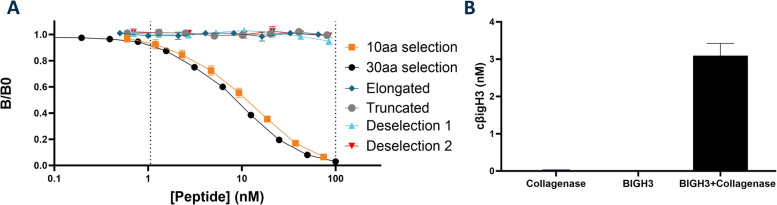 Figure 1
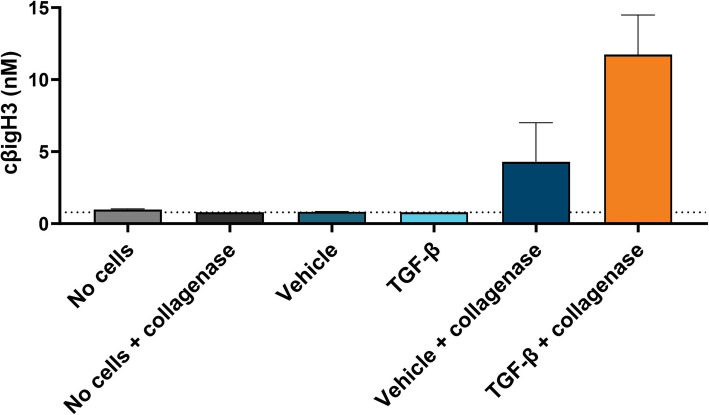 Figure 2
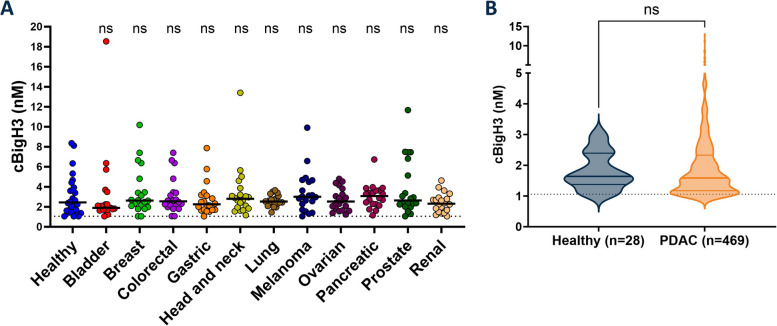 Figure 3
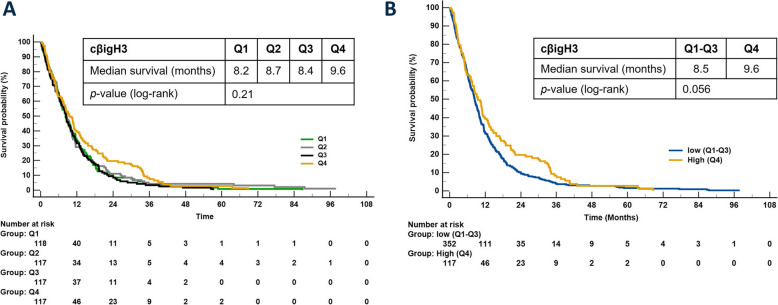 Figure 4
Peer Reviews
No public reviews on file for this paper yet. If you reviewed it on a platform where reviews are public (OpenReview, ICLR, NeurIPS, ICML), you can paste yours below so the community can read it here.
Videos
No videos yet. Explain this paper in a talk, walkthrough, or lecture? Add one.
Taxonomy
TopicsPancreatic and Hepatic Oncology Research · Pancreatitis Pathology and Treatment · Neuroendocrine Tumor Research Advances