Long-term outcomes of community-based intensive care treatment following neurological early rehabilitation– results of a multicentric German study
Bernadette Einhäupl, Danae Götze, Stephanie Reichl, Lina Willacker, Romy Pletz, Thomas Kohlmann, Esther Henning, Lena Schmeyers, Andreas Straube, Rebekka Süss, Steffen Fleßa, Simone Schmidt, Jens D. Rollnik, Friedemann Müller, Aukje Bartsch-de Jong, Svenja Blömeke

TL;DR
A German study found that patients needing home-based intensive care after neurological rehabilitation have high mortality, with older age and longer ventilation use linked to worse outcomes.
Contribution
This study provides new insights into long-term survival rates and predictors of mortality in patients requiring home-based intensive care after neurological rehabilitation.
Findings
One-year survival rate was 61.9%, dropping to 38.1% after four years.
Older age, higher morbidity, and discharge with mechanical ventilation were linked to higher mortality.
Longer stays in neurological rehabilitation correlated with better survival.
Abstract
Weaning from mechanical ventilation (MV) and tracheal cannula (TC) during neurological early rehabilitation (NER) is mostly successful. However, some patients leave NER with TC/MV, requiring home-based specialized intensive care nursing (HSICN). Data on medical and demographic characteristics and long-term outcomes of these patients are limited. A multicentric retrospective observational study across five German NER hospitals collected data from neurological patients with TC/MV at discharge. The study aimed to assess patients’ health status at NER discharge, and to identify predictors of post-discharge survival. Survival rates were analyzed using Kaplan-Meier estimates; further predictors of survival post-discharge were analyzed using Cox regression. Among 312 patients, the one-year survival rate was 61.9%, decreasing to 38.1% after approximately 4 years. Older age, higher overall…
Genes, proteins, chemicals, diseases, species, mutations and cell lines named across the full text — each resolved to its canonical identifier and authoritative record.
Click any figure to enlarge with its caption.
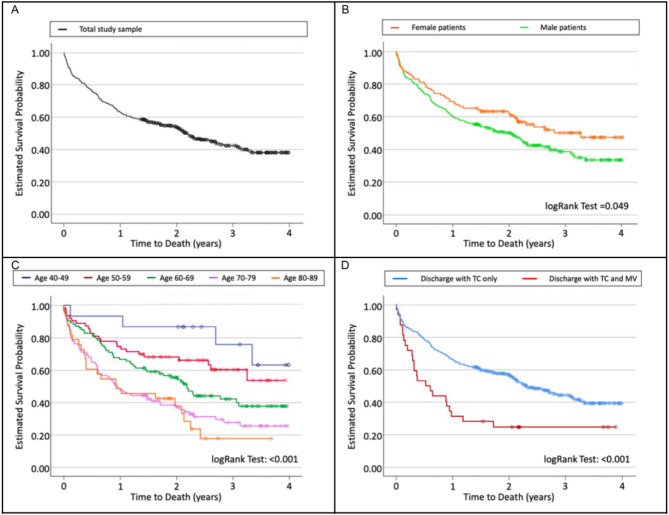 Figure 1
Peer Reviews
No public reviews on file for this paper yet. If you reviewed it on a platform where reviews are public (OpenReview, ICLR, NeurIPS, ICML), you can paste yours below so the community can read it here.
Videos
No videos yet. Explain this paper in a talk, walkthrough, or lecture? Add one.
Taxonomy
TopicsTraumatic Brain Injury Research · Intensive Care Unit Cognitive Disorders · Traumatic Brain Injury and Neurovascular Disturbances