I fear you’re getting too close: neural correlates of personal space violation in paranoia
Mélodie Derome, Frauke Conring, Nicole Gangl, Adamantini Hatzipanayioti, Florian Wüthrich, Maximilian Rüter, Stephanie Lefebvre, Sebastian Walther, Katharina Stegmayer

TL;DR
This study explores how the brain reacts to personal space violations in people with paranoia, finding differences in brain activity linked to threat perception.
Contribution
The study identifies specific brain regions associated with paranoia severity during personal space intrusion using a continuous model.
Findings
High paranoia patients showed hypoactivity in the OFC compared to low paranoia patients.
Paranoia severity was positively linked to activation in the right hippocampus.
Altered neural activity in limbic regions reflects paranoid threat experiences.
Abstract
Increased personal space (PS) is a clinically relevant marker for paranoia. Neuroimaging evidence suggested limbic and prefrontal circuit alterations related to threat processing and emotion regulation (i.e., amygdala, fronto-parietal cortex). We hypothesize that patients with paranoia will respond with altered activation in PS-relevant brain areas (i.e., limbic regions, fronto-parietal cortex) toward personal space intrusion. We included 79 participants with various degrees of paranoia severity; 49 patients diagnosed with schizophrenia and 30 controls. In this fMRI study, participants passively viewed pictures of facial expressions in approaching, static, or retracting motions. Violation of PS was modelled with the approaching faces condition. We used firstly a cut off to separate patients in high and low paranoia, and secondly the continuous variations of paranoia severity to…
Genes, proteins, chemicals, diseases, species, mutations and cell lines named across the full text — each resolved to its canonical identifier and authoritative record.
Click any figure to enlarge with its caption.
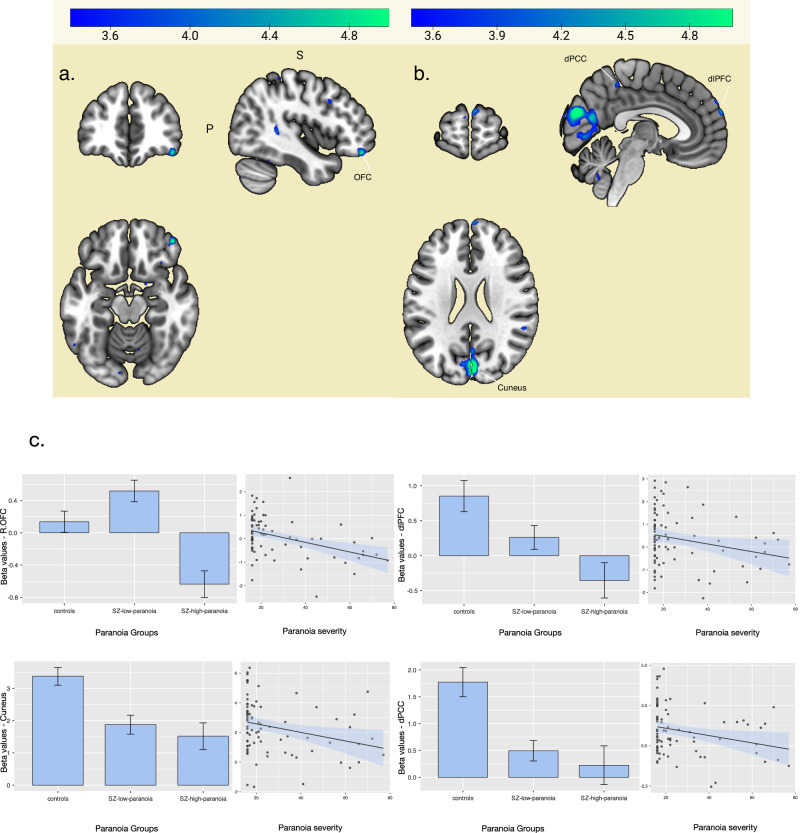 Figure 1
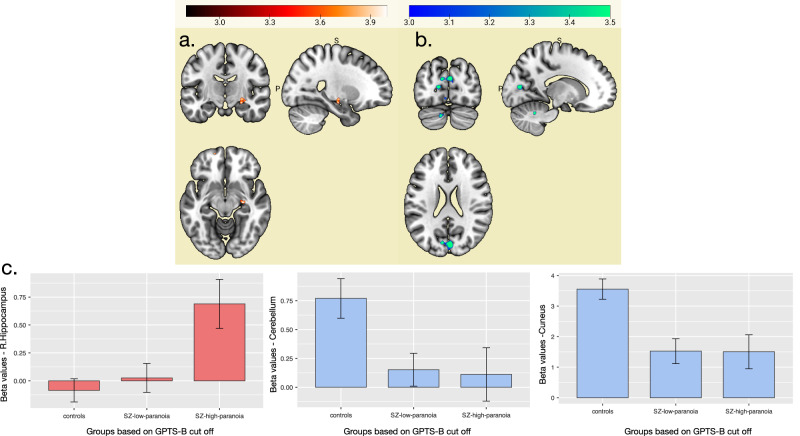 Figure 2
Peer Reviews
No public reviews on file for this paper yet. If you reviewed it on a platform where reviews are public (OpenReview, ICLR, NeurIPS, ICML), you can paste yours below so the community can read it here.
Videos
No videos yet. Explain this paper in a talk, walkthrough, or lecture? Add one.
Taxonomy
TopicsSchizophrenia research and treatment · Psychosomatic Disorders and Their Treatments · Mental Health and Psychiatry