Consecutive SSCs increase the SSC effect in skinned rat muscle fibres
Tobias Elst, Sven Weidner, André Tomalka, Daniel Hahn, Florian Kurt Paternoster, Wolfgang Seiberl, Tobias Siebert

TL;DR
This study shows that consecutive stretch-shortening cycles in rat muscle fibers enhance force and work output, especially at lower activation levels.
Contribution
The study reveals that the SSC effect increases across consecutive cycles, with distinct mechanisms at submaximal and maximal activation.
Findings
Fpeak and WorkSSC increased by 20.3% and 60.9%, respectively, from the first to the third SSC at all activation levels.
At 20% and 60% activation, Fonset, Fmin, and WorkSHO also increased from SSC1 to SSC3.
At 100% activation, Fmin decreased, suggesting different mechanisms for the SSC effect at maximal activation.
Abstract
Muscle function is essential for generating force and movement, with stretch–shortening cycles (SSCs) playing a fundamental role in the economy of everyday locomotion. Compared with pure shortening contractions, the SSC effect is characterised by increased force, work, and power output during the SSC shortening phase. Few studies have investigated whether SSC effects transfer across consecutive SSCs. Therefore, we investigated SSC effects over three consecutive SSCs in skinned rat muscle fibres by analysing the isometric force immediately before stretch onset (Fonset), the peak force at the end of stretching (Fpeak), and the minimum force at the end of shortening (Fmin), along with mechanical (WorkSSC) and shortening work (WorkSHO) at different activation levels (20%, 60%, and 100%). Each SSC was followed by an isometric hold phase, allowing force to return to a steady state. Results…
Genes, proteins, chemicals, diseases, species, mutations and cell lines named across the full text — each resolved to its canonical identifier and authoritative record.
Click any figure to enlarge with its caption.
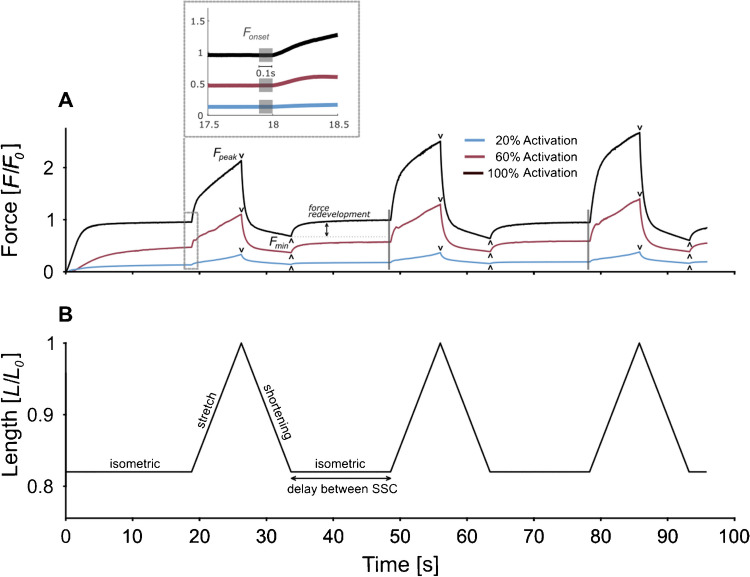 Figure 1
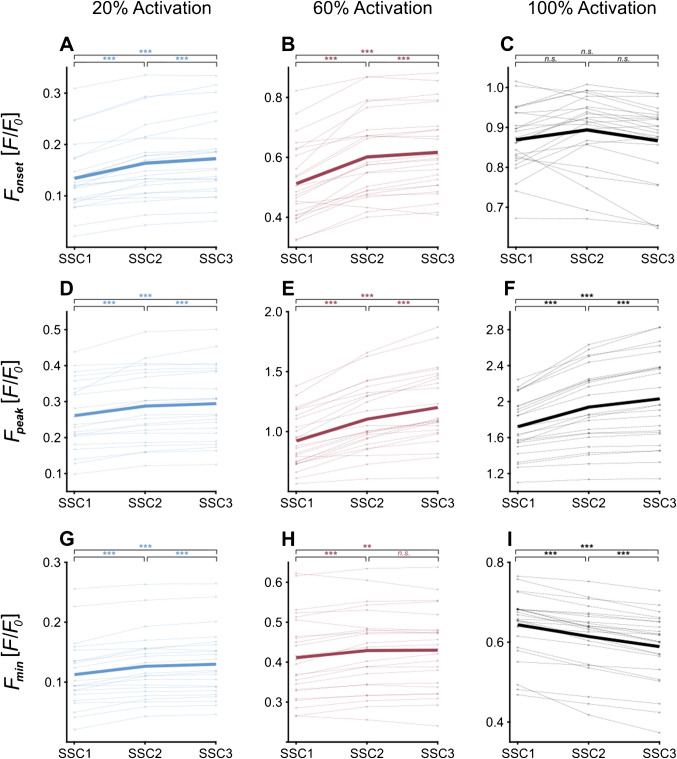 Figure 2
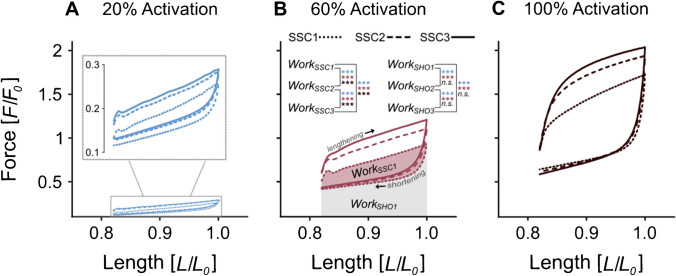 Figure 3
Peer Reviews
No public reviews on file for this paper yet. If you reviewed it on a platform where reviews are public (OpenReview, ICLR, NeurIPS, ICML), you can paste yours below so the community can read it here.
Videos
No videos yet. Explain this paper in a talk, walkthrough, or lecture? Add one.
Taxonomy
TopicsCardiomyopathy and Myosin Studies · Muscle activation and electromyography studies · Muscle Physiology and Disorders