Assessing visuospatial perception in clinical and healthy populations: Test–retest reliability and smallest real difference of hill steepness estimation and the distance-on-hill task in virtual reality
Erin MacIntyre, Mirinda M. Whitaker, Felicity A. Braithwaite, Jeanine K. Stefanucci, Tasha R. Stanton

TL;DR
This study evaluates the reliability of virtual reality tasks for measuring visuospatial perception in healthy and clinical populations.
Contribution
The study provides the first test–retest reliability and smallest real difference estimates for hill steepness and distance-on-hill tasks in virtual reality.
Findings
Hill steepness estimation tasks showed excellent reliability and sensitivity to change in both healthy and clinical populations.
The distance-on-hill task had poor reliability and low sensitivity, suggesting limited utility.
Results support using hill steepness tasks for measuring visuospatial perception in embodied perception research.
Abstract
Theories of embodied perception posit that the visuospatial perception of one’s environment is not only bound by features of the environmental itself, but also by the body capacity and affective state of the individual. Hill steepness and distance estimation tasks are widely used to assess the influence of physiological and psychological factors on visuospatial perception, but their test–retest reliability and measurement error are unknown. Such information is important to contextualise repeated measures study designs and understanding individual level differences. We aimed to evaluate the test–retest reliability and establish the smallest real difference (SRD) of three commonly used visuospatial perception tasks (ascending and descending hill steepness estimation, the distance-on-hill task) in healthy controls (n = 33) and people with painful knee osteoarthritis (n = 33). All…
Genes, proteins, chemicals, diseases, species, mutations and cell lines named across the full text — each resolved to its canonical identifier and authoritative record.
Click any figure to enlarge with its caption.
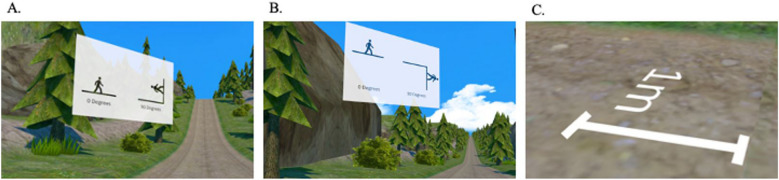 Figure 1
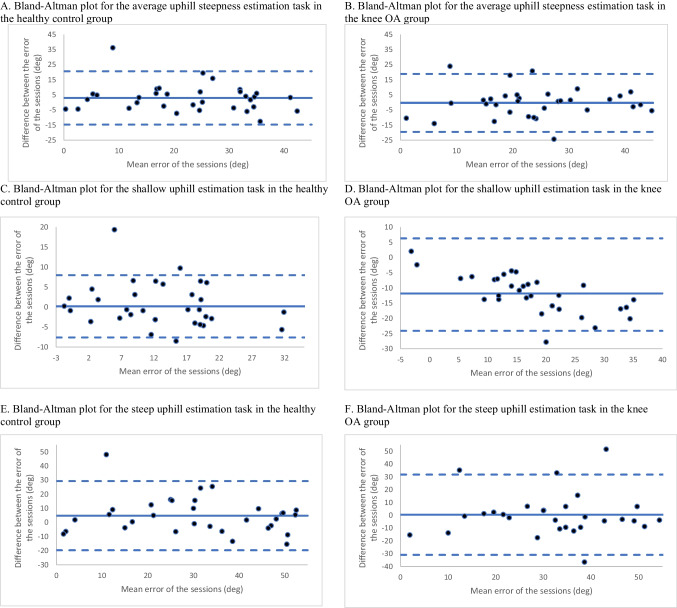 Figure 2
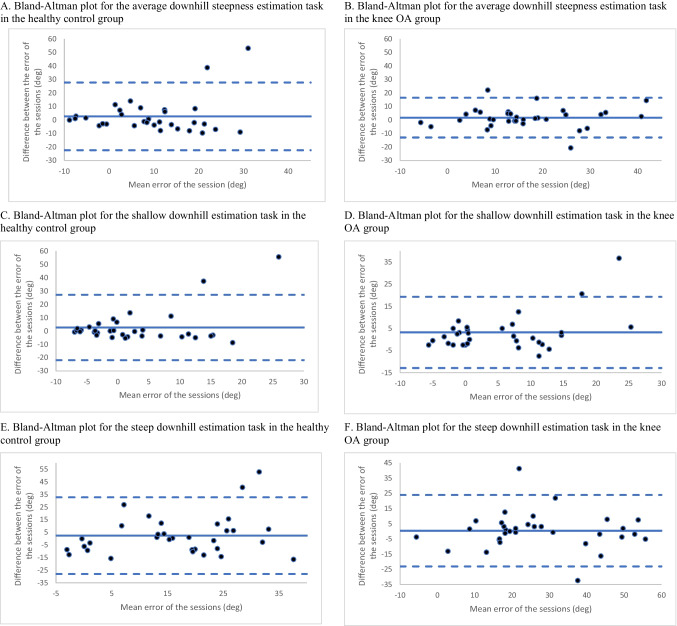 Figure 3
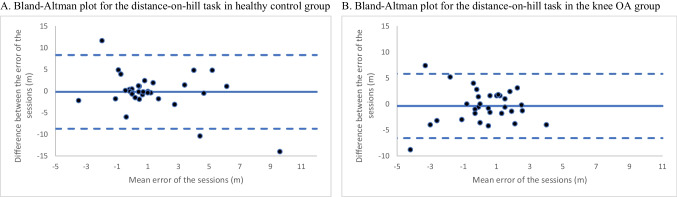 Figure 4
Peer Reviews
No public reviews on file for this paper yet. If you reviewed it on a platform where reviews are public (OpenReview, ICLR, NeurIPS, ICML), you can paste yours below so the community can read it here.
Videos
No videos yet. Explain this paper in a talk, walkthrough, or lecture? Add one.
Taxonomy
TopicsInfrared Thermography in Medicine · Musculoskeletal pain and rehabilitation · Virtual Reality Applications and Impacts