The mnemonic potency of functional facts
Stuart Wilson

TL;DR
This paper explores how people remember functional facts better than nonfunctional ones, suggesting that adaptive relevance influences memory.
Contribution
The study introduces a novel approach to categorizing semantic information based on adaptive relevance.
Findings
Functional facts are recalled more efficiently than nonfunctional facts.
Confirmatory feedback enhances the memory of functional facts.
Abstract
Learning and remembering what things are used for is a capacity that is central to successfully living in any human culture. The current paper investigates whether functional facts (information about what an object is used for) are remembered more efficiently compared with nonfunctional facts. Experiment 1 presented participants with images of functionally ambiguous objects associated with a (made-up) name and a (made-up) fact that could relate either to the object’s function or to something nonfunctional. Results show that recall of object names did not depend on whether they were associated with a functional or nonfunctional fact, while recall of the functional facts was significantly better than the nonfunctional facts. The second experiment replicated this main effect and further found that functional facts are remembered more efficiently after they have been associated with…
Genes, proteins, chemicals, diseases, species, mutations and cell lines named across the full text — each resolved to its canonical identifier and authoritative record.
Click any figure to enlarge with its caption.
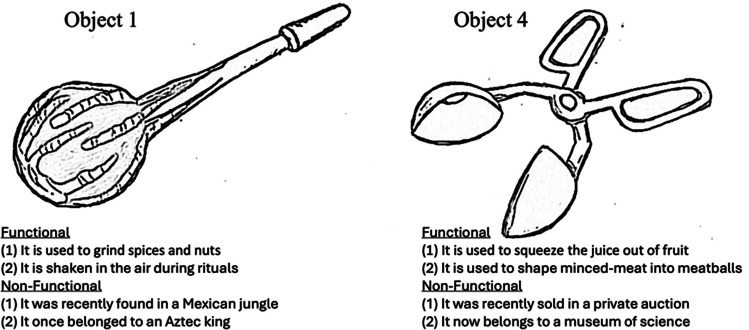 Figure 1
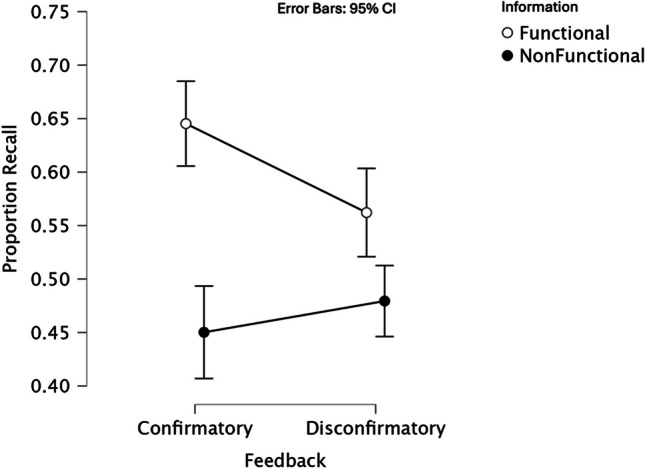 Figure 2
Peer Reviews
No public reviews on file for this paper yet. If you reviewed it on a platform where reviews are public (OpenReview, ICLR, NeurIPS, ICML), you can paste yours below so the community can read it here.
Videos
No videos yet. Explain this paper in a talk, walkthrough, or lecture? Add one.
Taxonomy
TopicsChild and Animal Learning Development · Memory Processes and Influences · Action Observation and Synchronization