Contributors to caregiver burden, depression, and anxiety in the partners of professional American-style football players: a cross-sectional study
Niki Konstantinides, Paula S. Atkeson, Heather DiGregorio, Inana Dairi, Cheyenne Brown, Kairi Noriega, Jillian Baker, Valencia Taylor, Christy Glass, Lewis E. Kazis, Rachel Terrill, Frank E. Speizer, Ross D. Zafonte, Herman A. Taylor, Aaron L. Baggish, Marc G. Weisskopf

TL;DR
This study explores how factors like chronic traumatic encephalopathy (CTE) and marital satisfaction affect the mental health and caregiver burden of partners of American-style football players.
Contribution
The study identifies CTE concerns as a novel risk factor for increased caregiver burden among partners of football players.
Findings
Poor health among partners was linked to higher depression and anxiety scores.
Higher marital satisfaction was associated with reduced caregiver burden and lower depression and anxiety scores.
Concerns about CTE were associated with increased caregiver burden and slightly higher anxiety.
Abstract
American-style football (ASF) has been linked to chronic adverse health outcomes. The extent to which ASF players' careers impact their spouses' caregiver burden, depression, and anxiety remains unknown. In addition to conventional family stressors, ASF families may have specific concerns such as chronic traumatic encephalopathy (CTE; a condition that can only be established at autopsy), which may additionally contribute to caregiver burden and mood symptoms. Family Experiences Managing Football Lives (FEM-FL) is a cross-sectional study developed under the Football Players Health Study at Harvard University. Eligible participants were partners of current and former professional ASF players who completed electronic surveys from 2021 to 2024. Data on age, race, family composition, income, employment status, caregiver help, personal health, marital satisfaction, player position, and…
Genes, proteins, chemicals, diseases, species, mutations and cell lines named across the full text — each resolved to its canonical identifier and authoritative record.
Click any figure to enlarge with its caption.
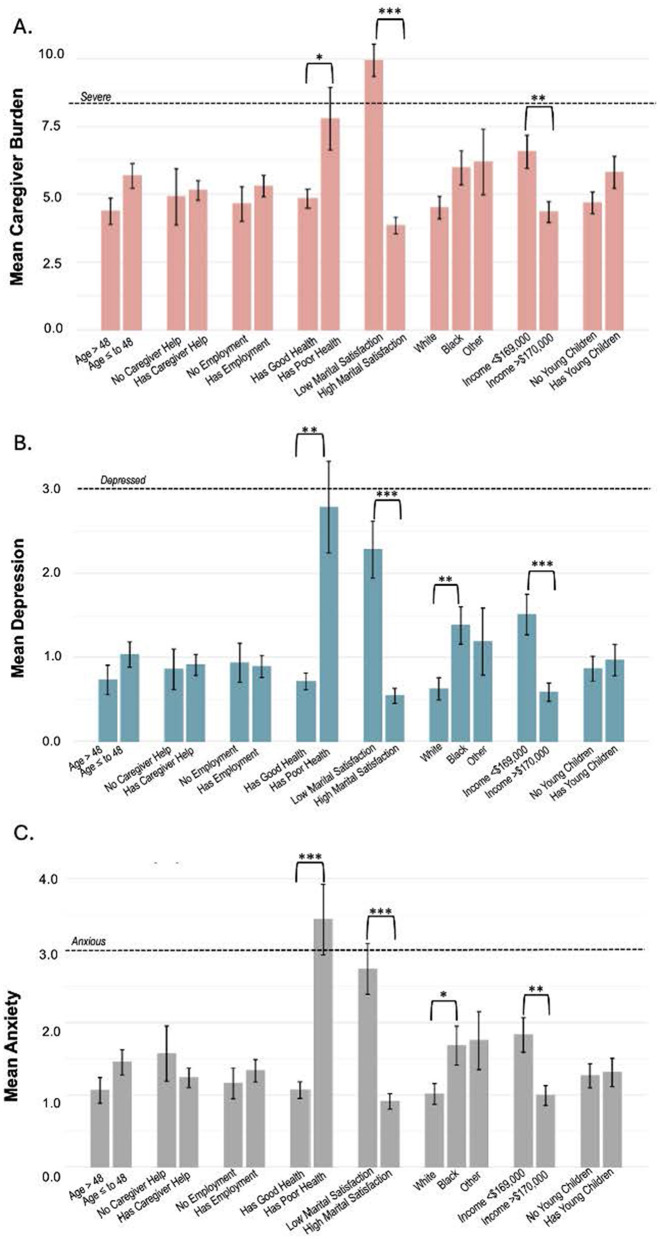 Figure 1
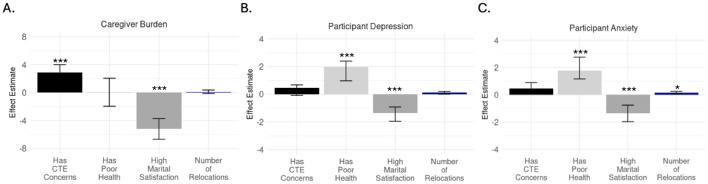 Figure 2
Peer Reviews
No public reviews on file for this paper yet. If you reviewed it on a platform where reviews are public (OpenReview, ICLR, NeurIPS, ICML), you can paste yours below so the community can read it here.
Videos
No videos yet. Explain this paper in a talk, walkthrough, or lecture? Add one.
Taxonomy
TopicsSport Psychology and Performance · Attachment and Relationship Dynamics · Sports injuries and prevention