Smartphone language features may help identify adverse post-traumatic neuropsychiatric sequelae and their trajectories
Lisa Vizer, Jennifer Pierce, Yinyao Ji, Meredith A. Bucher, Mochuan Liu, Lyle Ungar, Salvatore Giorgi, Zhaopeng Xing, Stacey L. House, Francesca L. Beaudoin, Jennifer S. Stevens, Thomas C. Neylan, Gari D. Clifford, Tanja Jovanovic, Sarah D. Linnstaedt, Donglin Zeng

TL;DR
This study shows that language patterns from smartphone use can reveal how trauma survivors are recovering and help predict symptom changes over time.
Contribution
The study identifies specific language features from smartphone use as markers for post-traumatic symptom severity and recovery trajectories.
Findings
Fourteen language features were linked to symptom severity at specific times after trauma.
Five language features predicted changes in symptom severity over time.
References to health or others in language were associated with symptom improvement or worsening.
Abstract
Language features may reflect underlying cognitive and emotional processes following a traumatic event that portend clinical outcomes. The authors sought to determine whether language features from usual smartphone use were markers associated with concurrent posttraumatic symptoms and worsening or improving posttraumatic symptoms over time following a traumatic exposure. This investigation was a secondary analysis of the Advancing Understanding of RecOvery afteR traumA study, a longitudinal study of traumatic outcomes among survivors recruited from 33 emergency departments across the United States. Adverse posttraumatic sequelae were assessed over the six months following the initial traumatic exposure. Language features were extracted from usual smartphone use in a specialized app. Bivariate linear mixed models were used to identify and validate language features that are markers…
Genes, proteins, chemicals, diseases, species, mutations and cell lines named across the full text — each resolved to its canonical identifier and authoritative record.
Click any figure to enlarge with its caption.
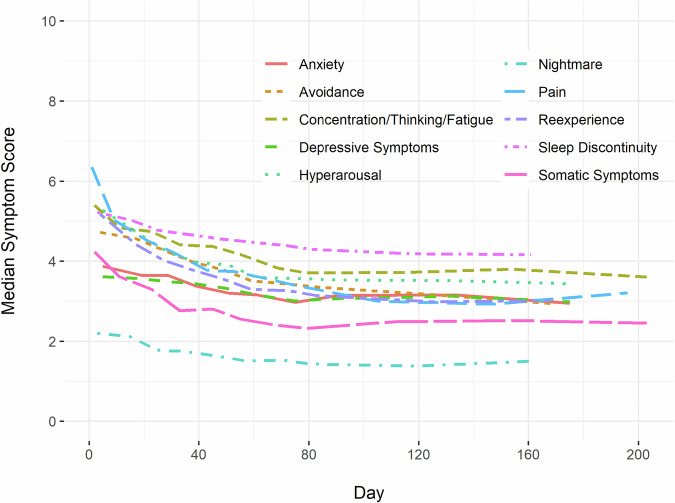 Figure 1
Peer Reviews
No public reviews on file for this paper yet. If you reviewed it on a platform where reviews are public (OpenReview, ICLR, NeurIPS, ICML), you can paste yours below so the community can read it here.
Videos
No videos yet. Explain this paper in a talk, walkthrough, or lecture? Add one.
Taxonomy
TopicsPosttraumatic Stress Disorder Research · Mental Health via Writing · Psychosomatic Disorders and Their Treatments