Reverse game: from Nash equilibrium to network structure, number and probability of occurrence
Ali Ebrahimi, Mehdi Sadeghi

TL;DR
This paper introduces a reverse game approach to determine network structures that can lead to a desired Nash equilibrium in different types of games.
Contribution
The novel contribution is the reverse game approach to identify network structures that achieve a given Nash equilibrium.
Findings
Acceptable networks that satisfy a Nash equilibrium are not unique and increase exponentially with the number of players.
Mathematical relationships are provided to calculate the number of networks for the best-shot public goods game.
Denser networks are more likely to lead to the desired Nash equilibrium, as shown by normal distribution in network density.
Abstract
In this paper, we introduce a reverse game approach to network-modelled games to determine the network structure among players that can achieve a desired Nash equilibrium. We consider three types of network games: the majority game, the minority game and the best-shot public goods game. For any proposed Nash equilibrium, we identify the conditions and constraints of the network structure necessary to achieve that equilibrium in each game. Acceptable networks—i.e. networks that satisfy the assumed Nash equilibrium—are not unique, and their numbers grow exponentially based on the number of players and the combination of strategies. We provide mathematical relationships to calculate the exact number of networks that can create the specified Nash equilibrium in the best-shot public goods game. Additionally, in the majority and minority games, the relationships presented under special…
Genes, proteins, chemicals, diseases, species, mutations and cell lines named across the full text — each resolved to its canonical identifier and authoritative record.
Click any figure to enlarge with its caption.
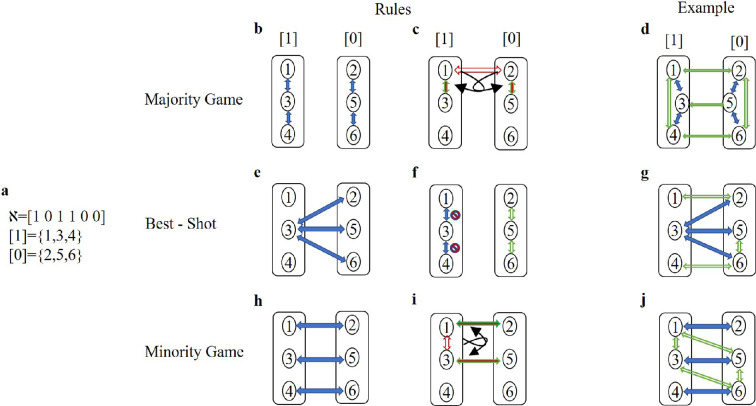 Figure 1
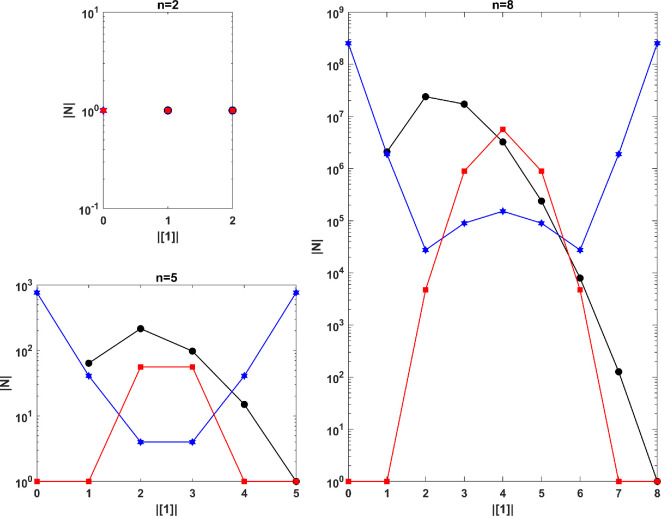 Figure 2
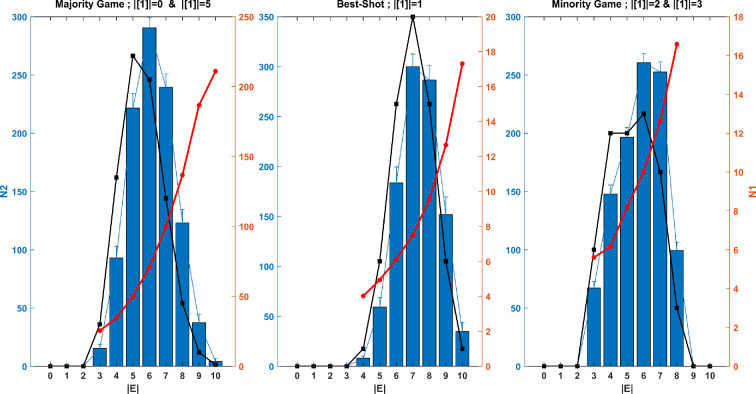 Figure 3
Peer Reviews
No public reviews on file for this paper yet. If you reviewed it on a platform where reviews are public (OpenReview, ICLR, NeurIPS, ICML), you can paste yours below so the community can read it here.
Videos
No videos yet. Explain this paper in a talk, walkthrough, or lecture? Add one.
Taxonomy
TopicsEvolutionary Game Theory and Cooperation · Opinion Dynamics and Social Influence · Game Theory and Applications