Human shape perception spontaneously discovers the biological origin of novel, but natural, stimuli
Kira Isabel Dehn, Guido Maiello, Frieder Tom Hartmann, Yaniv Morgenstern, Sara Joy Hawkins, Thomas Offner, Joshua Walter, Thomas Hassenklöver, Ivan Manzini, Roland W. Fleming

TL;DR
Humans can instinctively group unfamiliar natural shapes based on their biological origins, revealing hidden patterns in cell structures.
Contribution
Demonstrates that humans can spontaneously detect biological systematicities in novel natural shapes without prior knowledge.
Findings
Participants consistently grouped 3D-printed cell models by similarity, reflecting their biological classes.
Human perceptual organization aligns with the underlying biological processes shaping cell forms.
Findings suggest potential for integrating human perceptual strategies into automated biological analysis systems.
Abstract
Humans excel at categorizing objects by shape. This facility involves identifying shape features that objects have in common with other members of their class and relies—at least in part—on semantic/cognitive constructs. For example, plants sprout branches, fish grow fins, shoes are moulded to our feet. Can humans parse shapes according to the processes that give shapes their key characteristics, even when such processes are hidden? To answer this, we investigated how humans perceive the shape of cells from the olfactory system of Xenopus laevis tadpoles. These objects are novel to most humans yet occur in nature and cluster into classes following their underlying biological function. We reconstructed three-dimensional (3D) cell models through 3D microscopy and photogrammetry, then conducted psychophysical experiments. Human participants performed two tasks: they arranged 3D-printed…
Genes, proteins, chemicals, diseases, species, mutations and cell lines named across the full text — each resolved to its canonical identifier and authoritative record.
Click any figure to enlarge with its caption.
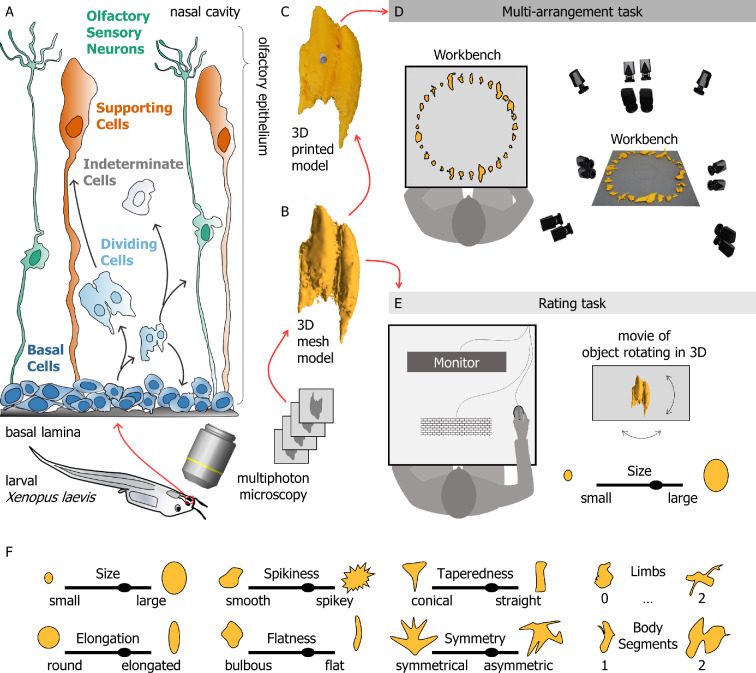 Figure 1
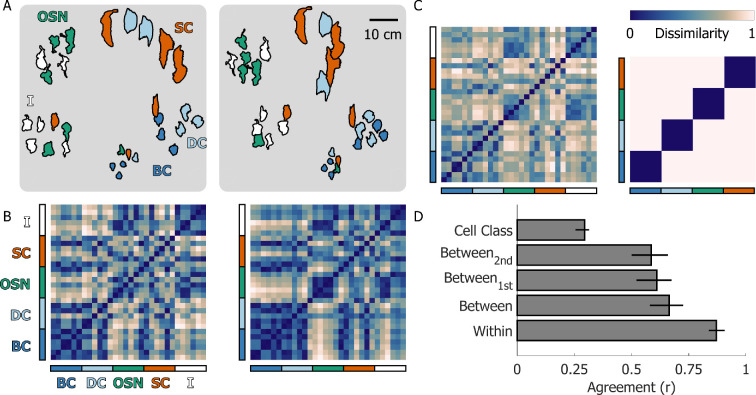 Figure 2
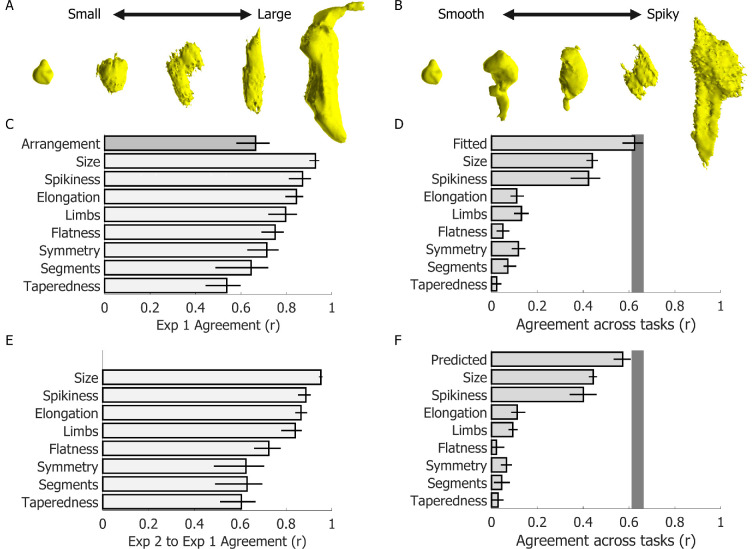 Figure 3
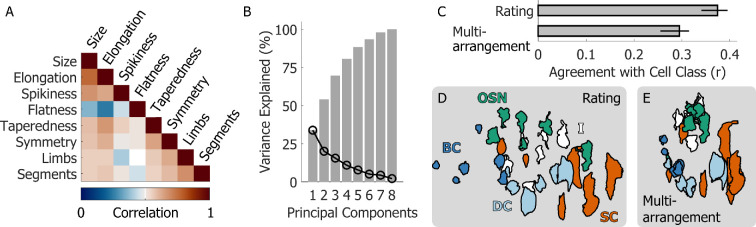 Figure 4
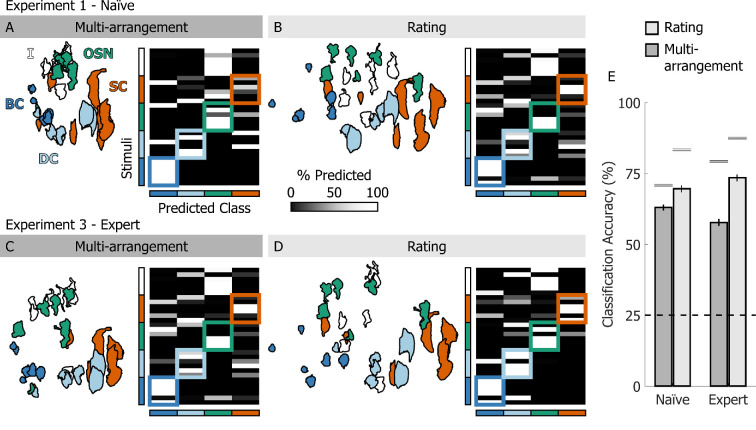 Figure 5
Peer Reviews
No public reviews on file for this paper yet. If you reviewed it on a platform where reviews are public (OpenReview, ICLR, NeurIPS, ICML), you can paste yours below so the community can read it here.
Videos
No videos yet. Explain this paper in a talk, walkthrough, or lecture? Add one.
Taxonomy
TopicsNeurobiology and Insect Physiology Research · Olfactory and Sensory Function Studies · Cephalopods and Marine Biology