Estimation of mass and radii for charged compact objects using a modified Chaplygin equation of state in the Buchdahl-I metric
A. Zahra, S. A. Mardan, Sana Saleem, Muhammad Bilal Riaz, Tomas Kozubek

TL;DR
This paper uses a modified equation of state to estimate the mass and radius of charged compact stars, supporting the physical viability of the model.
Contribution
A modified Chaplygin equation of state is applied to the Buchdahl-I metric for charged compact objects, yielding realistic predictions.
Findings
Maximum density and pressure occur at the center of the star and remain continuous.
The model avoids singularities and satisfies energy conditions for compact stars.
Predictions for mass and radius align with observed compact objects like neutron stars.
Abstract
In this article, a class of static configurations for stellar equilibrium in relativistic charged spheres with anisotropic fluid is studied. The Buchdahl ansatz is employed to solve the Einstein-Maxwell field equations, which govern the behavior of charged, relativistic stellar objects. The matter distribution within the charged sphere is shown to satisfy all the necessary energy conditions, including the hydrostatic equilibrium condition. Several compact objects, such as GW 190814, PSR J0952-0607, PSR J0030+0451, PSR J0740+6620, GW 170817, PSR J1614-2230, PSR J2215+5135, and 4U 1608-52, are discussed to predict their masses and radii. These predictions are crucial for understanding the properties of compact stars, including neutron stars and possibly exotic stars. The physical properties of the charged sphere are examined, including mass, surface redshift, adiabatic index, and the…
Genes, proteins, chemicals, diseases, species, mutations and cell lines named across the full text — each resolved to its canonical identifier and authoritative record.
Click any figure to enlarge with its caption.
 Figure 1
 Figure 2
 Figure 3
 Figure 4
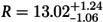 Figure 5
 Figure 6
 Figure 7
 Figure 8
 Figure 9
 Figure 10
 Figure 11
 Figure 12
 Figure 13
 Figure 14
 Figure 15
 Figure 16
 Figure 17
 Figure 18
 Figure 19
 Figure 20
 Figure 21
 Figure 22
 Figure 23
 Figure 24
 Figure 25
 Figure 26
 Figure 27
 Figure 28
 Figure 29
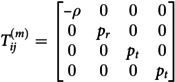 Figure 30
 Figure 31
 Figure 32
 Figure 33
 Figure 34
 Figure 35
 Figure 36
 Figure 37
 Figure 38
 Figure 39
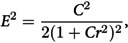 Figure 40
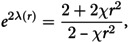 Figure 41
 Figure 42
 Figure 43
 Figure 44
 Figure 45
 Figure 46
 Figure 47
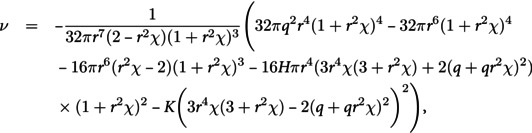 Figure 48
 Figure 49
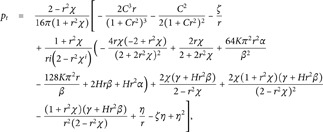 Figure 50
Peer Reviews
No public reviews on file for this paper yet. If you reviewed it on a platform where reviews are public (OpenReview, ICLR, NeurIPS, ICML), you can paste yours below so the community can read it here.
Videos
No videos yet. Explain this paper in a talk, walkthrough, or lecture? Add one.
Taxonomy
TopicsPulsars and Gravitational Waves Research · Cosmology and Gravitation Theories · Gamma-ray bursts and supernovae