Filter-based models of suppression in retinal ganglion cells: Comparison and generalization across species and stimuli
Neda Shahidi, Fernando Rozenblit, Mohammad H. Khani, Helene M. Schreyer, Matthias Mietsch, Dario A. Protti, Tim Gollisch, Matthias Hennig, Matthias Hennig, Matthias Hennig

TL;DR
This paper compares computational models of suppression in retinal ganglion cells across species and stimuli, finding that subtractive and divisive models perform best under different conditions.
Contribution
The study introduces a comparative analysis of suppression models in retinal ganglion cells across species and stimulus types.
Findings
Subtractive and divisive suppression models outperform feedback and linear-nonlinear models in predicting ganglion cell responses.
Divisive suppression models generalize better across temporal frequencies and contrast, while subtractive models excel for slow dynamics.
Suppression inclusion improves model performance compared to models without suppression.
Abstract
The dichotomy of excitation and suppression is one of the canonical mechanisms explaining the complexity of neural activity. Computational models of the interplay of excitation and suppression in single neurons aim at investigating how this interaction affects a neuron’s spiking responses and shapes the encoding of sensory stimuli. Here, we compare the performance of three filter-based stimulus-encoding models for predicting retinal ganglion cell responses recorded from axolotl, mouse, and marmoset retina to different types of temporally varying visual stimuli. Suppression in these models is implemented via subtractive or divisive interactions of stimulus filters or by a response-driven feedback module. For the majority of ganglion cells, the subtractive and divisive models perform similarly and outperform the feedback model as well as a linear-nonlinear (LN) model with no suppression.…
Genes, proteins, chemicals, diseases, species, mutations and cell lines named across the full text — each resolved to its canonical identifier and authoritative record.
Click any figure to enlarge with its caption.
 Figure 1
 Figure 2
 Figure 3
 Figure 4
 Figure 5
 Figure 6
 Figure 7
 Figure 8
 Figure 9
 Figure 10
 Figure 11
 Figure 12
 Figure 13
 Figure 14
 Figure 15
 Figure 16
 Figure 17
 Figure 18
 Figure 19
 Figure 20
 Figure 21
 Figure 22
 Figure 23
 Figure 24
 Figure 25
 Figure 26
 Figure 27
 Figure 28
 Figure 29
 Figure 30
 Figure 31
 Figure 32
 Figure 33
 Figure 34
 Figure 35
 Figure 36
 Figure 37
 Figure 38
 Figure 39
 Figure 40
 Figure 41
 Figure 42
 Figure 43
 Figure 44
 Figure 45
 Figure 46
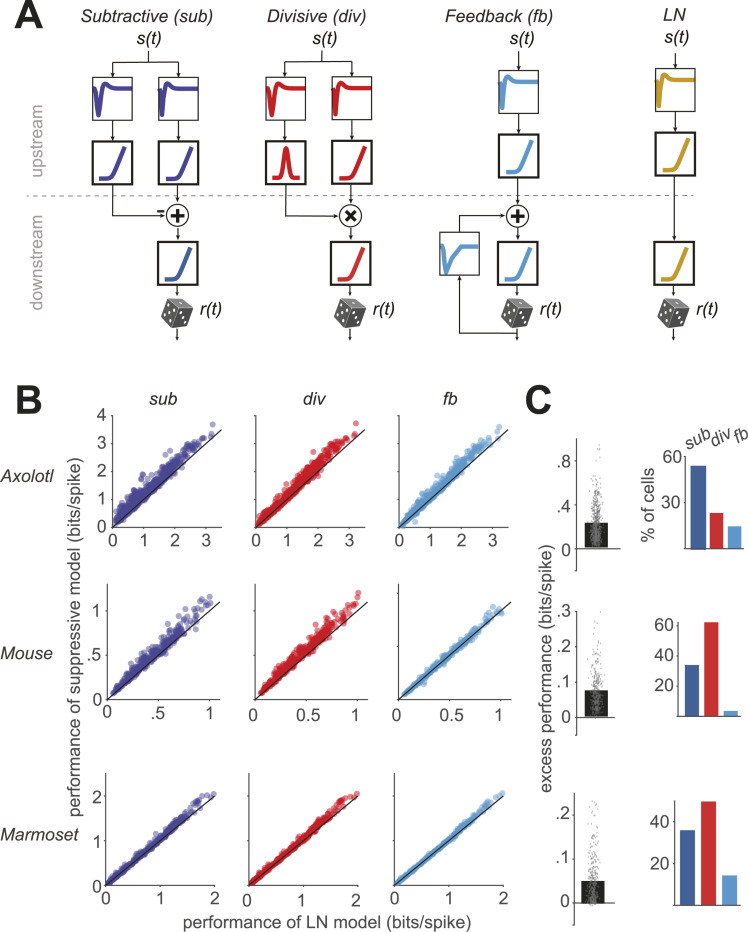 Figure 47
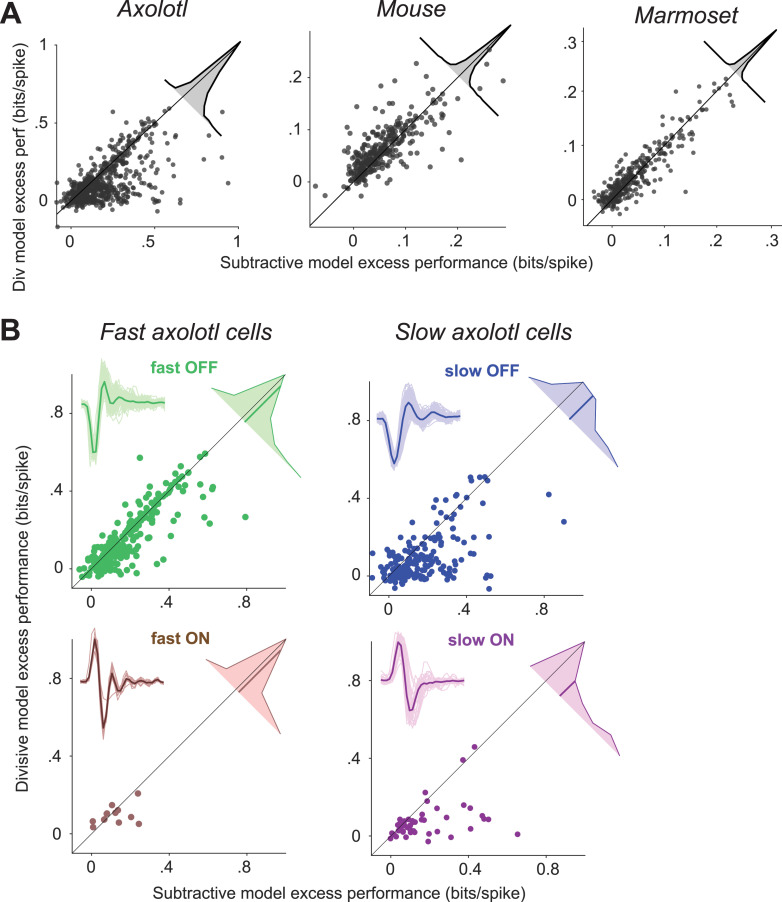 Figure 48
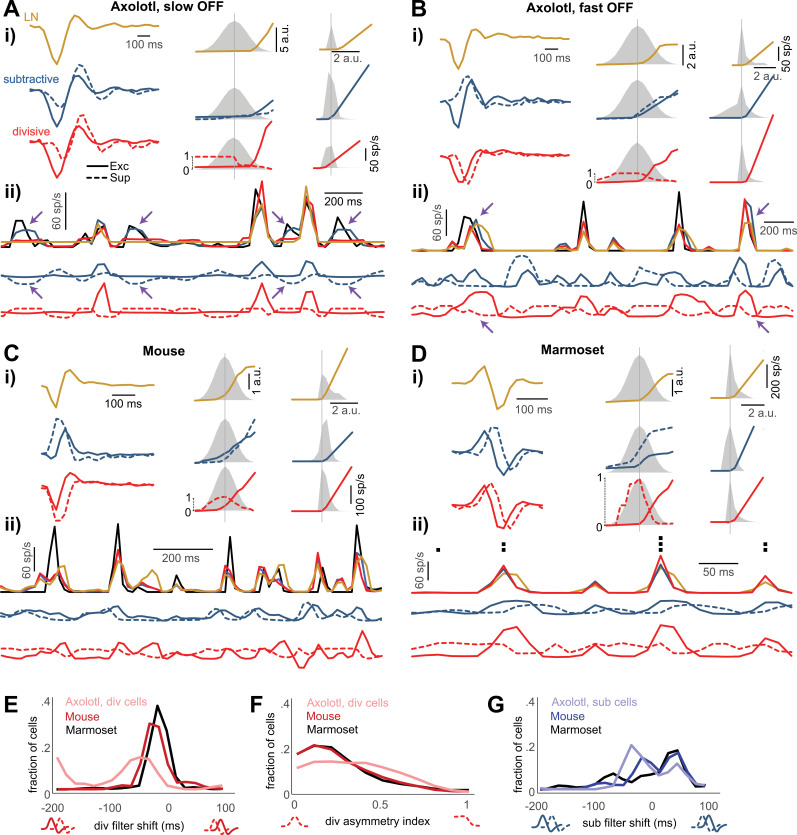 Figure 49
 Figure 50
Peer Reviews
No public reviews on file for this paper yet. If you reviewed it on a platform where reviews are public (OpenReview, ICLR, NeurIPS, ICML), you can paste yours below so the community can read it here.
Videos
No videos yet. Explain this paper in a talk, walkthrough, or lecture? Add one.
Taxonomy
TopicsNeural dynamics and brain function · Visual perception and processing mechanisms · Retinal Development and Disorders