Budd-Chiari Syndrome Secondary to Myelofibrosis in a Patient With Polycythemia Vera: A 16-Year Disease Progression Case Highlighting JAK2 Mutation Pathogenesis
Huyu Jiao, Zhengang Zhang

TL;DR
A 45-year-old man with polycythemia vera developed myelofibrosis and later Budd-Chiari syndrome, showing how MPNs can progress over time.
Contribution
This case highlights the rare progression from PV to MF and BCS, emphasizing thrombotic risks in advanced MPNs.
Findings
The patient's PV progressed to MF in 2021 and then to BCS in 2022.
BCS was managed with anticoagulation, diuretics, and a transjugular intrahepatic portosystemic shunt.
The case underscores the thrombotic risks in advanced MPN subtypes.
Abstract
Budd-Chiari syndrome (BCS) is a rare, life-threatening condition often caused by myeloproliferative neoplasms (MPNs), with polycythemia vera (PV) and essential thrombocythemia being common culprits. Myelofibrosis (MF)-related BCS is rare. We report a 45-year-old male patient with a 16-year history of PV that progressed to MF in 2021 and then to BCS in December 2022. The patient presented with abdominal distension and hepatomegaly, and imaging confirmed hepatic venous outflow obstruction. Treatment included anticoagulation, diuretics, and transjugular intrahepatic portosystemic shunt. This case highlights the delayed progression from PV to MF and subsequent BCS and the thrombotic risks in advanced MPN subtypes.
Genes, proteins, chemicals, diseases, species, mutations and cell lines named across the full text — each resolved to its canonical identifier and authoritative record.
Click any figure to enlarge with its caption.
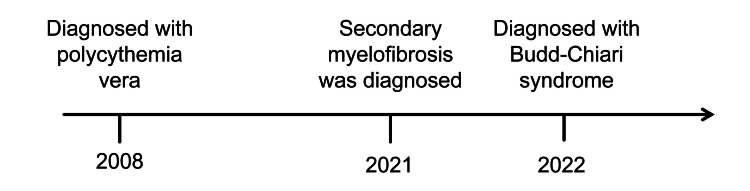 Figure 1
 Figure 2
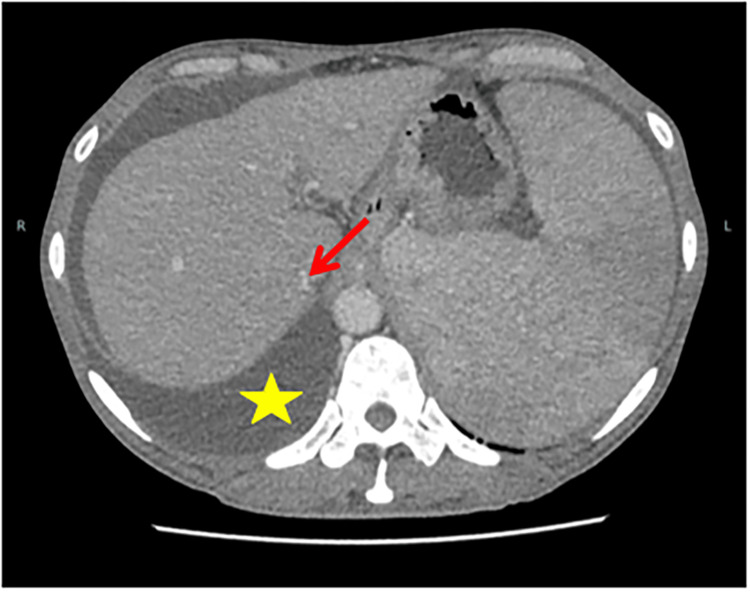 Figure 3
Peer Reviews
No public reviews on file for this paper yet. If you reviewed it on a platform where reviews are public (OpenReview, ICLR, NeurIPS, ICML), you can paste yours below so the community can read it here.
Videos
No videos yet. Explain this paper in a talk, walkthrough, or lecture? Add one.
Taxonomy
TopicsMyeloproliferative Neoplasms: Diagnosis and Treatment · Eosinophilic Disorders and Syndromes · Kruppel-like factors research