Risk‐Based Triage Strategy by Extended HPV Genotyping for Women With LSIL Cytology: A Real‐World Study
Chun Ye, Yi Liu, Huiru Huang, Ruizhe Chen, Ying Li, Xiaofei Zhang, Yunfeng Fu, Liang Feng, Xiao Li

TL;DR
This study proposes a new triage strategy for women with LSIL cytology using extended HPV genotyping to reduce unnecessary colposcopies while maintaining detection accuracy.
Contribution
A novel risk-based triage strategy using extended HPV genotyping for LSIL women is developed and validated in a real-world setting.
Findings
HPV16, 73, and 33 are associated with the highest immediate CIN2+/3+ risk.
The new strategy significantly increases specificity while reducing colposcopy referrals by 19.82%.
Group A genotypes require immediate colposcopy, while Groups B and C suggest alternative follow-up methods.
Abstract
To evaluate the immediate risk of (pre)cancer for cytology low‐grade squamous intraepithelial lesion (LSIL) women infected with or without specific HPV genotype and develop a risk‐based management strategy. A total of 4567 LSIL women with extended HPV genotyping and colposcopy results were enrolled according to the inclusive and exclusive criteria. The distribution and immediate cervical intraepithelial neoplasia grade 2 or worse and 3+ or worse (CIN2+/3+) risks of specific HPV genotypes were assessed using Minimum Estimate, Any Type Estimate, and Hierarchical Attribution Estimate. A risk‐based strategy was further established and evaluated. CIN2+/3+ were 729/328 cases, including 691/317 in 3398 HPV‐positive and 38/11 in 1169 HPV‐negative women. HPV16, 52, 58, and 18 were the most prevalent genotypes in both HPV‐positive and CIN2+/3+ cases. HPV16, 73, and 33 carried the highest…
Genes, proteins, chemicals, diseases, species, mutations and cell lines named across the full text — each resolved to its canonical identifier and authoritative record.
Click any figure to enlarge with its caption.
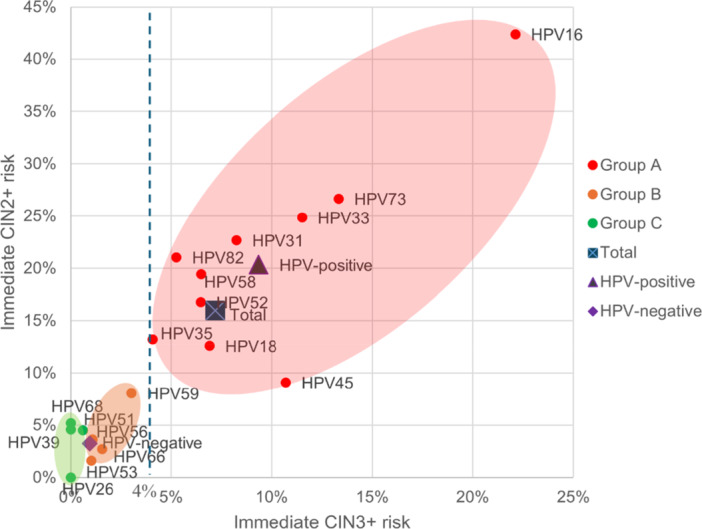 Figure 1
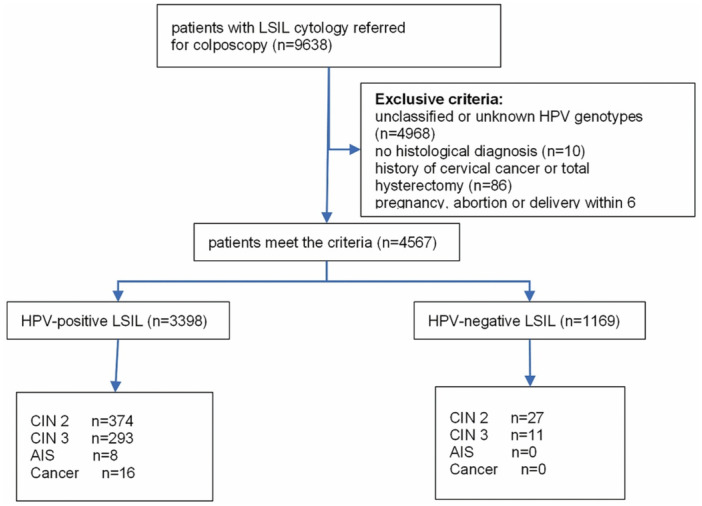 Figure 2
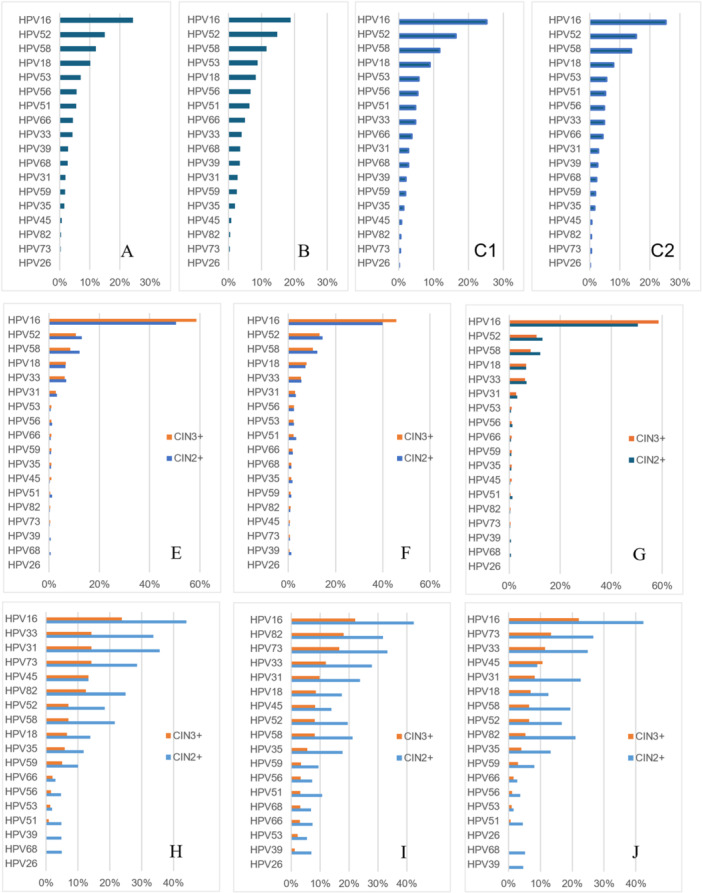 Figure 3
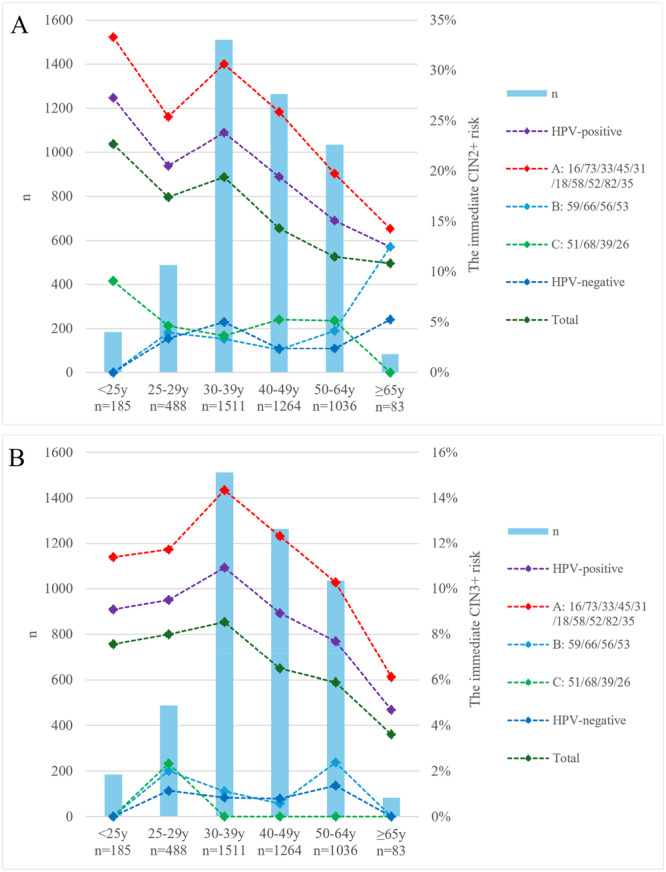 Figure 4
Peer Reviews
No public reviews on file for this paper yet. If you reviewed it on a platform where reviews are public (OpenReview, ICLR, NeurIPS, ICML), you can paste yours below so the community can read it here.
Videos
No videos yet. Explain this paper in a talk, walkthrough, or lecture? Add one.
Taxonomy
TopicsCervical Cancer and HPV Research · Reproductive tract infections research · Genital Health and Disease