Planetary health and Indigenous sovereignty: exploring the theory of change of the Healthy Environments and Lives (HEAL) network in Western Australia
Lucie O’Sullivan, Theoni Whyman, Mara West, Noel Nannup, Jaime Yallup Farrant, Naomi Joy Godden, Emma-Leigh Synnott, Raewyn Mutch, Anita J Campbell, Kylie Wrigley, Brad Farrant

TL;DR
This paper describes how the HEAL network in Western Australia uses Indigenous knowledge and community-led research to improve health and address climate change.
Contribution
The paper introduces a theory of change that integrates Indigenous sovereignty and participatory research for equitable climate and health outcomes.
Findings
Community-Based Participatory Action Research (CBPAR) is used to center Indigenous voices in climate and health research.
Integrating young people's perspectives ensures intergenerational justice in research and policy.
Collaborative relationships between researchers and communities lead to equitable, place-based solutions.
Abstract
This paper outlines the theory of change which underpins the Western Australian (WA) hub of the Healthy Environments and Lives (HEAL) network. HEAL is an Australian national research initiative that aims to address the health impacts of climate and environmental change. The WA hub’s theory of change is focused on improving the health and well-being of the planet and people, including children, through centring Indigenous sovereignty, voices and ways of knowing and being in research, policy development and service provision. The WA hub also recognises it is essential for place-based, community-led solutions, which strengthens responses to climate and environmental change, grounding mitigation and adaptation efforts in local priorities, knowledges and relationships. To action its theory of change, the HEAL WA hub has embraced Community-Based Participatory Action Research (CBPAR), which…
Genes, proteins, chemicals, diseases, species, mutations and cell lines named across the full text — each resolved to its canonical identifier and authoritative record.
Click any figure to enlarge with its caption.
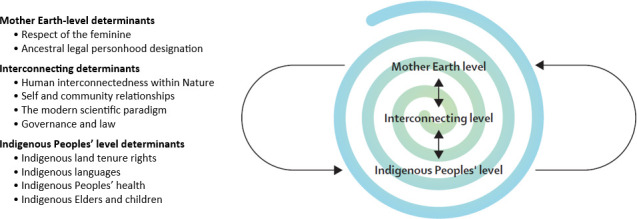 Figure 1
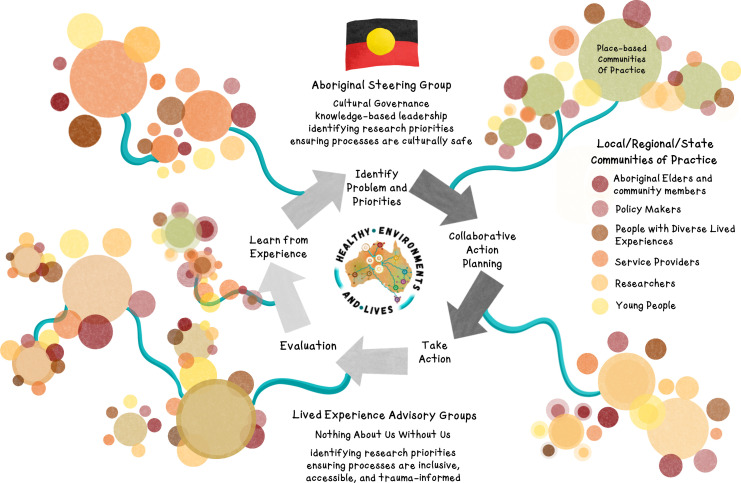 Figure 2
Peer Reviews
No public reviews on file for this paper yet. If you reviewed it on a platform where reviews are public (OpenReview, ICLR, NeurIPS, ICML), you can paste yours below so the community can read it here.
Videos
No videos yet. Explain this paper in a talk, walkthrough, or lecture? Add one.
Taxonomy
TopicsClimate Change and Health Impacts · Indigenous Health, Education, and Rights · Health, psychology, and well-being