Electroencephalographic characteristics of transcutaneous auricular vagus nerve stimulation for prolonged disorders of consciousness: a study protocol
Haoyang Jiao, Weihang Zhai, Jinling Zhang, Long Xu, Xiaoli Geng, Xueling Chen, Yi Yang, Yifei Wang

TL;DR
This study aims to identify EEG patterns that predict which patients with prolonged disorders of consciousness will benefit from transcutaneous auricular vagus nerve stimulation.
Contribution
The study introduces a protocol to screen EEG characteristics for selecting suitable patients for taVNS treatment in prolonged disorders of consciousness.
Findings
Patients will be classified into response and non-response groups based on changes in CRS-R scores after taVNS treatment.
Differences in brain power spectrum and functional connectivity from resting EEG will be compared between response and non-response groups.
The study will follow up with patients for 12 months to assess long-term effects of taVNS.
Abstract
Increasing evidence indicates that transcutaneous auricular vagus nerve stimulation (taVNS) can promote the recovery of consciousness levels in patients with prolonged disorders of consciousness (pDOC). However, previous clinical studies have shown inconsistent clinical efficacy of taVNS in treating pDOC. This could be because no research has clearly defined the indications for taVNS treatment in patients with pDOC, and patients who were not indicated for taVNS treatment were included. Therefore, screening out the indications for patients with pDOC who are suitable for taVNS treatment is a key scientific issue that requires urgent resolution at present. We aim to incorporate 50 patients with pDOC into this study. All patients will undergo a 4-week taVNS treatment, and 30-min resting electroencephalogram (EEG) and Coma Recovery Scale-Revised (CRS-R) scores of each patient will be…
Genes, proteins, chemicals, diseases, species, mutations and cell lines named across the full text — each resolved to its canonical identifier and authoritative record.
Click any figure to enlarge with its caption.
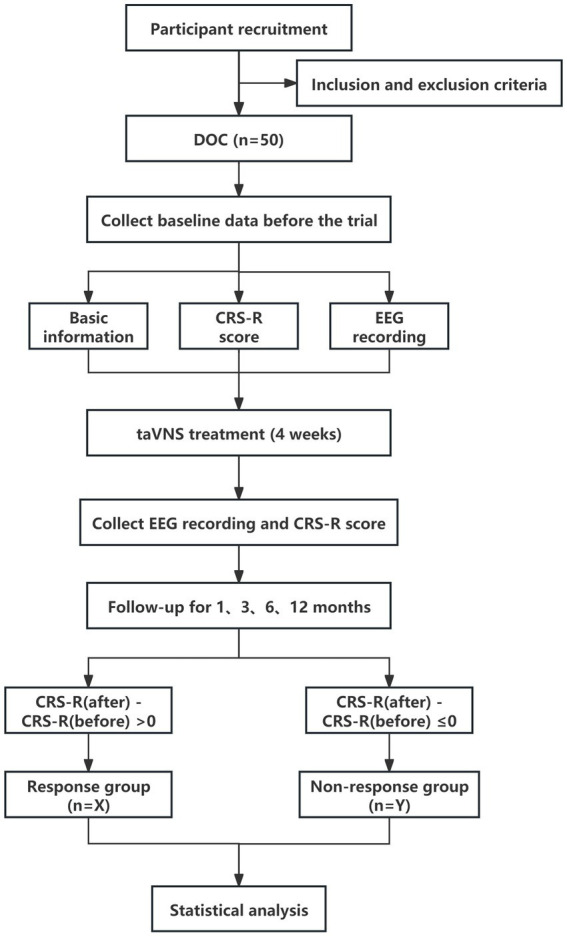 Figure 1
 Figure 2
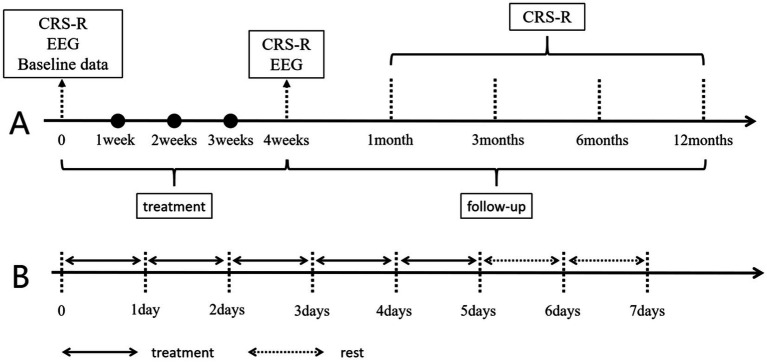 Figure 3
Peer Reviews
No public reviews on file for this paper yet. If you reviewed it on a platform where reviews are public (OpenReview, ICLR, NeurIPS, ICML), you can paste yours below so the community can read it here.
Videos
No videos yet. Explain this paper in a talk, walkthrough, or lecture? Add one.
Taxonomy
TopicsVagus Nerve Stimulation Research · EEG and Brain-Computer Interfaces · Heart Rate Variability and Autonomic Control