Exploring the Potential of Homologous Recombination Protein PALB2 in Synthetic Lethal Combinations
Xinyan Lu, Basilius Sauter, Aramis Keller, Saule Zhanybekova, Dennis Gillingham

TL;DR
This paper explores how targeting the PALB2 protein, involved in DNA repair, could lead to new cancer treatments by exploiting synthetic lethal interactions.
Contribution
The study introduces a model system using a degron in PALB2 and identifies a high-affinity peptide ligand for future drug development.
Findings
A model system was developed to study PARP/HR synthetic lethality using a zinc-finger degron in PALB2.
A high-affinity peptide ligand for PALB2 was identified, supporting future therapeutic development.
PALB2 is validated as a promising drug target for exploiting synthetic lethal interactions in cancer cells.
Abstract
Cells with defective homologous recombination (HR) are highly sensitive to poly(ADP-ribose) polymerase (PARP) inhibition. Current therapeutic approaches leverage this vulnerability by using PARP inhibitors in cells with genetically compromised HR. However, if HR factors in cancer cells could be inhibited or degraded pharmacologically, it might reveal other opportunities for synergistic combinations. In this study, we developed a model system that recapitulates PARP/HR synthetic lethality by integrating a small-molecule responsive zinc-finger degron into the HR factor Partner and Localizer of BRCA2 (PALB2). We further tested a series of peptide ligands for PALB2 based on its natural binding partners, which led to the discovery of a high affinity peptide that will support future work on PALB2 and HR. Together, our findings validate PALB2 as a promising drug target and provide the tools…
Genes, proteins, chemicals, diseases, species, mutations and cell lines named across the full text — each resolved to its canonical identifier and authoritative record.
Click any figure to enlarge with its caption.
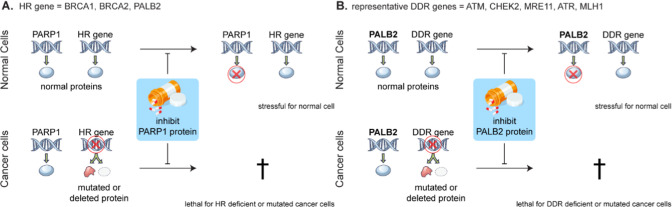 Figure 1
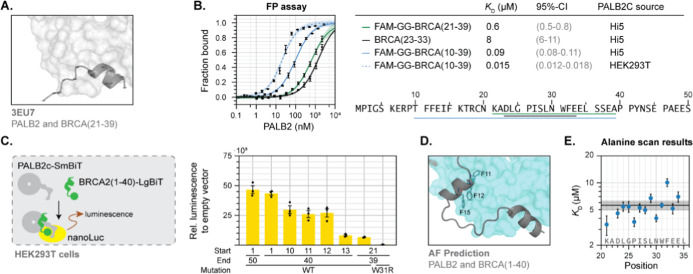 Figure 2
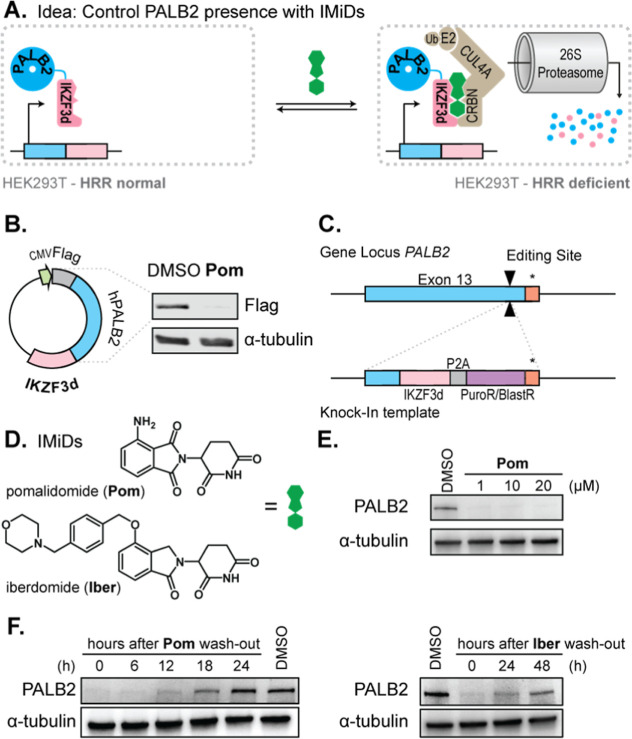 Figure 3
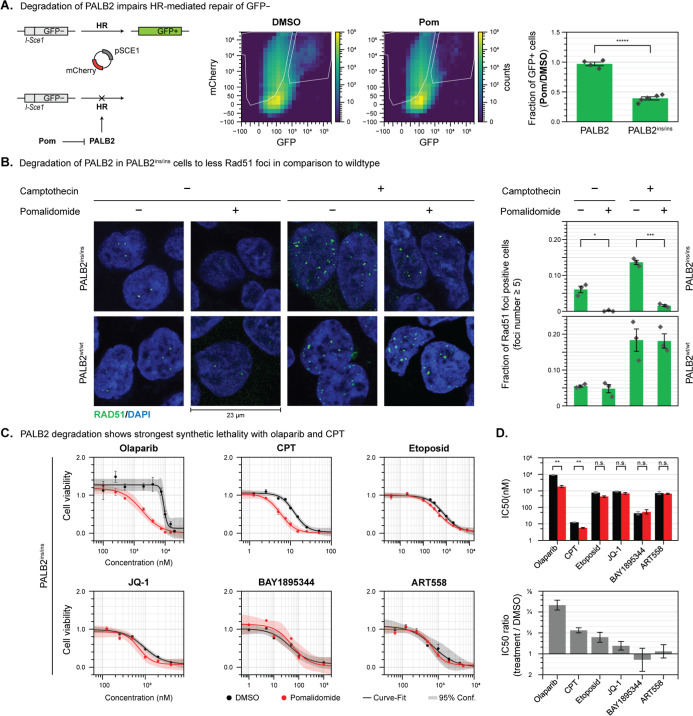 Figure 4
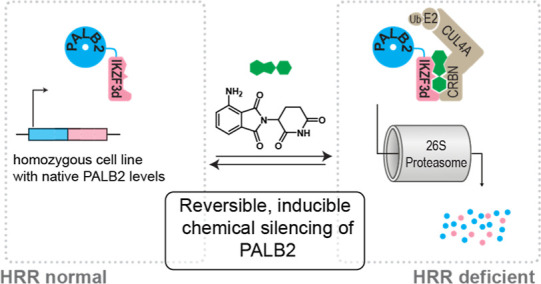 Figure 5
Peer Reviews
No public reviews on file for this paper yet. If you reviewed it on a platform where reviews are public (OpenReview, ICLR, NeurIPS, ICML), you can paste yours below so the community can read it here.
Videos
No videos yet. Explain this paper in a talk, walkthrough, or lecture? Add one.
Taxonomy
TopicsCRISPR and Genetic Engineering · PARP inhibition in cancer therapy · Ubiquitin and proteasome pathways