Chemical Protein Engineering: Backbone Cyclization Rescues Folding of a 183‐Residue Truncated Domain of Malaria Parasite Protein PfAMA1
Jamsad Mannuthodikayil, Vishal Malik, Abhisek Kar, Sameer Singh, Kalyaneswar Mandal

TL;DR
Scientists chemically synthesized a malaria parasite protein domain and used backbone cyclization to improve its folding, potentially aiding drug development.
Contribution
First chemical synthesis of a 183-residue cyclic PfAMA1 domain I using cyclization to aid folding and stabilize structure.
Findings
Backbone cyclization improved disulfide bond formation in PfAMA1-DI by restricting terminal flexibility.
Cyclic PfAMA1-DI retained PfRON2 ligand binding similar to native interactions.
Multipurpose tags enhanced folding yield by reducing aggregation.
Abstract
The interaction between apical membrane antigen 1 (PfAMA1) and rhoptry neck protein 2 (PfRON2) is crucial for Plasmodium falciparum red blood cell invasion, making it a key target for anti‐malarial drug development strategies. Here, we report the chemical synthesis of PfAMA1 domain I (PfAMA1‐DI) in both linear and backbone‐circularized forms, employing a six‐segment convergent synthesis approach exploiting one‐pot chemistries and solubilizing tags. The chemically synthesized linear PfAMA1‐DI construct exhibited incomplete disulfide bond formation during folding, likely due to increased terminal flexibility in the absence of domain II. To address this, we employed backbone cyclization of the large 180‐residue polypeptide chain, with 3‐residue linker sequence, as a unique strategy to conformationally restrict its termini and facilitate correct disulfide bond formation. Introducing a…
Genes, proteins, chemicals, diseases, species, mutations and cell lines named across the full text — each resolved to its canonical identifier and authoritative record.
Click any figure to enlarge with its caption.
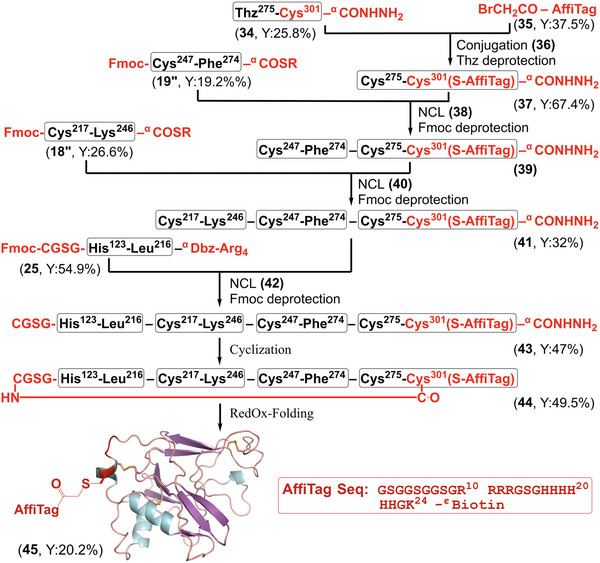 Figure 1
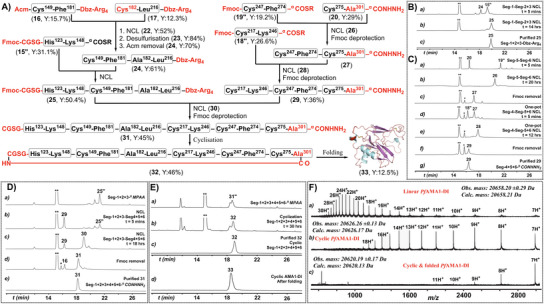 Figure 2
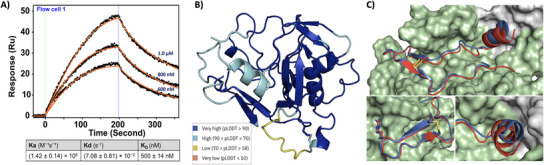 Figure 3
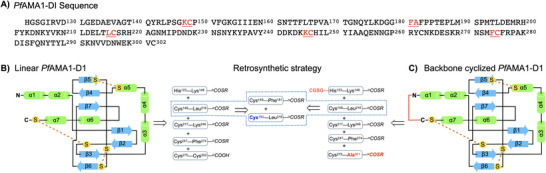 Figure 4
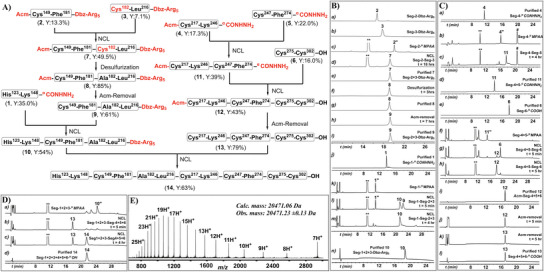 Figure 5
 Figure 6
Peer Reviews
No public reviews on file for this paper yet. If you reviewed it on a platform where reviews are public (OpenReview, ICLR, NeurIPS, ICML), you can paste yours below so the community can read it here.
Videos
No videos yet. Explain this paper in a talk, walkthrough, or lecture? Add one.
Taxonomy
TopicsTrypanosoma species research and implications · Transgenic Plants and Applications · Biochemical and Structural Characterization