Toolkit for adapting community engagement studios to effectively engage older adults in research
Shaye A. Kerper, Janelle C. Christensen, Steven M. Albert

TL;DR
This paper introduces a toolkit to adapt community engagement studios to better include older adults in health research.
Contribution
The novel contribution is the development of an OA-CES toolkit for adapting community engagement to older adults.
Findings
The OA-CES model gathers feedback to make research more accessible to older adults.
The toolkit supports adapting the model to other research areas for improved inclusion.
OA-CES addresses the underrepresentation of older adults in health research.
Abstract
Older adults have largely been excluded from health research despite bearing a disproportionate disease burden. The Community Engagement Studio (CES) model, initially developed at Vanderbilt University in 2009, allows potential research participants to help shape research to promote greater inclusion. The University of Pittsburgh adapted the CES model for older adults (OA-CES). Tailored specifically to older adults, OA-CES addresses underrepresentation in research by gathering valuable feedback that allows investigators to make research more accessible and relevant to older people. An OA-CES toolkit will help in adapting the model in other research areas to close the gap in research inclusion.
Genes, proteins, chemicals, diseases, species, mutations and cell lines named across the full text — each resolved to its canonical identifier and authoritative record.
Click any figure to enlarge with its caption.
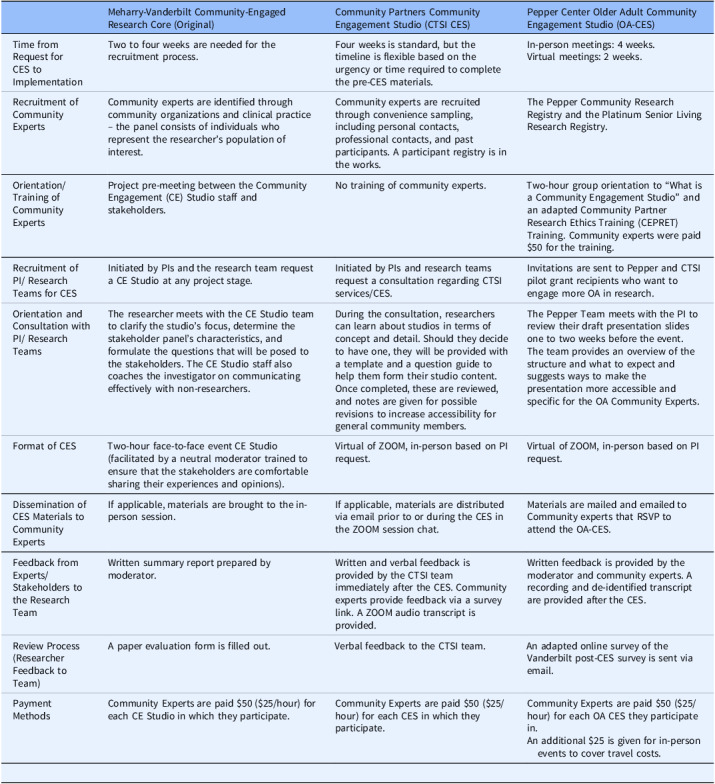 Figure 1
Peer Reviews
No public reviews on file for this paper yet. If you reviewed it on a platform where reviews are public (OpenReview, ICLR, NeurIPS, ICML), you can paste yours below so the community can read it here.
Videos
No videos yet. Explain this paper in a talk, walkthrough, or lecture? Add one.
Taxonomy
TopicsAging and Gerontology Research · Mental Health and Patient Involvement