CBT for depression and anxiety adapted for psychosis risk in primary care: controlled trial to assess feasibility, acceptability and signals of efficacy
Katherine Newman-Taylor, Tess Maguire, Tanya Smart, Emma Bayford, Emily Gosden, Grace Addyman, Jessica Grange, Pete Bullard, Miriam Simmons-Dauvin, Morad Margoum, Ben Smart, Keith Das, Sophie Hardy, Catherine Hiscutt, Charlotte Hodges, Adam Holleyman, Hettie Jones, Kate Spurr

TL;DR
This study shows that adapting CBT for depression and anxiety to address psychosis risk in primary care is feasible and promising.
Contribution
The first controlled trial of CBT adapted for psychosis risk in primary care for depression and anxiety.
Findings
CBT adapted for psychosis risk showed improved clinical and recovery outcomes.
Higher retention rates in the adapted CBT group suggest better acceptability.
Sustained improvements in psychosis and relational measures were observed at 3 months.
Abstract
People at high risk for psychosis access primary care mental health services for depression and anxiety and are unlikely to recover from these affective symptoms. We report the first controlled trial of cognitive–behavioural therapy (CBT) for depression and anxiety, minimally adapted for psychosis risk, in primary care. To evaluate feasibility, acceptability and signals of efficacy for CBT for depression and anxiety adapted for psychosis risk, designed in collaboration with people with psychosis. A longitudinal controlled trial comparing best practice CBT for depression and anxiety (CBT-BP) with CBT adapted for psychosis risk (CBT-PR), in patients meeting criteria for UK primary care services and who are also clinically high risk for psychosis (trial registration no. ISRCTN40678). Rates of recruitment (55 to CBT-BP, 44 to CBT-PR), completion of measures (90% CBT-BP, 94% CBT-PR) and…
Genes, proteins, chemicals, diseases, species, mutations and cell lines named across the full text — each resolved to its canonical identifier and authoritative record.
Click any figure to enlarge with its caption.
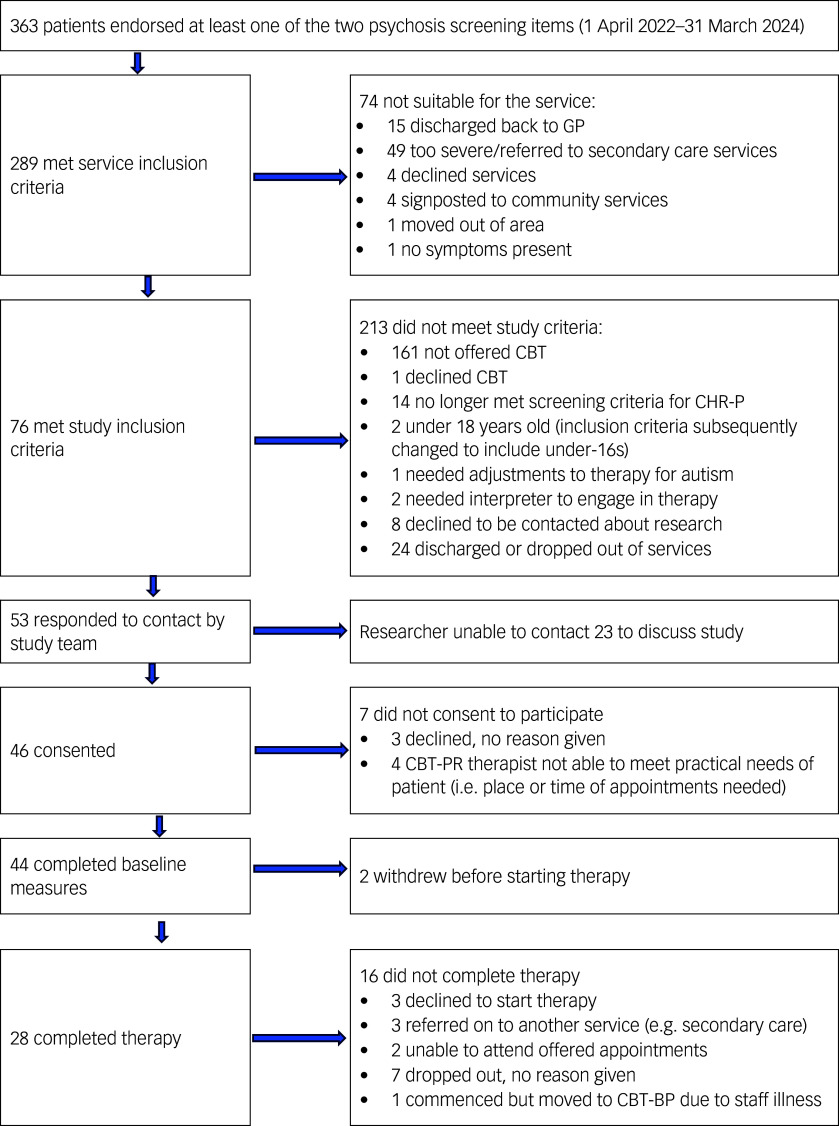 Figure 1
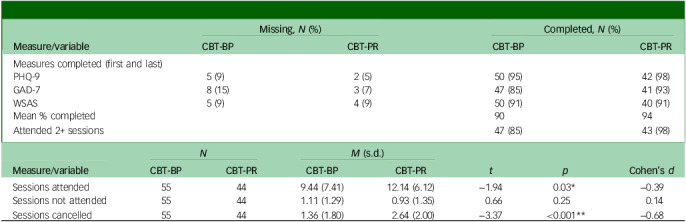 Figure 2
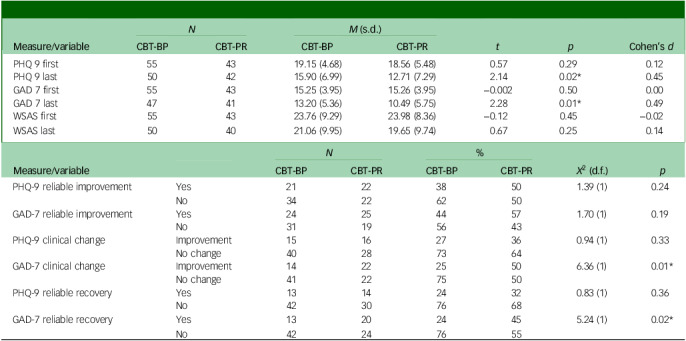 Figure 3
 Figure 4
Peer Reviews
No public reviews on file for this paper yet. If you reviewed it on a platform where reviews are public (OpenReview, ICLR, NeurIPS, ICML), you can paste yours below so the community can read it here.
Videos
No videos yet. Explain this paper in a talk, walkthrough, or lecture? Add one.
Taxonomy
TopicsSchizophrenia research and treatment · Mental Health Treatment and Access · Mental Health and Psychiatry