Posterior Reversible Encephalopathy Syndrome as a Complication of Essential Thrombocythemia: A Case Report and Literature Review
Raul Hernandez-Iglesias, Pablo Arroyo-Pereiro, Alejandro Caravaca, Carla Marco, Maria Bea-Sintes, Alicia Senin, Jasson Andres Villareal-Hernandez, Monica Cos-Domingo, Antonio Martinez-Yelamos, Sergio Martinez-Yelamos, Albert Muñoz-Vendrell

TL;DR
A man with essential thrombocythemia developed a brain condition called PRES, which improved after treatment, showing that high platelet counts can cause neurological issues even without high blood pressure.
Contribution
This case report highlights that essential thrombocythemia can cause PRES even with normal blood pressure, emphasizing the need for platelet monitoring.
Findings
A 47-year-old male with CALR-mutated essential thrombocythemia developed PRES symptoms including headache, drowsiness, nausea, and blindness.
MRI showed bilateral parieto-occipital FLAIR hyperintensities consistent with PRES, which nearly resolved after treatment.
Symptoms improved with hydroxyurea treatment and platelet reduction, with only mild visual disturbances persisting after four months.
Abstract
Posterior reversible encephalopathy syndrome (PRES) is a well-defined clinicoradiological syndrome that can arise in various clinical settings, most commonly in association with hypertensive states. However, less typical causes, including hematologic disorders, have also been reported. A 47-year-old male with CALR-mutated essential thrombocythemia (ET) on chronic aspirin therapy developed progressive headache, drowsiness, nausea, and blindness. Workup revealed worsening thrombocytosis (1,250 × 10⁹/L) with unremarkable blood pressure, craniocervical AngioTac, and systemic assessment. PRES secondary to ET exacerbation was suspected. Hydroxyurea was initiated, leading to platelet reduction and symptom improvement. Brain MRI showed bilateral parieto-occipital Fluid-Attenuated Inversion Recovery (FLAIR) hyperintensities. At four months, only mild visual disturbances persisted, with…
Genes, proteins, chemicals, diseases, species, mutations and cell lines named across the full text — each resolved to its canonical identifier and authoritative record.
Click any figure to enlarge with its caption.
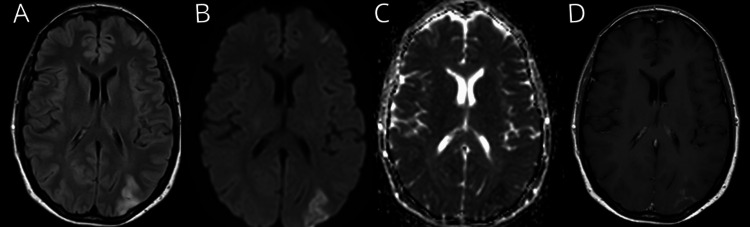 Figure 1
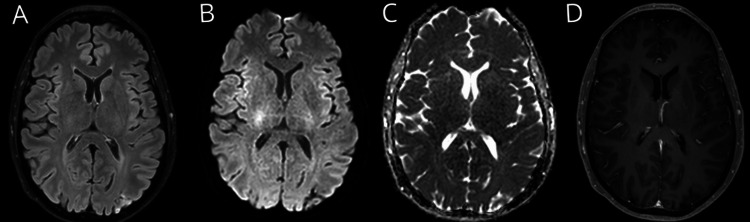 Figure 2
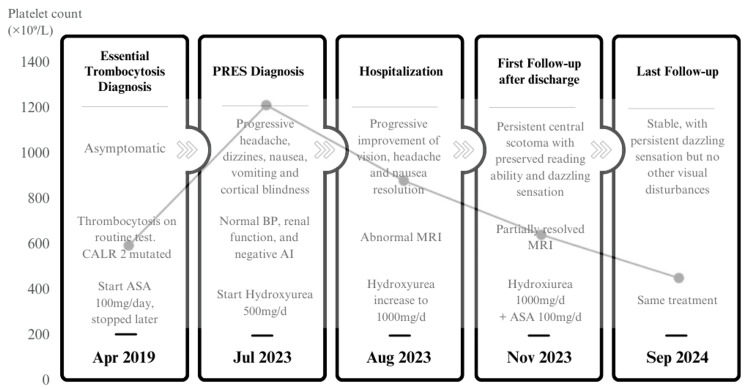 Figure 3
Peer Reviews
No public reviews on file for this paper yet. If you reviewed it on a platform where reviews are public (OpenReview, ICLR, NeurIPS, ICML), you can paste yours below so the community can read it here.
Videos
No videos yet. Explain this paper in a talk, walkthrough, or lecture? Add one.
Taxonomy
TopicsNeurological Complications and Syndromes · Moyamoya disease diagnosis and treatment · Pregnancy and preeclampsia studies