Psychosocial factors associated with the trajectories of interparental conflict for Australian fathers of autistic children: A longitudinal study across 10 years of child development
Monique Seymour, Grace McMahon, Ali Fogarty, Bridget O’Connor, Mark Feinberg, Rob Hock, Rebecca Giallo

TL;DR
This study explores how fathers of autistic children experience partner conflict over 10 years and identifies factors linked to different levels of conflict.
Contribution
The study identifies distinct patterns of interparental conflict and their psychosocial predictors in fathers of autistic children.
Findings
Fathers of autistic children reported higher interparental conflict at multiple ages compared to fathers of non-autistic children.
Three distinct IPC trajectories were identified: low and stable, moderate and stable, and persistently elevated.
Factors like co-parenting support and father age predicted different IPC patterns among fathers of autistic children.
Abstract
Limited research exists on fathers’ experiences of interparental conflict (IPC) in families with autistic children. We aimed to identify: (1) the extent to which these fathers report IPC across 10 years of child development (4–14 years) and how this compares to fathers of non-autistic children; (2) distinct trajectories of IPC for fathers of autistic children and (3) factors associated with trajectories of IPC among fathers of autistic children. This is a retrospective study using a national dataset. Participants were 281 fathers of autistic children and 7046 fathers of non-autistic children. Although small effect sizes, fathers of autistic children, on average, reported significantly higher IPC when their child was 4–5, 6–7, 8–9 and 10–12 years of age, compared to fathers of non-autistic children. For fathers of autistic children, longitudinal latent class analysis revealed three…
Genes, proteins, chemicals, diseases, species, mutations and cell lines named across the full text — each resolved to its canonical identifier and authoritative record.
Click any figure to enlarge with its caption.
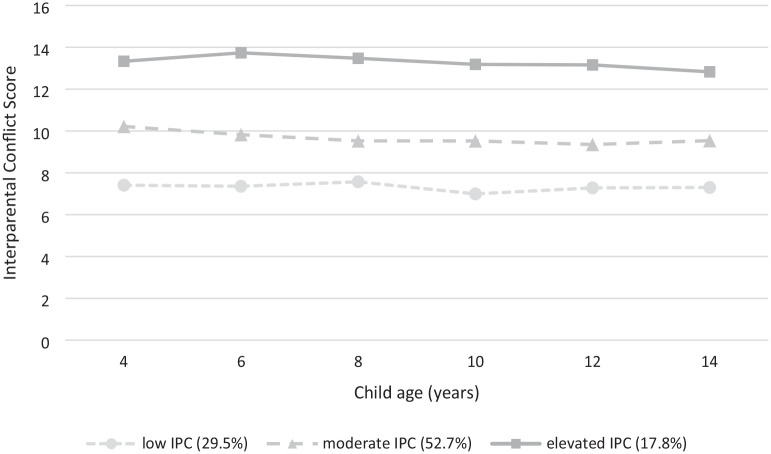 Figure 1
 Figure 2
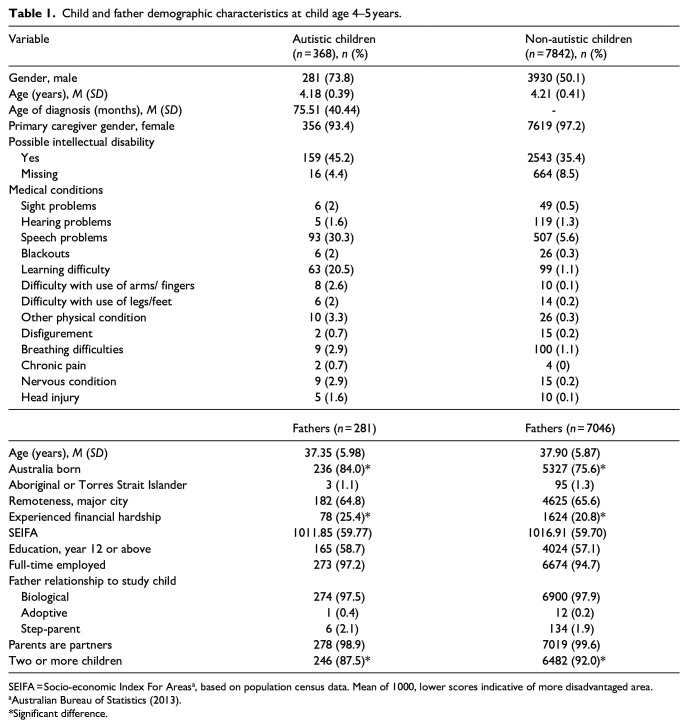 Figure 3
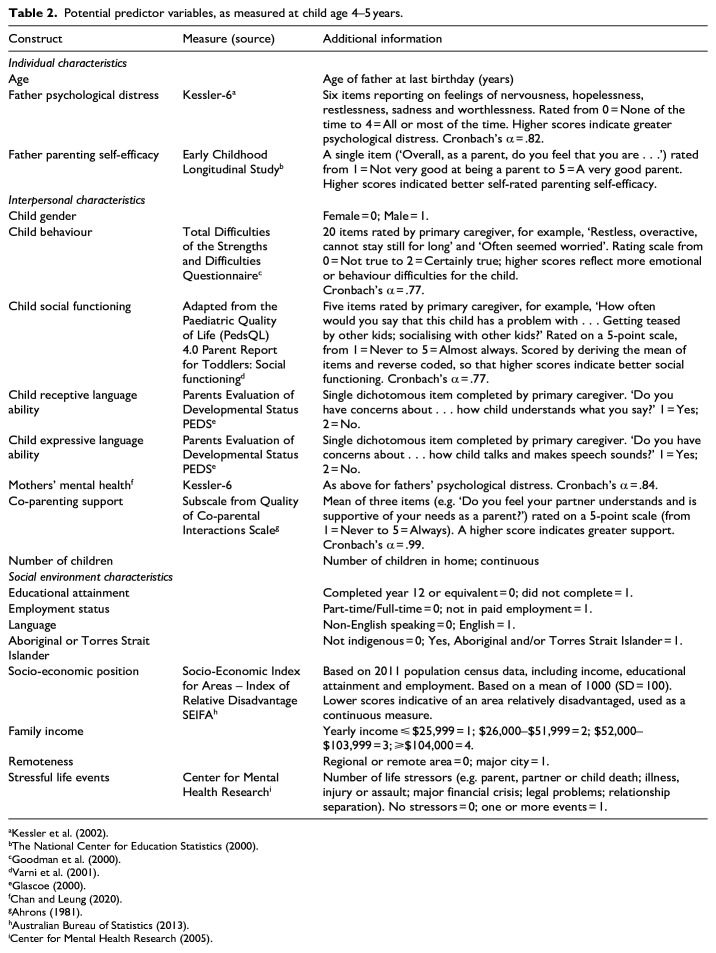 Figure 4
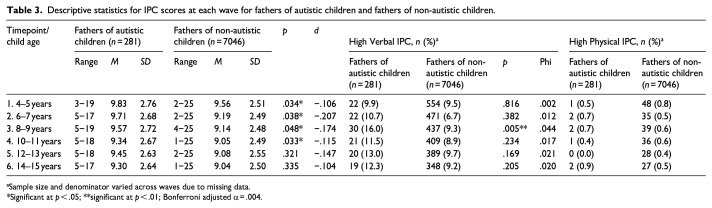 Figure 5
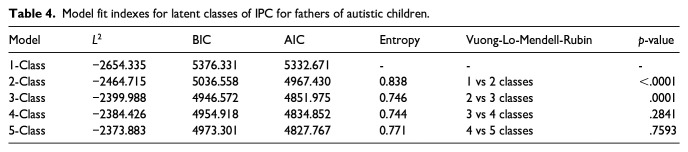 Figure 6
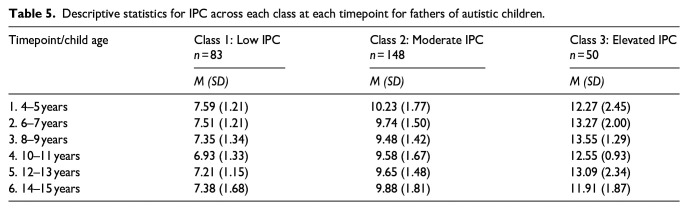 Figure 7
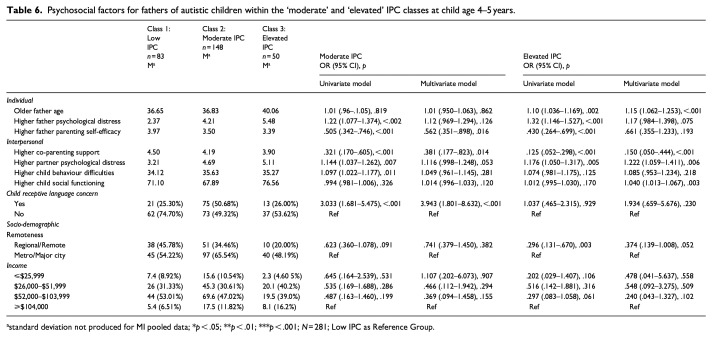 Figure 8
Peer Reviews
No public reviews on file for this paper yet. If you reviewed it on a platform where reviews are public (OpenReview, ICLR, NeurIPS, ICML), you can paste yours below so the community can read it here.
Videos
No videos yet. Explain this paper in a talk, walkthrough, or lecture? Add one.
Taxonomy
TopicsFamily and Disability Support Research · Assisted Reproductive Technology and Twin Pregnancy · Child Welfare and Adoption