Brain structural correlates of an impending initial major depressive episode
Anna Kraus, Katharina Dohm, Tiana Borgers, Janik Goltermann, Dominik Grotegerd, Alexandra Winter, Katharina Thiel, Kira Flinkenflügel, Navid Schürmeyer, Tim Hahn, Simon Langer, Tilo Kircher, Igor Nenadić, Benjamin Straube, Hamidreza Jamalabadi, Nina Alexander, Andreas Jansen

TL;DR
This study identifies brain structure changes in people who later develop depression, suggesting potential early markers for predicting and preventing the disorder.
Contribution
The study identifies pre-existing brain structural correlates specific to individuals who later develop their first major depressive episode.
Findings
Converters had higher amygdala gray matter volume compared to both healthy controls and MDD patients.
Lower gray matter volume in the dorsolateral prefrontal cortex and insula was specific to patients with acute MDD.
Findings suggest a temporary neurobiological vulnerability that could aid in predicting and preventing depression.
Abstract
Neuroimaging research has yet to elucidate whether reported gray matter volume (GMV) alterations in major depressive disorder (MDD) exist already before the onset of the first episode. Recruitment of presently healthy individuals with a subsequent transition to MDD (converters) is extremely challenging but crucial to gain insights into neurobiological vulnerability. Hence, we compared converters to patients with MDD and sustained healthy controls (HC) to distinguish pre-existing neurobiological markers from those emerging later in the course of depression. Combining two clinical cohorts (n = 1709), voxel-based morphometry was utilized to analyze GMV of n = 45 converters, n = 748 patients with MDD, and n = 916 HC in a region-of-interest approach and exploratory whole-brain. By contrasting the subgroups and considering both remission state and reported recurrence at a 2-year clinical…
Genes, proteins, chemicals, diseases, species, mutations and cell lines named across the full text — each resolved to its canonical identifier and authoritative record.
Click any figure to enlarge with its caption.
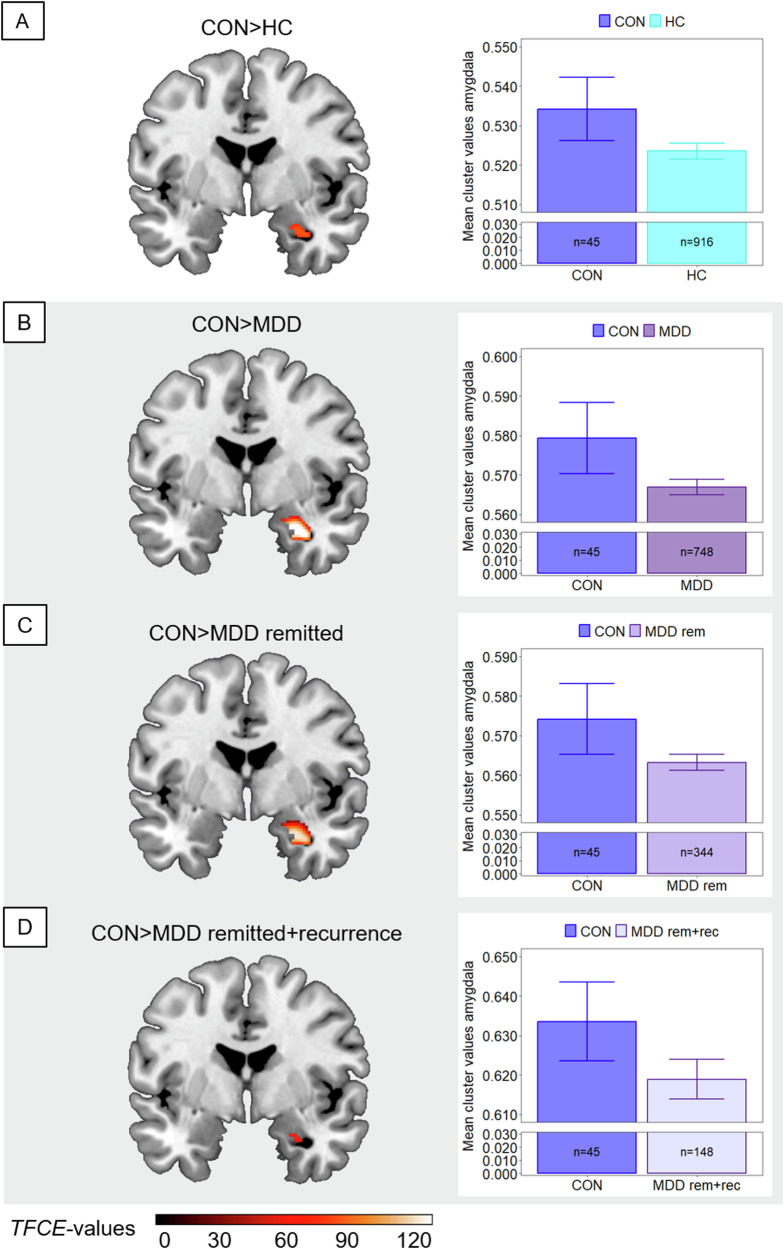 Figure 1
Peer Reviews
No public reviews on file for this paper yet. If you reviewed it on a platform where reviews are public (OpenReview, ICLR, NeurIPS, ICML), you can paste yours below so the community can read it here.
Videos
No videos yet. Explain this paper in a talk, walkthrough, or lecture? Add one.
Taxonomy
TopicsFunctional Brain Connectivity Studies · Treatment of Major Depression · Mental Health Research Topics