Does contrast echocardiography induce increases in markers of myocardial necrosis, inflammation and oxidative stress suggesting myocardial injury?
Fabian Knebel, Ingolf Schimke, Stephan Eddicks, Torsten Walde, Reinhard Ziebig, Sebastian Schattke, Gert Baumann, Adrian Constantin Borges

TL;DR
This study investigates whether contrast echocardiography causes signs of heart muscle injury in humans by measuring specific blood markers before and after the procedure.
Contribution
The study provides new evidence on the safety of contrast echocardiography in humans by analyzing multiple biomarkers of myocardial injury.
Findings
No clinically significant increases in markers of myocardial necrosis, inflammation, or oxidative stress were observed after contrast echocardiography.
Approximately 50% of patients showed cTnI increases exceeding the critical difference threshold, but this was not predicted by baseline cytokine or oxidative stress levels.
Baseline cTnI levels were elevated in 50% of patients, and these patients had higher TNF-α and IL-6 levels.
Abstract
Contrast echocardiography is a precise tool for the non-invasive assessment of myocardial function and perfusion. Side effects of contrast echocardiography resulting from contrast-agent induced myocardial micro-lesions have been found in animals. The goal of this study is to measure markers of myocardial necrosis, inflammation and oxidative stress in humans to evaluate potential side-effects of contrast echocardiography. 20 patients who underwent contrast echocardiography with Optison as the contrast medium were investigated. To evaluate myocardial micro-necrosis, inflammation and oxidative stress, cardiac troponin I (cTnI), tumor necrosis factor-α (TNF-α), interleukin (IL)-6, -8 and thiobarbituric acid reactive substances (TBARS) were measured at baseline and at 2, 4, 8 and 24 hours after contrast echocardiography. At baseline, 50% of the patients had cTnI and TBARS values outside…
Genes, proteins, chemicals, diseases, species, mutations and cell lines named across the full text — each resolved to its canonical identifier and authoritative record.
Click any figure to enlarge with its caption.
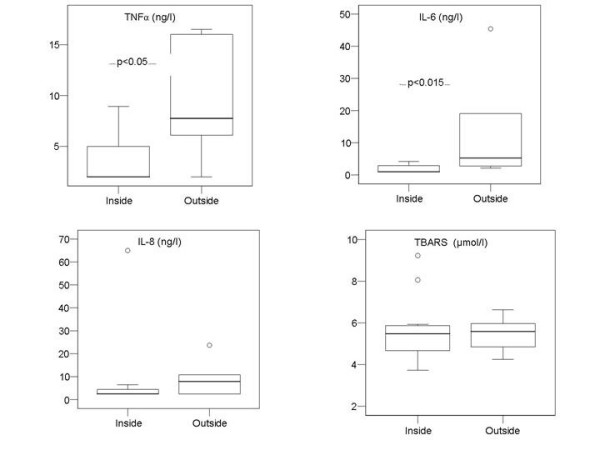 Figure 1
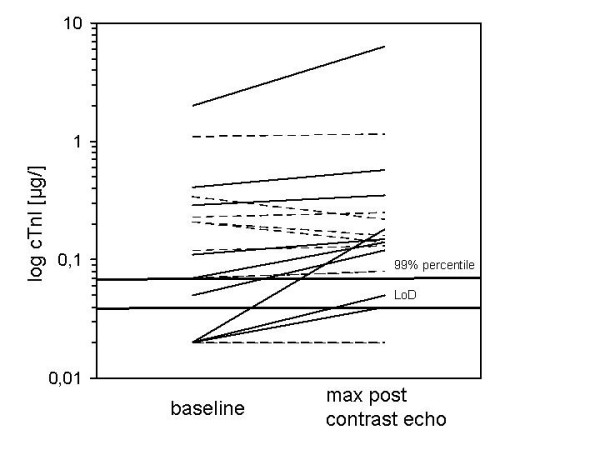 Figure 2
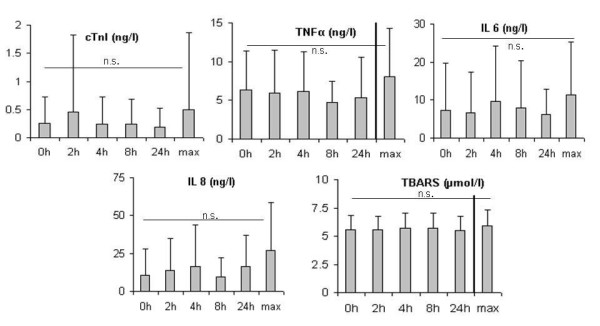 Figure 3
Peer Reviews
No public reviews on file for this paper yet. If you reviewed it on a platform where reviews are public (OpenReview, ICLR, NeurIPS, ICML), you can paste yours below so the community can read it here.
Videos
No videos yet. Explain this paper in a talk, walkthrough, or lecture? Add one.
Taxonomy
TopicsSpanish Literature and Culture Studies · History of Education in Spain · Spanish Culture and Identity