The Phase‐Amplitude Coupling Changes Induced by Smoking Cue After 12‐H Abstinence in Young Smokers
Zhiwei Ren, Juan Wang, Yongxin Cheng, Yuxin Ma, Youwei Dong, Yiming Lu, Ting Xue, Gengdi Huang, Dahua Yu, Fang Dong, Kai Yuan

TL;DR
This study shows how brain activity changes in young smokers when exposed to smoking cues after 12 hours of not smoking, linking these changes to cravings.
Contribution
The study is the first to show PAC abnormalities in young smokers under short-term abstinence linked to craving and inhibitory control.
Findings
Smoking-related cues reduced PAC and connectivity in the right prefrontal cortex.
Parietal cortex showed increased PAC and enhanced connectivity with smoking cues.
PAC values were significantly correlated with craving levels in young smokers.
Abstract
Tobacco use causes more than 8 million deaths globally each year, and the number of younger smokers is growing. It is of great practical importance to explore the underlying neural mechanisms behind the behaviour of young smokers. During cue‐induced craving, reward system in the brain generates neural oscillations at specific frequencies. The phase–amplitude coupling (PAC) can capture interactions between these frequencies and may be a more sensitive quantitative indicator for characterizing abnormal neural oscillations in smokers. We monitored the electroencephalography (EEG) data of 30 young smokers during a cue task after 12 h of abstinence, dividing the data into the neutral and smoking‐related groups based on different experimental stimuli to analyse the relationship between PAC and craving. In addition, we computed the functional connectivity (FC) under the PAC mechanism. The…
Genes, proteins, chemicals, diseases, species, mutations and cell lines named across the full text — each resolved to its canonical identifier and authoritative record.
Click any figure to enlarge with its caption.
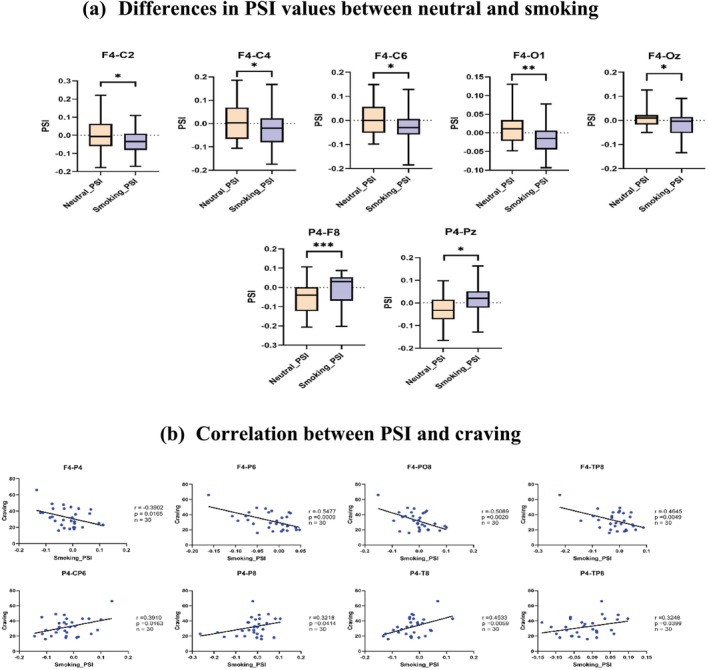 Figure 1
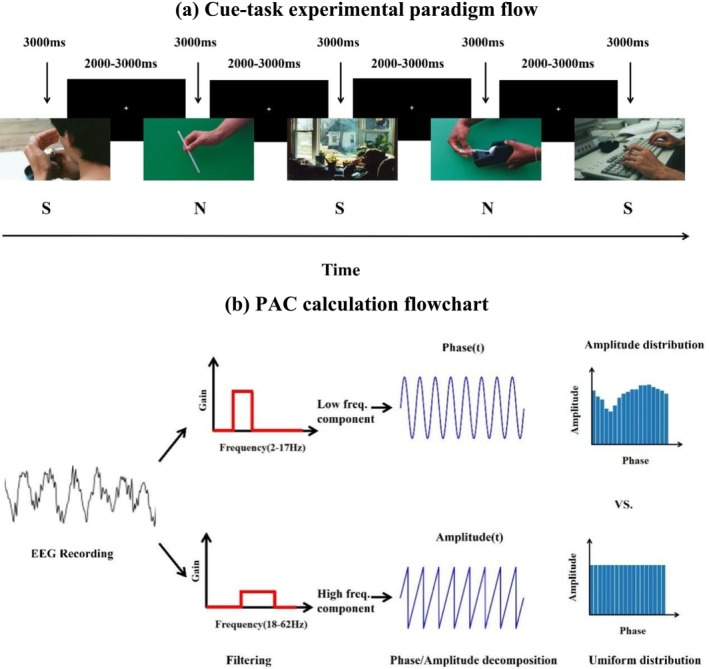 Figure 2
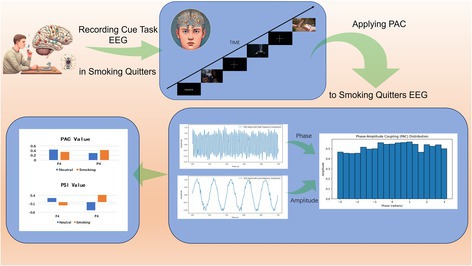 Figure 3
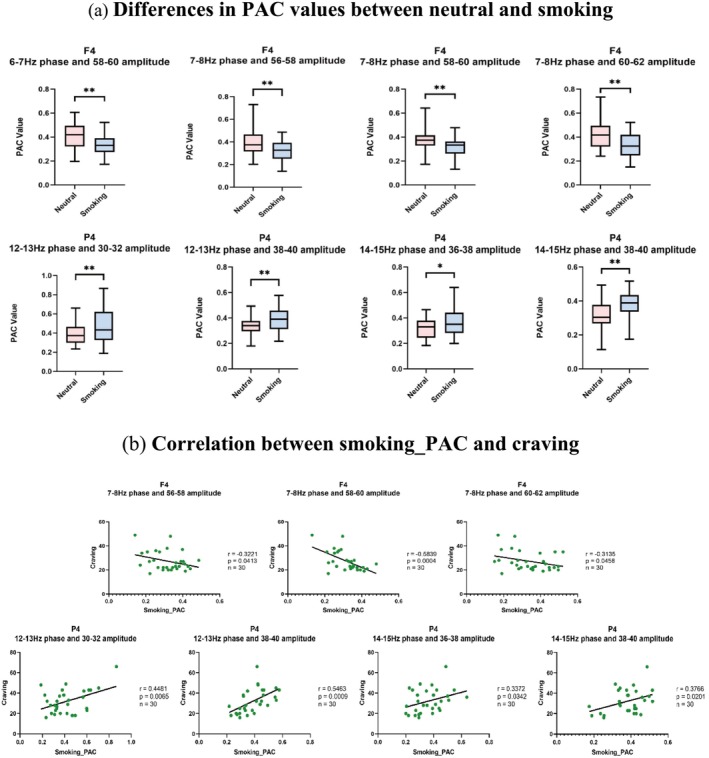 Figure 4
Peer Reviews
No public reviews on file for this paper yet. If you reviewed it on a platform where reviews are public (OpenReview, ICLR, NeurIPS, ICML), you can paste yours below so the community can read it here.
Videos
No videos yet. Explain this paper in a talk, walkthrough, or lecture? Add one.
Taxonomy
TopicsNeural dynamics and brain function · Nicotinic Acetylcholine Receptors Study · Functional Brain Connectivity Studies