Non-diabetic Ketoacidosis in a Patient With Amyotrophic Lateral Sclerosis: The Role of Stewart’s Approach in Analyzing Acid-Base Disorders
Frédéric Franconieri, Sophie Fayolle, Prescillia Raviol

TL;DR
A rare case of non-diabetic ketoacidosis in an ALS patient is analyzed using Stewart's acid-base model, showing the importance of nutritional assessment in such patients.
Contribution
This is the first reported case of non-diabetic ketoacidosis in a patient with ALS, highlighting a novel metabolic complication.
Findings
Stewart’s physicochemical approach identified acidosis due to unmeasured fixed acids (ketone bodies) in an ALS patient.
Discontinuation of bicarbonate therapy and initiation of glucose hydration led to rapid clinical improvement.
The case emphasizes the diagnostic value of Stewart’s model in complex acid-base disorders.
Abstract
Amyotrophic lateral sclerosis (ALS) is often complicated by severe malnutrition, increasing the risk of metabolic disturbances. Non-diabetic ketoacidosis (NDKA) is a rare but serious complication, typically related to prolonged fasting or catabolic states. A 62-year-old female patient with ALS and hypothyroidism presented with pneumonia and tetraplegia. Her body mass index (BMI) was 17 kg/m². Laboratory findings showed a high anion gap (AG) metabolic acidosis (pH 7.23, bicarbonate 13 mmol/L, partial pressure of carbon dioxide (pCO₂) 28 mmHg) without hyperlactatemia, but with significant ketonemia (5 mmol/L), severe hypophosphatemia, and signs of systemic inflammation. Upon admission, she received an intravenous infusion of 4.2% sodium bicarbonate. The simplified strong ion difference (SID) was preserved, excluding dilutional or hyperchloremic causes. Stewart’s physicochemical approach,…
Genes, proteins, chemicals, diseases, species, mutations and cell lines named across the full text — each resolved to its canonical identifier and authoritative record.
Click any figure to enlarge with its caption.
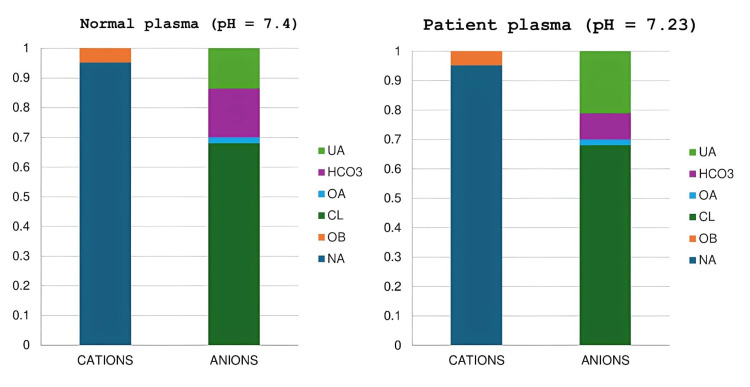 Figure 1
Peer Reviews
No public reviews on file for this paper yet. If you reviewed it on a platform where reviews are public (OpenReview, ICLR, NeurIPS, ICML), you can paste yours below so the community can read it here.
Videos
No videos yet. Explain this paper in a talk, walkthrough, or lecture? Add one.
Taxonomy
TopicsRenal function and acid-base balance · Diet and metabolism studies · Metabolism and Genetic Disorders