Putting the Social in Emotions: The Effect of Audience Presence on Pride and Embarrassment Across Ontogeny
Christopher Riddell, Milica Nikolić, Mariska E. Kret

TL;DR
This study explores how the presence of others affects children and adults' expressions of pride and embarrassment as they grow up.
Contribution
The study reveals new insights into how audience presence influences self-conscious emotions across different ages.
Findings
Participants showed more embarrassment and blushing when others were present.
Pride expressions varied by age, with adults showing the most nonverbal pride.
Emotional regulation is shaped by social contexts during development.
Abstract
We care about others’ opinions of us and regulate our emotions to make positive impressions. This form of impression management may change during ontogeny as children become increasingly sensitive to others. To examine whether self‐conscious emotions are influenced by audience presence across the lifespan, we induced embarrassment and pride in n = 71 3.5–5‐year‐old children, n = 71 8–10‐year‐old children, and n = 73 adults, either in the presence of an audience or alone. We measured nonverbal expressions of emotion, physiological arousal, and self‐reported emotional experiences. All participants reported more embarrassment and blushed more while watching their singing performance in the presence of others. However, participants’ pride was not contingent on audience presence and differed across age, with adults showing the most nonverbal expressions of pride. These results elucidate how…
Genes, proteins, chemicals, diseases, species, mutations and cell lines named across the full text — each resolved to its canonical identifier and authoritative record.
Click any figure to enlarge with its caption.
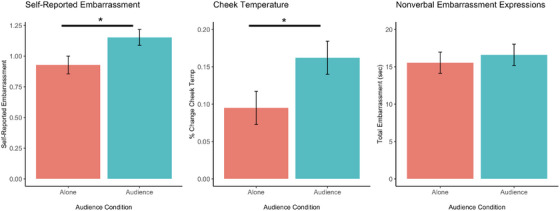 Figure 1
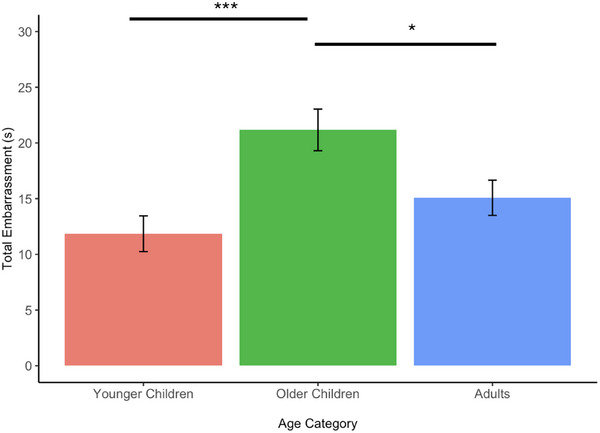 Figure 2
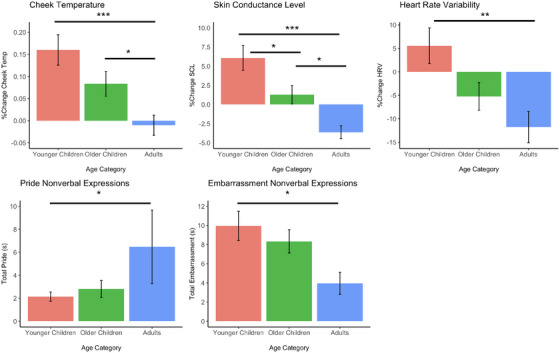 Figure 3
Peer Reviews
No public reviews on file for this paper yet. If you reviewed it on a platform where reviews are public (OpenReview, ICLR, NeurIPS, ICML), you can paste yours below so the community can read it here.
Videos
No videos yet. Explain this paper in a talk, walkthrough, or lecture? Add one.
Taxonomy
TopicsEmotions and Moral Behavior · Face Recognition and Perception · Child and Animal Learning Development