Quantitative assessment of bladder tissue properties using magnetic resonance fingerprinting: a pilot feasibility study in healthy volunteers
Eduardo Thadeu de Oliveira Correia, Jad Badreddine, Rasim Boyacioglu, Madison E. Kretzler, Mark A. Griswold, David Sheyn, Chris A. Flask, Yong Chen, Adonis Hijaz, Leonardo Kayat Bittencourt

TL;DR
This study shows that magnetic resonance fingerprinting can measure bladder tissue properties in healthy volunteers, with changes observed before and after urination.
Contribution
The study demonstrates the feasibility of using MRF to quantify bladder wall T1 and T2 relaxation times in healthy individuals.
Findings
T1 relaxation times decreased by 6% after voiding compared to before (p = 0.035).
Mean T1 relaxation times were 1,575 ms pre-void and 1,476 ms post-void.
T2 relaxation times showed minimal change, with values of 55 ms pre-void and 53 ms post-void.
Abstract
To investigate the feasibility of performing magnetic resonance fingerprinting (MRF) of the bladder and quantify the T1 and T2 relaxation times of the bladder wall in healthy female volunteers, before and after voiding. Volunteers without lower urinary tract symptoms underwent pelvic MRF. Five axial MRF slices of the bladder were obtained before and after voiding. Regions of interest were annotated on MRF T1 maps: one on the anterior bladder wall, and one on a lateral wall. Annotations made on T1 maps were subsequently copied to coregistered T2 maps. Student’s t-tests for paired samples were employed to compare the T1 and T2 values obtained before voiding with those obtained after voiding. Eight volunteers were included. The mean preand post-void T1 relaxation times were 1,575 ± 93 ms and 1,476 ± 138 ms, respectively. The mean preand post-void T2 relaxation times were 55 ± 21 ms and…
Genes, proteins, chemicals, diseases, species, mutations and cell lines named across the full text — each resolved to its canonical identifier and authoritative record.
Click any figure to enlarge with its caption.
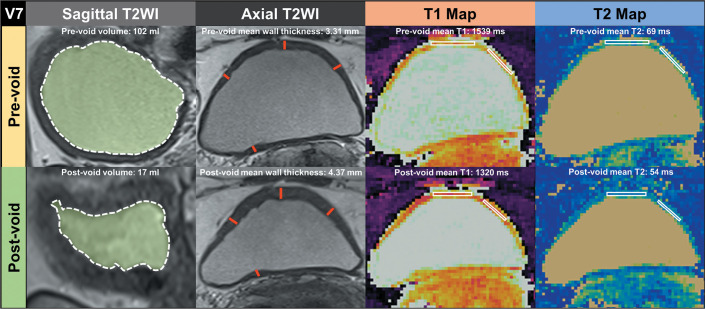 Figure 1
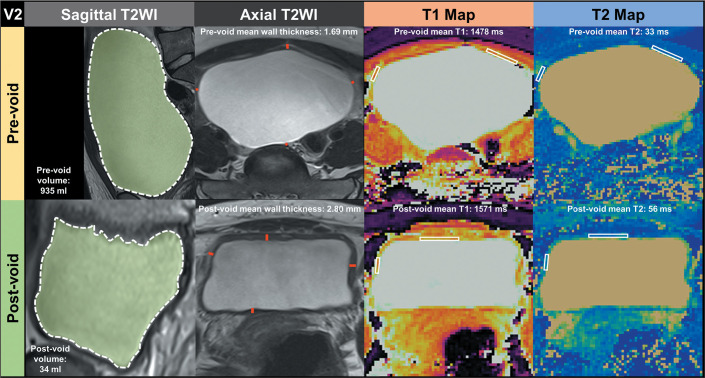 Figure 2
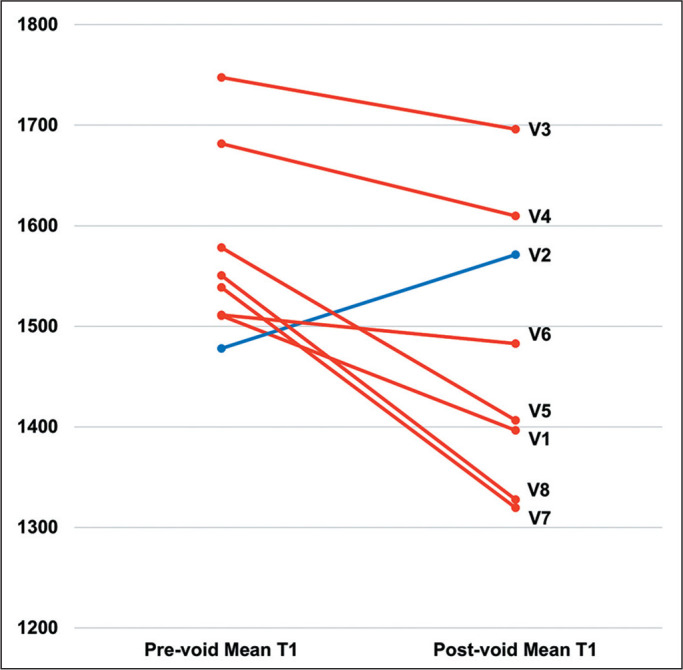 Figure 3
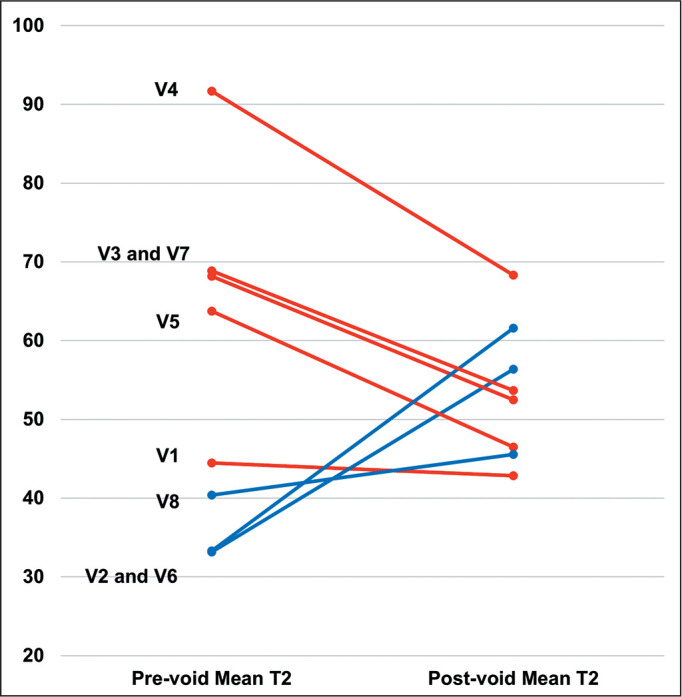 Figure 4
Peer Reviews
No public reviews on file for this paper yet. If you reviewed it on a platform where reviews are public (OpenReview, ICLR, NeurIPS, ICML), you can paste yours below so the community can read it here.
Videos
No videos yet. Explain this paper in a talk, walkthrough, or lecture? Add one.
Taxonomy
TopicsAdvanced MRI Techniques and Applications · MRI in cancer diagnosis · Urinary Bladder and Prostate Research