What Is Evidence‐Based Pharmacy?
Jennifer Maria Alexa, Katja Suter‐Zimmermann, Thilo Bertsche, Samuel S. Allemann

Abstract
Genes, proteins, chemicals, diseases, species, mutations and cell lines named across the full text — each resolved to its canonical identifier and authoritative record.
Click any figure to enlarge with its caption.
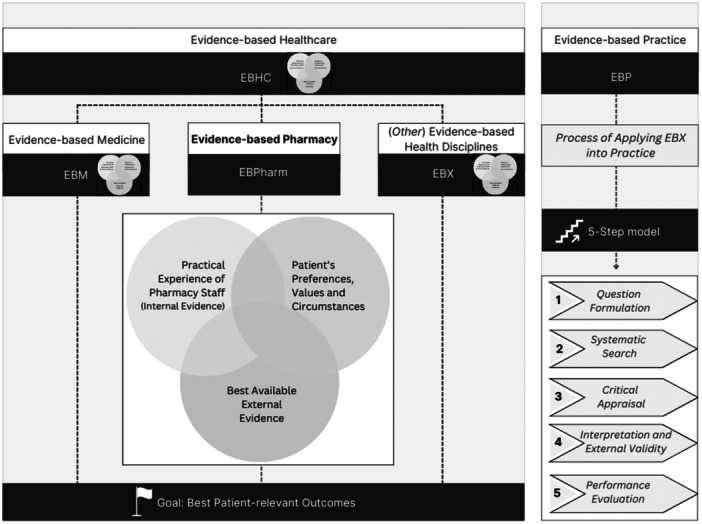 Figure 1
Peer Reviews
No public reviews on file for this paper yet. If you reviewed it on a platform where reviews are public (OpenReview, ICLR, NeurIPS, ICML), you can paste yours below so the community can read it here.
Videos
No videos yet. Explain this paper in a talk, walkthrough, or lecture? Add one.
Taxonomy
TopicsHealth Sciences Research and Education · Meta-analysis and systematic reviews · Pharmaceutical Practices and Patient Outcomes
Evidence‐based pharmacy (EBPharm) appears to be a vague term. This term has been used interchangeably and with overlapping meanings [1, 2, 3, 4, 5, 6, 7, 8, 9, 10, 11, 12, 13]. Furthermore, it remains underrepresented in the literature and seems to be mostly unknown [14, 15]. EBPharm has a great potential to contribute to an individualized, safe and effective pharmaceutical care and consequently to a reduced burden on healthcare systems. However, a successful implementation of EBPharm into practice requires a clear understanding of what it embodies. To date, a widely accepted definition of EBPharm is lacking. The purpose of this commentary is to propose a definition for EBPharm in alignment with existing terminology.
The Roots of Evidence‐Based Pharmacy and a Varying Terminology
1
EBPharm emerged in recent years based on evidence‐based medicine (EBM). The most commonly used definition of EBM was coined in 1996 by D.L. Sackett and his colleagues [16]. They defined EBM as the ‘conscientious, explicit, and judicious use of current best evidence in making decisions about the care of individual patients.’ Within the same editorial the authors also stated that ‘integrating individual clinical expertise’ and the ‘patient's choice’ [16] are of great importance in EBM. Furthermore, according to Sackett et al. ‘good doctors use both individual clinical expertise and the best available external evidence,’ because ‘neither alone is enough [16].’
Despite the frequent use of this definition, some confusion and disagreement still seem to exist.
Many authors cited only the first part of the definition when referring to EBM. Therefore, EBM was mistakenly accused of neglecting health professionals' practical experiences and of being too focused on clinical data [17, 18]. However, it is well‐established that EBM integrates the following three factors equally: 1) external evidence as well as 2) a patient's preferences and 3) a healthcare professional's practical experience. This constitutes the core of EBM and other evidence‐based health disciplines. One could argue that the most commonly used sentence of the definition indirectly implies the consideration of all three factors. Misunderstandings may, nonetheless, be due to the fact, that Sackett et al. did not clearly mention all three key factors of EBM within their most prominent line of the editorial and subheading.
Overlap and Distinction Between Commonly Used Terms
2
Another cause for uncertainty and confusion is the ambiguous use of the term evidence‐based practice (EBP). Some authors utilize EBP and EBM synonymously. Sackett et al. stated that ‘the practice of evidence‐based medicine’ requires ‘integrating individual clinical expertise with the best available external clinical evidence from systematic research’ [16].
Based on the Sicily statement on evidence‐based practice [19], however, EBP refers to the process of considering the three key factors in practice. EBP comprises 5 main steps, which are also often labelled as the 5‐step‐model [20]. The five main steps include: 1) The formulation of a precise clinical question, 2) a systematic search for the best available external evidence, 3) critical appraisal of the identified external evidence concerning internal and external validity, 4) transfer of results into practice in alignment with the patient's preferences and the healthcare professional's practical experience, and lastly 5) a performance evaluation concerning the effectiveness and safety of the intervention, if the patient revisits [19, 20]. These steps apply to all health disciplines. EBP is, therefore, independent of a health discipline. In contrast to EBP, the term evidence‐based pharmacy practice as used by C. Chant and H.Z. Toklu [8, 11] relates to EBP in the context of pharmacy.
The frequently cited definition of EBM by Sackett et al. originated in the medical context. As a result, different evidence‐based health disciplines, such as evidence‐based nursing or evidence‐based physiotherapy, were defined and established in recent years [21, 22]. This is due to the fact that each health profession's role in healthcare is substantially different based on the legal framework and scope of practice.
Despite profession‐related differences, evidence‐based health disciplines also share common grounds and often a multiprofessional collaboration. All evidence‐based health disciplines are united through the umbrella‐term evidence‐based healthcare (EBHC) [23, 24].
EBHC can be used to describe the concept of healthcare, that involves the consideration of the healthcare workforces' clinical expertise, the preferences and values of a patient (group) as well the best available external evidence when striving for best patient‐relevant outcomes. The term EBHC is, however, again used inconsistently and with overlapping meanings.
In general, EBHC aims to foster multiprofessional collaboration across all evidence‐based health disciplines. In this context, however, the need for a novel term evolved and manifested itself among evidence‐based healthcare‐oriented associations such as the “Deutsches Netzwerk Evidenzbasierte Medizin e.V.” [25] The term and abbreviation EBX is used to refer to any evidence‐based health discipline within all established evidence‐based health disciplines. The X stands for any unspecified health discipline. Box 1.
Box 1The definition of evidence‐based pharmacy.1We suggest to define evidence‐based pharmacy (EBPharm) as a three‐factor‐based individualized concept that aims to achieve best patient‐relevant outcomes when counseling and making clinical decisions in the context of pharmacy. Evidence‐based pharmacy requires pharmacy staff to consider the following three factors:
- 1.the patient's preferences, values and circumstances;
- 2.their own practical experience (internal evidence) as well as;
- 3.the best available external evidence.
Figure 1 illustrates what evidence‐based pharmacy embodies as well as frequently used terms in relation to evidence‐based pharmacy.
Graphical display of evidence‐based pharmacy and associated terms.
The best available external evidence in this case refers to relevant data from clinical research that has been identified through a systematic search of available resources and is ideally of high internal validity as well as prone to a low risk of bias [26, 27]. Internal evidence, in contrast, describes each pharmacy staff's practical work experience, which accumulates over time and is shaped by feedback‐based interactions with patients for instance, own experiences with pharmaceutical interventions, and versatile expertise about pharmacology, medicine management, drug formulation or preparation for example. The best patient relevant outcome in this case refers to an outcome that is in alignment with the patient's preferences, values and circumstances. This requires an active involvement of the patient in the decision‐making process. EBPharm, therefore, also promotes shared decision‐making (SDM) between the pharmacist and the patient.
Finally, it is important to highlight that EBPharm is very dynamic and patient‐centered and does not at all mean to simply follow “cookbook” recommendations.
Implementing Evidence‐Based Pharmacy—The Next Steps
3
Continuous efforts are necessary to raise the awareness about EBPharm and EBHC. We recommend to use a consistent terminology related to EBPharm, EBHC, and EBP. A consistent terminology will ease the dissemination of pre‐existing knowledge and application of EBPharm into practice. This can ultimately contribute to achieving benefits on the patient‐level as well as for healthcare systems and research.
Moreover, this helps to avoid confusion and a loss of content. Existing research can, for instance, be adequately attributed to EBPharm and EBHC. Therefore, we also suggest to introduce EBPharm as a keyword and MESH‐term to help allocate pre‐existing research and to facilitate its accessibility. Previously published studies tended to focus on examining pharmaceutical staff's attitude towards evidence‐based medicine, barriers to evidence‐based medicine and evidence‐based practice, as well as the evaluation of evidence‐based medicine‐related educational interventions in the context of pharmacy [4, 28, 29, 30, 31].
By proposing a definition of EBPharm, we intend to contribute to a common understanding and to promote the consistent use of related terms. We ultimately hope to promote progress in the implementation of EBPharm into practice and pharmacy‐related research.
Conflicts of Interest
The authors declare no conflicts of interest.
5
The reference list from the paper itself. Each links out to its DOI / PubMed record.
- 1L. A. Hanna and C. M. Hughes , “Pharmacists' Attitudes Towards an Evidence‐Based Approach for Over‐The‐Counter Medication,” International Journal of Clinical Pharmacy 34, no. 1 (2012): 63–71, 10.1007/s 11096-011-9586-y.22108790 · doi ↗ · pubmed ↗
- 2K. Ngwerume , M. Watson , C. Bond , and A. Blenkinsopp , “An Evaluation of an Intervention Designed to Improve the Evidence‐Based Supply of Non‐Prescription Medicines From Community Pharmacies,” International Journal of Pharmacy Practice 23, no. 2 (2015): 102–110, 10.1111/ijpp.12118.24841328 · doi ↗ · pubmed ↗
- 3A. F. Ozaki , S. Nakagawa , and C. A. Jackevicius , “Cross‐Cultural Comparison of Pharmacy Students' Attitudes, Knowledge, Practice, and Barriers Regarding Evidence‐Based Medicine,” American Journal of Pharmaceutical Education 83, no. 5 (2019): 6710, 10.5688/ajpe 6710.31333249 PMC 6630851 · doi ↗ · pubmed ↗
- 4W. M. C. Bond , C. M. Grimshaw , J. M. Mollison , J. Ludbrook , and A. Walker , “AE. Educational Strategies to Promote Evidence‐Based Community Pharmacy Practice: A Cluster Randomized Controlled Trial (RCT),” Family Practice 19, no. 5 (2002): 529–536, 10.1093/fampra/19.5.529.12356708 · doi ↗ · pubmed ↗
- 5R. Abu Farha , E. Alefishat , M. Suyagh , E. Elayeh , and A. Mayyas , “Evidence‐Based Medicine Use in Pharmacy Practice: A Cross‐Sectional Survey,” Journal of Evaluation in Clinical Practice 20, no. 6 (2014): 786–792, 10.1111/jep.12212.25040154 · doi ↗ · pubmed ↗
- 6A. Margolis , S. Shah , C. Kraus , and D. W. Pigarelli , “Longitudinal Assessment of Pharmacy Students' Confidence and Skill in Providing Evidence‐Based Answers to Clinical Questions,” American Journal of Pharmaceutical Education 84, no. 10 (2020): ajpe 7884, 10.5688/ajpe 7884.33149326 PMC 7596605 · doi ↗ · pubmed ↗
- 7S. Al‐Jamei , R. Abu Farha , M. Zawiah , T. Kadi , and A. Al‐Sonidar , “Perceptions, Knowledge, and Perceived Barriers of Yemeni Pharmacists and Pharmacy Technicians Towards Evidence‐Based Practice,” Journal of Evaluation in Clinical Practice 25, no. 4 (2019): 585–590, 10.1111/jep.12988.30028072 · doi ↗ · pubmed ↗
- 8H. Z. Toklu , “Promoting Evidence‐Based Practice in Pharmacies,” Integrated Pharmacy Research & Practice 4 (2015): 127–131, 10.2147/IPRP.S 70406.29354526 PMC 5741015 · doi ↗ · pubmed ↗