The complete mitogenome of Theloderma albopunctatum (Liu & Hu 1962) (Anura: Rhacophoridae) from the Karst areas of southwestern China
Jiang Yang, Ming-Le Mao, Cui-Pao He, Qiu-Yuan Lu, Chen-Rui Yan, Ning Xiao, Jiang Zhou

TL;DR
This paper presents the full mitochondrial genome of Theloderma albopunctatum, a frog species from China, and uses it to explore evolutionary relationships within its family.
Contribution
The study provides the first complete mitogenome of Theloderma albopunctatum and contributes to Rhacophoridae phylogenetics.
Findings
The mitogenome is 15,780 bp long with typical mitochondrial gene content.
Phylogenetic analysis supports the division of Rhacophorinae and Buergeriinae subfamilies.
The mitogenome serves as a valuable resource for evolutionary studies in Rhacophoridae.
Abstract
This study reports and characterizes the complete mitogenome of Theloderma albopunctatum. The mitogenome was 15,780 bp in length and contained 13 protein-coding genes, 22 transfer RNA genes, and two ribosomal RNA genes, with 29.35% A, 25.17% T, 14.24% G, and 31.24% C. The original data were assembled and annotated, and the complete mitochondrial genome was mapped. The phylogenetic tree obtained in this study supports the division of the Rhacophorinae and Buergeriinae subfamilies. This mitogenome provides a valuable resource for understanding evolutionary relationships within the Rhacophoridae family.
Genes, proteins, chemicals, diseases, species, mutations and cell lines named across the full text — each resolved to its canonical identifier and authoritative record.
Click any figure to enlarge with its caption.
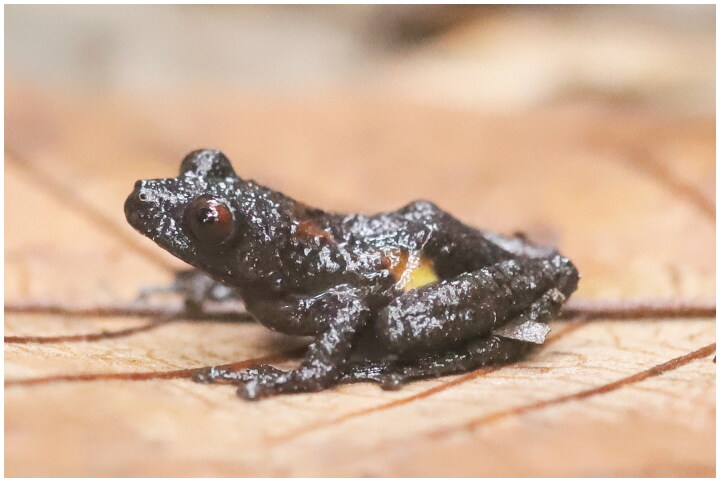 Figure 1
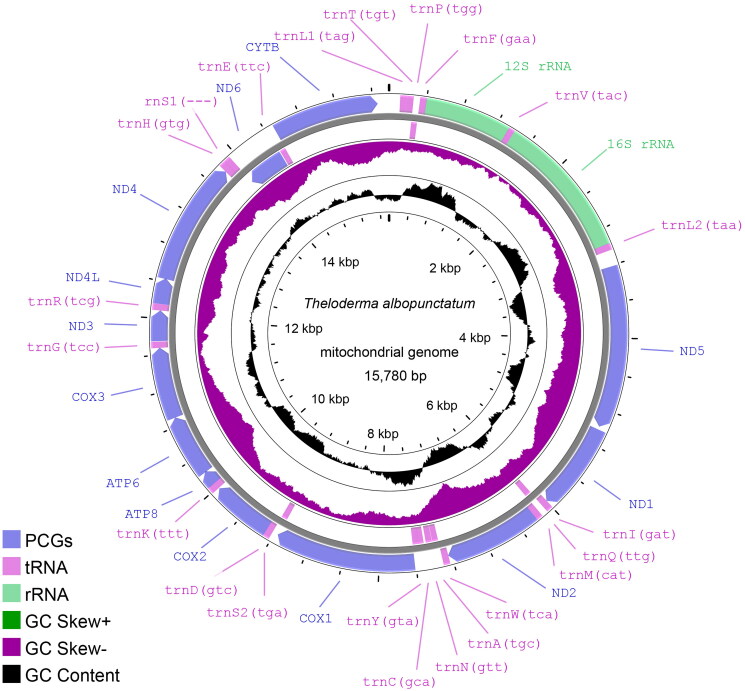 Figure 2
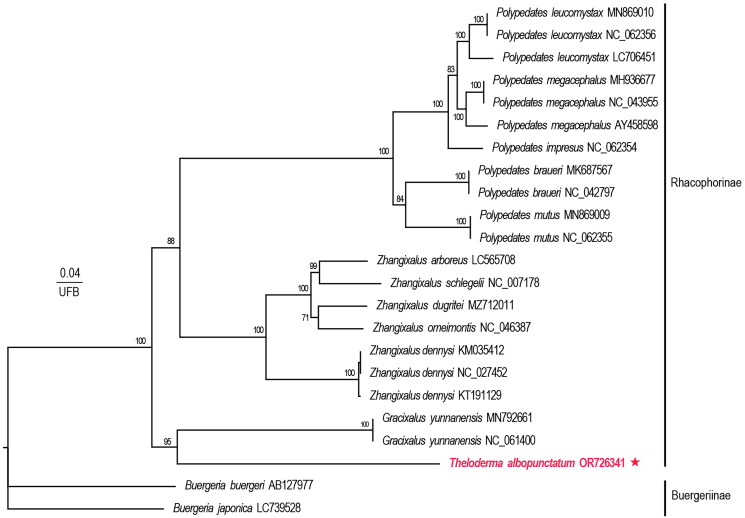 Figure 3
- —Endangerment Processes and Mechanisms of Endangered Flagship Animals
- —Diversity and Distribution Survey of Chiroptera species in China
Peer Reviews
No public reviews on file for this paper yet. If you reviewed it on a platform where reviews are public (OpenReview, ICLR, NeurIPS, ICML), you can paste yours below so the community can read it here.
Videos
No videos yet. Explain this paper in a talk, walkthrough, or lecture? Add one.
Taxonomy
TopicsAmphibian and Reptile Biology · Genomics and Phylogenetic Studies · Aquaculture disease management and microbiota
Introduction
The family Rhacophoridae is highly diverse and widely distributed across Asia (AmphibiaWeb 2024; Frost 2024). Species in this family exhibit a wide range of trait differences and have received considerable attention in the field of biological evolution (Chen et al. 2020). The mossy frogs of the genus Theloderma comprise 29 species distributed in southern China, central and northern Vietnam, Laos, and southeastern Cambodia (Frost 2024). Theloderma albopunctatum has a body length of approximately 33 mm (Figure 1), and is distributed in the karst mountainous areas of China, including Guangxi, Yunnan, and Hainan (AmphibiaChina 2024). Previous phylogenetic studies have supported Theloderma as a sister clade of Nyctixalus (Poyarkov et al. 2018), Theloderma can be further divided into two subgenera (Stelladerma and Theloderma) (Poyarkov et al. 2015) and seven species (Luo et al. 2023). This wide distribution suggests the existence of cryptic species (Luo et al. 2023), though genetic markers remain insufficient for identifying geographic populations. Currently, there are no complete mitochondrial genome reports of the genus Theloderma. To fill this gap in knowledge, we sequenced the complete mitogenome of T. albopunctatum. This is the first report of the complete mitogenome of the genus Theloderma mitogene and will contribute to understanding phylogenetic relationships between Theloderma and other genera in the family Rhacophoridae.
Photo of T. albopunctatum by tao luo.
Materials and methods
Sample collection
In June 2021, approval was obtained from the Bangliang Gibbon National Nature Reserve to conduct biodiversity surveys. Specimen No. 1 was collected from the Bangliang Gibbon National Nature Reserve, Jingxi City, Guangxi Province, China (22.91906924°N, 106.50275230°E; elevation, 827 m). After morphological identification, muscle samples were extracted from the posterior thigh limb of the specimen for genomic analysis and preserved at −20 °C in 95% alcohol at Guizhou Normal University, Guiyang City, Guizhou Province, China (sample ID: GZNU20210715002, http://gznu.edu.cn; contact person: Huai-Qing Deng; e-mail: [email protected]).
Methods
Genomic DNA was extracted from 95% ethanol-preserved tissue using the cetyltrimethylammonium bromide method (Allen et al. 2006). The mitogenome was sequenced by Tsingke Biotechnology Co., Ltd. (Chengdu, China) using an Illumina Novaseq 6000 platform (Illumina, San Diego, CA, USA) with 150 bp paired-end reads. Sequencing generated 5.7 G of raw data, which were filtered using SOAPnuke 1.3 (Chen et al. 2018) to obtain 5.4 G of clean data. Clean data were assembled de novo using the Mitoz v. 2.3 software (Supplementary Figure S1). The splicing results were compared with the close reference genome using BLASTN (version: BLAST 2.2.30+; parameter: -value 1e-5) to determine the candidate sequence assembly results. The assembled mitogenome was annotated with genes using MITOS2 (Bernt et al. 2013) and uploaded to the National Center for Biotechnology Information (NCBI) under the accession number OR726341. A circular genome map was generated using Proksee (https://proksee.ca/; Grant et al. 2023). We downloaded 22 mitogenomes from NCBI for molecular analysis, including 11 species of Rhacophorinae and two outgroups. The nucleotide sequences of 13 protein-coding genes (PCGs), 22 tRNAs, and 2 rRNAs from these species were aligned using MAFFT 7.471 (Katoh and Standley 2013) in PhyloSuite 1.2.2 (Zhang et al. 2020) to select the best-fit model (GTR + I + G). Phylogenetic trees were reconstructed based on best-fit partitioning and nucleotide substitution models using the maximum likelihood method in IQ-tree 2.0.4, running 2000 ultrafast bootstrap replicates.
Results
The complete mitogenome of T. albopunctatum was 15,780 bp in length (Figure 2) and contained 13 PCGs, 22 tRNA genes, and two rRNA genes, with 29.35% A, 25.17% T, 14.24% G, and 31.24% C (54.52% A + T and 45.48% C + G). The following genes are encoded on the L-strand: nad6, trnQ(ttg), trnA(tgc), trnN(gtt), OL, trnC(gca), trnY(gta), trnS(tga), trnE(ttc), and trnP(tgg); the remaining genes are encoded on the H-strand, which is similar to other typical amphibian mitogenomes (Huang et al. 2019b). Among the PCGs, the largest gene was nad5, and the smallest was atp8. Among the 13 PCGs, cox1, nad1, nad2, and nad3 used GTG, CTT, ATA, and ATT as the start codons, respectively, and the remaining nine PCGs used ATG as the start codon. The genes nad4L, nad6, and cytb have TAA as the stop codon; cox2, nad5, nad2, and atp8 have TAG as stop codons; atp6, cox3, nad1, nad3, and nad4 have T as an incomplete stop codon; and cox1 uses AGG as the stop codon. The lengths of the 16S and 12S rRNA sequences were 1572 and 928 bp, respectively. The lengths of the 22 tRNA genes ranged between 64 and 73 bp.
The genome map of the T. albopunctatum mitogenome with 13 PCGs, 22 tRNAs, and 2 rRNAs. The inner circle represents the average GC content, while the outer ring shows the reverse and forward strands. Proksee (Grant et al. 2023) was used to create the drawing.
Discussion and conclusion
The results of this study show that the mitogenome sequences of T. albopunctatum are similar to those of other species in the subfamily Rhacophorinae in terms of gene arrangement and nucleotide composition. The mitogenome of T. albopunctatum was slightly shorter than that of the reference species of the same subfamily, whereas the lengths of the 16S and 12S rRNA genes were similar, which is consistent with the results of Nguyen et al. (2015).
The phylogenetic tree obtained in this study supports the division of the subfamilies Rhacophorinae and Buergeriinae (ultrafast bootstrap (UFB) = 100%; Figure 3). Furthermore, the phylogenetic analysis confirmed that Theloderma was closely related to Gracixalus (UFB = 95%; Figure 3), which agrees with the results of Chen et al. (2020). To the best of our knowledge, this is the first report of the sequence, assembly, and annotation of the complete mitogenome of T. albopunctatum, providing an opportunity to explore the phylogenetic relationships between T. albopunctatum and other species in the subfamily Rhacophorinae. Furthermore, this study provides a reference and basis for systematic classification of the genus Theloderma. However, the molecular evidence inferred in this study is limited, and more mitogenomic information on other Theloderma species is necessary to elucidate the evolutionary relationships within the major lineages of Rhacophoridae.
Phylogenetic tree based on the reconstructed mitogenome. Numbers to the left of each node indicate ultrafast bootstrap values (UBP) for maximum likelihood analysis. The specimens of this study are marked in red with a five-pointed star in the figure. The following sequences were used: Polypedates leucomystax MN869010, P. leucomystax NC062356, P. leucomystax LC706451, P. megacephalus MH936677 (Huang et al. 2019a), P. megacephalus NC043955, P. megacephalus AY458598 (Zhang et al. 2005), P. impresus NC062354, P. braueri MK687567 (Huang et al. 2019b), P. braueri NC042797, P. mutus MN869009, P. mutus NC062355, zhangixalus arboreus LC565708 (Inagaki et al. 2020), Z. schlegelii NC007178 (Sano et al. 2005), Z. dugritei MZ712011, Z. omeimontis NC046387 (Fu et al. 2019), Z. dennysi KM035412 (Li et al. 2021), Z. dennysi NC027452 (Li et al. 2021), Z. dennysi KT191129 (Huang et al. 2016), gracixalus yunnanensis MN792661, G. yunnanensis NC061400, theloderma albopunctatum OR726341 (this study, in red), buergeria buergeri AB127977 (Sano et al. 2004), B. japonica LC739528 (Asaeda et al. 2023).
Supplementary Material
Supplemental Material
Supplemental Material
The reference list from the paper itself. Each links out to its DOI / PubMed record.
- 1Allen GC, Flores-Vergara MA, Krasynanski S, Kumar S, Thompson WF. 2006. A modified protocol for rapid DNA isolation from plant tissues using cetyltrimethylammonium bromide. Nat Protoc. 1(5):2320–2325. doi:10.1038/nprot.2006.384.17406474 · doi ↗ · pubmed ↗
- 2Amphibia China. 2024. The database of Chinese amphibians. Kunming: Kunming Institute of Zoology (CAS). [accessed 2024 Nov 23]. Electronic Database accessible at http://www.amphibiachina.org/.
- 3Amphibia Web. 2024. Information on amphibian biology and conservation. Berkeley (CA). [accessed 2024 Nov 23]. Available from: https://www.amphibiachina.org/.
- 4Asaeda Y, Shiraga K, Suzuki M, Sambongi Y, Ogino H, Igawa T. 2023. Rapid and collective determination of the complete "hot-spring frog" mitochondrial genome containing long repeat regions using Nanopore sequencing. P Lo S One. 18(10):e 0280090. doi:10.1371/journal.pone.0280090.37906558 PMC 10617713 · doi ↗ · pubmed ↗
- 5Bernt M, Donath A, Jühling F, Externbrink F, Florentz C, Fritzsch G, Pütz J, Middendorf M, Stadler PF. 2013. MITOS: improved de novo metazoan mitochondrial genome annotation. Mol Phylogenet Evol. 69(2):313–319. doi:10.1016/j.ympev.2012.08.023.22982435 · doi ↗ · pubmed ↗
- 6Chen JM, Prendini E, Wu YH, Zhang BL, Suwannapoom C, Chen HM, Jin JQ, Lemmon EM, Lemmon AR, Stuart BL, et al. 2020. An integrative phylogenomic approach illuminates the evolutionary history of Old World tree frogs (Anura: Rhacophoridae). Mol Phylogenet Evol. 145:106724. doi:10.1016/j.ympev.2019.106724.31881327 · doi ↗ · pubmed ↗
- 7Chen Y, Chen Y, Shi C, Huang Z, Zhang Y, Li S, Li Y, Ye J, Yu C, Li Z, et al. 2018. SOA Pnuke: a Map Reduce acceleration-supported software for integrated quality control and preprocessing of high-throughput sequencing data. Gigascience. 7(1):1–6. doi:10.1093/gigascience/gix 120.PMC 578806829220494 · doi ↗ · pubmed ↗
- 8Frost DR. 2024. Amphibian species of the world: an online reference. Version 6.2. [accessed 2024 Mar 19]. Available from: http://research.amnh.org/vz/herpetology/amphibia.