Correction to “The Melamine-Driven Solvation Effect Promotes Oxygen Reduction on Platinum Catalyst: Machine Learning-Aided Free Energy Calculations”
Ryosuke Jinnouchi, Saori Minami

Abstract
Click any figure to enlarge with its caption.
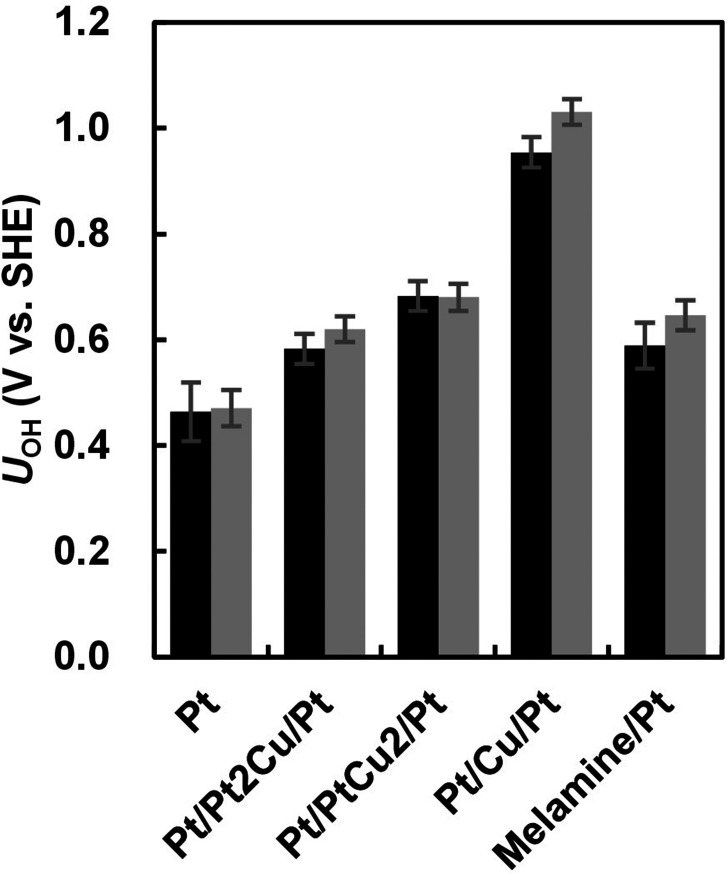 Figure 1
Peer Reviews
No public reviews on file for this paper yet. If you reviewed it on a platform where reviews are public (OpenReview, ICLR, NeurIPS, ICML), you can paste yours below so the community can read it here.
Videos
No videos yet. Explain this paper in a talk, walkthrough, or lecture? Add one.
Taxonomy
TopicsMachine Learning in Materials Science · Fuel Cells and Related Materials · Electrocatalysts for Energy Conversion
In our original manuscript, we inadvertently used base-10 logarithms instead of natural logarithms in implementing eqs (S32) and (S33) of the Supporting Information, which are used to calculate the vibrational quantum correction for the hydrogen atom bonded to water. This error resulted in an overestimation of the free energy of the hydrogen atom by approximately 60 meV, thereby lowering the redox potential UOH associated with OH adsorption on Pt catalysts both with and without melamine, as well as on various Pt alloys by 60 mV, shown in Figure 3 (a). A corrected version of Figure 3 (a), along with updated vibrational quantum correction values in Table S3 of the Supporting Information, is provided below. Since the evaluation of catalytic activity in our study relied on relative differences in UOH among the Pt catalysts, this uniform shift in absolute values does not alter the other results presented. Consequently, the main conclusions of the study remain unaffected. Nonetheless, the corrected absolute value of UOH, for instance, on Pt(111) increases from 0.40 to 0.46 V vs SHE, bringing it closer to the experimental reference value of 0.6 V vs SHE in ref. [14] of the original manuscript.