Childcare Affordability and Benefits Among Resident Physicians
Ryan C. L. Brewster, Alex Butler, Katherina Tanson, Shafeeque Kunhiabdullah, Jennifer Kesselheim, Catherine D. Michelson

TL;DR
This study examines how affordable childcare is for resident physicians in the US and how it affects their benefits.
Contribution
The study provides new insights into childcare affordability trends among resident physicians nationwide.
Findings
Childcare costs vary significantly across different residency programs.
Affordability challenges are more pronounced in certain regions and specialties.
Abstract
This cross-sectional study evaluates trends in childcare affordability for US resident physicians across all accredited residency programs.
Genes, proteins, chemicals, diseases, species, mutations and cell lines named across the full text — each resolved to its canonical identifier and authoritative record.
Click any figure to enlarge with its caption.
 Figure
| Characteristic | Institutions, No. (%) (N = 936) | β (95% CI) | |
|---|---|---|---|
| Unadjusted | Adjusted | ||
| Childcare affordability index | |||
| ≥7% | 856 (91.6) | NA | NA |
| <7% | 80 (8.6) | NA | NA |
| Subsidized childcare | 111 (11.9) | 0.07 (−0.47 to 0.62) | −0.11 (−0.53 to 0.31) |
| On-site childcare | 239 (25.5) | −0.02 (−0.42 to 0.38) | −0.21 (−0.69 to 0.27) |
| US region | |||
| East North Central (Illinois, Indiana, Michigan, Ohio, Wisconsin) | 163 (17.4) | 2.27 (1.81 to 2.73) | 2.0 (0.81 to 3.19) |
| East South Central (Alabama, Kentucky, Mississippi, Tennessee) | 41 (4.4) | −1.41 (−2.14 to −0.69) | −0.96 (−2.48 to 0.57) |
| Mid-Atlantic (New Jersey, New York, Pennsylvania) | 194 (20.7) | 2.8 (2.36 to 3.24) | 2.5 (0.37 to 4.63) |
| Mountain (Arizona, Colorado, Idaho, Montana, New Mexico, Nevada, Utah, Wyoming) | 38 (4.1) | 0.17 (−0.58 to 0.92) | 0.04 (−1.39 to 1.47) |
| New England (Connecticut, Maine, Massachusetts, New Hampshire, Rhode Island, Vermont) | 57 (6.1) | 3.71 (3.07 to 4.35) | 3.75 (2.19 to 5.32) |
| Pacific (Alaska, California, Hawaii, Oregon, Washington) | 129 (13.8) | 3.88 (3.39 to 4.37) | 3.42 (2.37 to 4.46) |
| South Atlantic (District of Columbia, Delaware, Florida, Georgia, Maryland, North Carolina, South Carolina, Virginia, West Virginia) | 169 (18.1) | [Reference] | [Reference] |
| West North Central (Iowa, Kansas, Minnesota, Missouri, Nebraska, North Dakota, South Dakota) | 56 (6.0) | 0.83 (0.19 to 1.48) | 0.87 (−0.79 to 2.54) |
| West South Central (Arkansas, Louisiana, Oklahoma, Texas) | 89 (9.5) | −1.16 (−1.71 to −0.61) | −1.09 (−2.11 to −0.07) |
| Institution type | |||
| Community-based | 178 (19.0) | [Reference] | [Reference] |
| Community-based university-affiliated | 520 (55.6) | 0.77 (0.31 to 1.23) | 0.02 (−0.29 to 0.32) |
| University-based | 235 (25.1) | 0.64 (0.11 to 1.17) | −0.29 (−0.93 to 0.35) |
| Military-based | 2 (0.3%) | 4.61 (0.79 to 8.43) | 2.08 (−0.16 to 4.31) |
| Residency programs per institution | |||
| 1-2 | 619 (66.1) | [Reference] | [Reference] |
| 3-4 | 110 (11.8) | 0.42 (−0.14 to 0.98) | −0.05 (−0.45 to 0.36) |
| ≥5 | 207 (22.1) | 0.33 (−0.11 to 0.76) | 0.34 (−0.31 to 0.98) |
| Rural-urban status | |||
| Medium metropolitan | 393 (42.0) | [Reference] | [Reference] |
| Rural | 28 (3.0) | −2.81 (−3.77 to −1.85) | −2.12 (−2.68 to −1.57) |
| Small metropolitan | 221 (23.6) | −1.23 (−1.65 to −0.82) | −0.78 (−1.19 to −0.37) |
| Urban | 294 (31.4) | 1.53 (1.15-1.91) | 1.12 (0.29 to 1.96) |
Peer Reviews
No public reviews on file for this paper yet. If you reviewed it on a platform where reviews are public (OpenReview, ICLR, NeurIPS, ICML), you can paste yours below so the community can read it here.
Videos
No videos yet. Explain this paper in a talk, walkthrough, or lecture? Add one.
Taxonomy
TopicsDiversity and Career in Medicine · Healthcare Policy and Management · Global Health Workforce Issues
Introduction
Although residency coincides with peak reproductive years for physicians, extensive training duration, hours, and requirements combined with financial strain can pose formidable barriers to family building.^1^ Previous research has found inadequate supports for resident parents, including access to childcare, but has been limited to qualitative studies or subsets of institutions and specialties.^2^ We aimed to evaluate national trends in childcare affordability for residents and availability of childcare benefits across all US Accreditation Council for Graduate Medical Education (ACGME)–accredited residency programs.
Methods
Boston Children’s Hospital Institutional Review Board deemed this cross-sectional study exempt from review with a waiver of informed consent because it was not considered human participant research. The STROBE reporting guideline was followed. Childcare benefits–including childcare subsidies and onsite childcare–and salaries for the 2023 to 2024 postgraduate year 1 were obtained for all categorical ACGME-accredited residency programs and sponsoring institutions from the American Medical Association Fellowship and Residency Electronic Interactive Database (eMethods in Supplement 1).^3^ We assumed a 2-partner household with a single infant enrolled in center-based, nonresidential care. The 2023 median annual price for county-level, single infant, center-based childcare was calculated from the US Department of Labor and linked to sponsoring institutions by county.^4^ We used 2023 county-level income estimates from the US Census to approximate a resident partner’s median income.
The Department of Health & Human Services defines affordable childcare as not exceeding 7% of a household’s income. We used this definition to calculate the childcare affordability index by dividing a household’s annual childcare costs by annual gross income (combined income of resident and partner). Lastly, we evaluated trends in inflation-adjusted childcare costs and resident salaries from July 2000 to July 2023 using the Consumer Price Index for All Urban Consumers: Childcare and Nursery School and the 2023 Association of American Medical Colleges Survey of Resident/Fellow Stipends and Benefits.^5^
Factors associated with the childcare affordability index were evaluated with multivariable linear regression, with adjustment for institutional characteristics. Regression covariables were determined a priori and counties within states were clustered to account for spatial correlation. We used the modified Mann-Kendall trend test for temporal trends in childcare costs relative to resident salaries. Statistical analyses were performed in R, version 3.5.2, with a 2-sided P < .05 considered significant.
Results
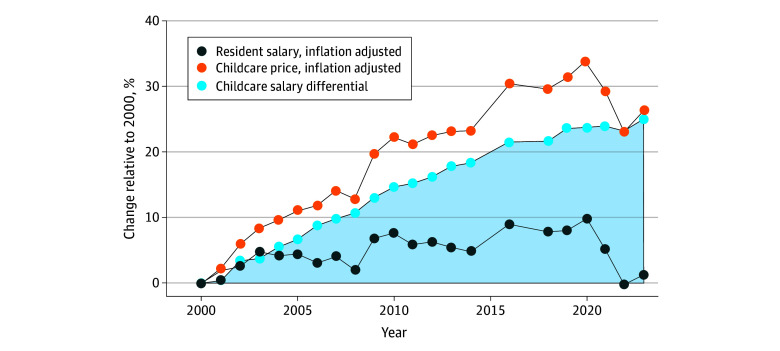
Among 936 sponsoring institutions analyzed, 520 (56.6%) were community-based with a university affiliation, 393 (42.0%) were in a medium metropolitan area and 294 (31.4%) in an urban area with 1 to 2 associated residency programs (619 [66.1%]) (Table). Using the HHS definition, childcare was unaffordable at 856 institutions (91.6%). The median (IQR) childcare affordability index was 10.3% (8.5%-12.3%). In all, 111 sponsoring institutions (11.9%) offered childcare subsidies and 239 (25.5%) offered onsite childcare. Childcare affordability index was associated with urbanicity (adjusted β, 1.12; 95% CI, 0.29-1.96) and geography (eg, Pacific vs South Atlantic: adjusted β, 3.75; 95% CI, 2.19-5.32) but not with subsidized or onsite childcare availability (Table). From 2000 to 2023, inflation-adjusted childcare costs increased 26.4% (P < .001) while resident salaries increased 1.2% (P = .03) (Figure).
Childcare Prices and Postgraduate Year 1 (PGY-1) Resident Salaries From 2000 to 2023Childcare prices and PGY-1 salaries were inflation-adjusted with the Consumer Price Index for All Urban Consumers US city average.
Discussion
Childcare has become increasingly unaffordable for residents, with a widening disparity between resident salaries and childcare costs over the last 20 years. Meanwhile, a minority of sponsoring institutions offer childcare subsidies or onsite childcare.
These findings extend prior research^1,2^ emphasizing the structural and cultural challenges to effective family building. While rising childcare costs are ubiquitous, residents may be uniquely disadvantaged due to long, inflexible duty hours, inconsistent parental leave and benefits, and lack of negotiated benefits at hire. Childcare may compound with other cost of living considerations, such as housing, suggesting financial strain for many trainees, especially in coastal, metropolitan centers.^6^
Study limitations include use of population-level data sources, which prevented adjustment for different family arrangements (eg, single-parent households) and a partner’s actual income. Ultimately, multilevel advocacy is needed for national childcare reform, strengthening of institutional benefits, and reformulation of graduate medical education reimbursements to support family building among physician parents.
The reference list from the paper itself. Each links out to its DOI / PubMed record.
- 1Marshall AL, Salles A. Supporting physicians along the entire journey of fertility and family building. JAMA Netw Open. 2022;5(5):e 2213342. doi:10.1001/jamanetworkopen.2022.1334235583873 · doi ↗ · pubmed ↗
- 2King Z, Zhang Q, Liang JW, . Barriers to family building among physicians and medical students. JAMA Netw Open. 2023;6(12):e 2349937. doi:10.1001/jamanetworkopen.2023.4993738153730 PMC 10755597 · doi ↗ · pubmed ↗
- 3American Medical Association. FREIDA AMA Residency & Fellowship Programs Database. Accessed November 1, 2024. https://freida.ama-assn.org/
- 4United States Department of Labor. National Database of Childcare Prices. Accessed November 1, 2024. https://www.dol.gov/agencies/wb/topics/featured-childcare
- 5Association of American Medical Colleges. AAMC Survey of Resident/Fellow Stipends and Benefits.; 2022. Accessed November 1, 2024. https://www.aamc.org/data-reports/students-residents/report/aamc-survey-resident/fellow-stipends-and-benefits
- 6Brewster RCL, Butler A, Michelson CD, Kesselheim J. Evaluation of housing affordability among US resident physicians. JAMA Netw Open. 2023;6(6):e 2320455. doi:10.1001/jamanetworkopen.2023.2045537368404 PMC 10300675 · doi ↗ · pubmed ↗