Pharmacokinetics and Safety of Single-Dose Sotrovimab in High-Risk Children and Adolescents With Mild-to-Moderate COVID-19
Jennifer Moore, Daren Austin, Alicia Aylott, Jerzy Daniluk, Leah A Gaffney, Marjan Hezareh, Ahmed Nader, Nadia Noormohamed, Charlene Parado, Amanda Peppercorn, Yessica Sachdeva, Scott Segal, Klaudia Steplewski, Phillip J Yates, Jill Walker, Andrew Skingsley

TL;DR
This study shows that sotrovimab is safe and has similar effects in adolescents as in adults for treating mild-to-moderate COVID-19.
Contribution
The study provides new safety and pharmacokinetic data for sotrovimab in high-risk children and adolescents.
Findings
Sotrovimab was well tolerated in children and adolescents with mild-to-moderate COVID-19.
Pharmacokinetic parameters in adolescents were similar to those in adults.
Abstract
Sotrovimab was well tolerated by children/adolescents (6 to <18 years) with mild-to-moderate COVID-19 at high risk of progression to severe disease. Pharmacokinetic parameters in adolescents (12 to <18 years) were generally similar to those reported in adult studies of sotrovimab.
Genes, proteins, chemicals, diseases, species, mutations and cell lines named across the full text — each resolved to its canonical identifier and authoritative record.
Click any figure to enlarge with its caption.
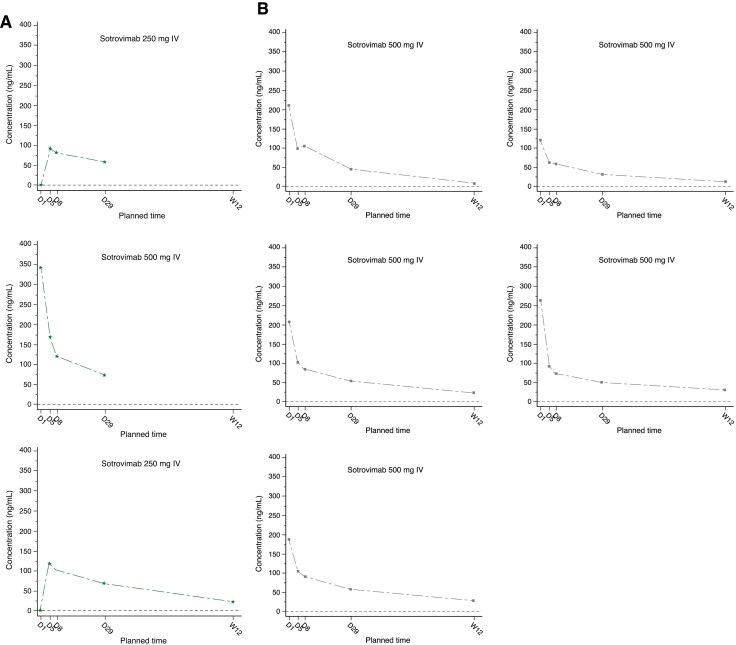 Figure 1
- —Vir Biotechnology, Inc
Peer Reviews
No public reviews on file for this paper yet. If you reviewed it on a platform where reviews are public (OpenReview, ICLR, NeurIPS, ICML), you can paste yours below so the community can read it here.
Videos
No videos yet. Explain this paper in a talk, walkthrough, or lecture? Add one.
Taxonomy
TopicsCOVID-19 Clinical Research Studies · SARS-CoV-2 and COVID-19 Research · PARP inhibition in cancer therapy
Previous studies have detailed the efficacy/safety and pharmacokinetics (PK) of sotrovimab in adult patients with mild-to-moderate COVID-19.^1-3^ The Phase 2b COMET-PACE study assessed the PK, pharmacodynamics (PD), and tolerability of sotrovimab in children and adolescents (aged <18 years) with COVID-19 (full eligibility criteria in Supplementary Table 1), intended as part of a PK-bridging approach. The study design included 2 cohorts (N = 36 planned for each), with Cohort A receiving intravenous (IV) sotrovimab and Cohort B receiving intramuscular (IM) sotrovimab (Supplementary Figure 1); however, enrollment was paused in March 2022 due to decreased in vitro neutralization of sotrovimab against circulating SARS-CoV-2 variants during this period (BA.2).^4^ Consequently, no participants received IM dosing (Part B). The study was terminated in June 2023 for programmatic reasons.
Primary objectives were to evaluate the PK, safety, and tolerability of sotrovimab through day 29 and week 36. Secondary objectives were COVID-19 disease progression, change in SARS-CoV-2 viral load over time, change in laboratory parameters, and occurrence of disease-related events and multisystem inflammatory syndrome (MIS-C) through day 29. No formal statistical significance tests were performed.
Eight (out of a planned 36) participants received treatment with sotrovimab IV (Supplementary Figure 2). Two participants (both 6 to <12 years; <40 kg) received sotrovimab 250 mg IV and the remaining 6 (n = 5 aged 12 to <18 years, n = 1 aged 6 to <12 years; all >40 kg) received sotrovimab 500 mg IV. Median duration of post-dose follow-up was 253 days. Median age of participants was 13.5 years; none were aged <6 years and all had ≥1 predefined risk factor for COVID-19 progression (Supplementary Table 2).
Sotrovimab serum-concentration results are shown in Figure 1 and Supplementary Table 3. Comparison of PK parameters with the final sotrovimab model (see Supplementary Material) revealed comparable exposures between adolescents (12 to <18 years) and adults, and higher exposures in the 6 to <12 years age group as compared to adults (geometric mean AUC_0–D29_ 1.7-fold and Cmax 1.4-fold higher; Table 1). PK results in the 6 to <12 years age group should be interpreted with caution, however, given the small number of assessable participants (n = 1) for some parameters (Table 1; Supplementary Table 4).
Six post-dose adverse events (AEs) in 2 participants were reported through day 29, and 9 in 4 participants were reported up to week 36; none were considered to be treatment-related, and all were of Grade 1 or 2 severity (Supplementary Table 5). There were no treatment-related changes in laboratory values, vital signs, or electrocardiograms. There were no reports of serious AEs or AEs leading to interrupted/incomplete infusion, MIS-C, infusion-related reactions occurring within 24 hours post-dose, hypersensitivity reactions at any time post-dose, events suggestive of antibody-dependent enhancement, or immunogenicity-related AEs. Through day 29, no participants reported progression of COVID-19 or development of severe and/or critical respiratory COVID-19 requiring supplemental oxygen. There were no deaths reported through week 36. One participant had treatment-emergent antidrug antibodies (not neutralizing).
Viral-load data showed a decrease from baseline over time in mean values at all time points through day 29 (Supplementary Table 6; Supplementary Figure 3). Two (25%) participants (both in the 6 to <12 years age group) met the criteria for viral rebound; both were infected with Omicron BA.1.1, and no treatment-emergent substitutions in the sotrovimab epitope were observed. All participants had an undetectable viral-load result on day 29.
Some limitations should be acknowledged. There was no control arm, and early termination of enrollment resulted in a small sample size (enrolled from only 2 centers), both of which limit the interpretation of the findings. Only 1 participant in the 6 to <12 years age group had a quantifiable sample for analysis of some PK parameters. In addition, all eight participants enrolled were infected with Omicron BA.1 or BA1.1 subvariants. Of the small number of enrolled participants, none were aged <6 years.
In conclusion, a single weight-based IV infusion of sotrovimab (250 or 500 mg) given to children/adolescents (6 to <18 years) with mild-to-moderate COVID-19 at high risk of progression to severe disease was well tolerated. Among the 8 participants enrolled, no new safety concerns related to sotrovimab were identified and COVID-19-related clinical outcomes were seemingly favorable. PK parameters in the adolescent population (12 to <18 years) were generally similar to those reported previously in adult studies of sotrovimab, indicating that the current weight-based dosing appears appropriate for adolescents. The exposure equivalence and safety of sotrovimab have not been established in children aged <12 years or weighing <40 kg.
Supplementary Material
piaf027_suppl_Supplementary_Materials
The reference list from the paper itself. Each links out to its DOI / PubMed record.
- 1Gupta A , Gonzalez-Rojas Y, Juarez E, et al; COMET-ICE Investigators. Effect of sotrovimab on hospitalization or death among high-risk patients with mild to moderate COVID-19: a randomized clinical trial. JAMA 2022;327:1236–1246. https://doi.org/10.1001/jama.2022.283235285853 PMC 8922199 · doi ↗ · pubmed ↗
- 2Shapiro AE , Sarkis E, Acloque J, et al Intramuscular vs intravenous SARS-Co V-2 neutralizing antibody sotrovimab for treatment of COVID-19 (COMET-TAIL): a randomized noninferiority clinical trial. Open Forum Infect Dis 2023;10:ofad 354. https://doi.org/10.1093/ofid/ofad 35437577112 PMC 10414803 · doi ↗ · pubmed ↗
- 3Sager JE , El-Zailik A, Passarell J, et al Population pharmacokinetics and exposure-response analysis of a single dose of sotrovimab in the early treatment of patients with mild to moderate COVID-19. CPT Pharmacometr Syst Pharmacol 2023;12:853–864. https://doi.org/10.1002/psp 4.12958 PMC 1027229836922886 · doi ↗ · pubmed ↗
- 4Park YJ , Pinto D, Walls AC, et al Imprinted antibody responses against SARS-Co V-2 Omicron sublineages. Science 2022;378:619–627. https://doi.org/10.1126/science.adc 912736264829 PMC 12945441 · doi ↗ · pubmed ↗