Expanding the potential of monoclonal antibodies against interleukin-4 and interleukin-13 in genodermatoses: A case series on the efficacy and safety of dupilumab in epidermolysis bullosa and ichthyosis
Francesca Caroppo, Roberto Mazzetto, Elisa Milan, Fortunato Cassalia, Anna Belloni Fortina

Abstract
Genes, proteins, chemicals, diseases, species, mutations and cell lines named across the full text — each resolved to its canonical identifier and authoritative record.
Click any figure to enlarge with its caption.
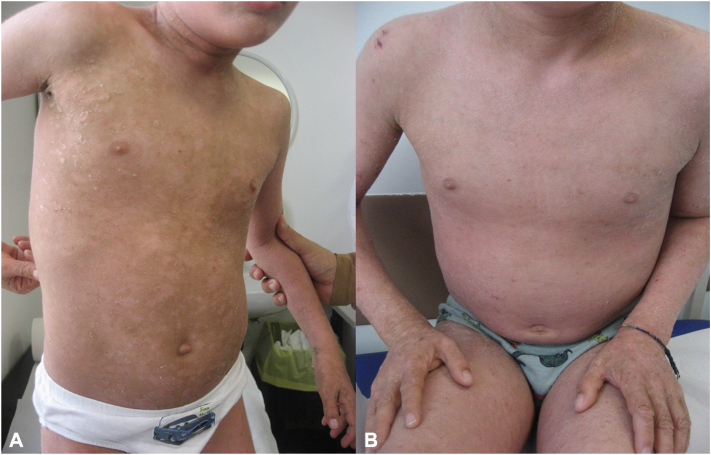 Figure 1
Peer Reviews
No public reviews on file for this paper yet. If you reviewed it on a platform where reviews are public (OpenReview, ICLR, NeurIPS, ICML), you can paste yours below so the community can read it here.
Videos
No videos yet. Explain this paper in a talk, walkthrough, or lecture? Add one.
Taxonomy
TopicsSkin and Cellular Biology Research · Autoimmune Bullous Skin Diseases · Coagulation, Bradykinin, Polyphosphates, and Angioedema
Introduction
Genodermatoses are a group of rare genetic diseases characterized by alterations in skin keratinization, which can significantly affect patients' quality of life.
Recent studies have shown an upregulation of various Th-1 and Th-2 cytokines in patients with certain genodermatoses, including ichthyosis and epidermolysis bullosa (EB). Additionally, emerging evidence suggests the potential effectiveness of biological therapies in treating these conditions.1
In this case series, we present our clinical experience with the use of dupilumab in 7 patients (3 adults and 4 children) diagnosed with ichthyoses and EB, shedding light on its potential benefits in this challenging therapeutic context.
Case series
Data were collected from 7 patients referred to the Paediatric and Rare Diseases Regional Center at the University of Padova between January 2021 and September 2023. The cohort included 5 males (71.4%) and 2 females (28.6%), with a mean age of 18.29 years (±11.9).
Questionnaires were administered at baseline and every 3 months during the first year of therapy. After completing the first year, reassessments were conducted every 6 months.
Internationally validated questionnaires were utilized to evaluate quality of life. For patients older than 16 years, the Dermatology Life Quality Index (DLQI)2 was applied, while an adapted and validated version, the Children’s DLQI,3 was used for those younger than 16 years.
The numerical rating scale (NRS), modified according to Wong-Baker's version4 for patients younger than 16 years of age, was used to assess pain and itching.
Epidemiological data and disease distribution for each patient are summarized in Table I.Table IClinical characteristics, disease details, genetic mutations, and reported adverse effects in patients affected by severe genodermatoses treated with dupilumabNAgeSexDiseaseMutationInheritanceDrug startAdverse effects145FDEBCOL7A1Autosomic recessiveSep-21/210FDEBCOL7A1Autosomic recessiveFeb-22/314MDEBCOL7A1Autosomic recessiveMar-22/419MEBSKRT14Autosomic recessiveMay-22Eye discomfort511MIchthyosisNIPAL4Autosomic recessiveJun-22/622MIchthyosisN/AN/ASep-21/77MIchthyosisABCA12Autosomic recessiveFeb-23/ABCA12, ATP-binding cassette subfamily A member 12; COL7A1, collagen type VII alpha 1 chain; D**EB, dystrophic epidermolysis bullosa; KRT14, keratin 14; NIPAL4, NIPA-like domain containing 4.
Patient 5, an 11-year-old male with congenital ichthyosis and severe autism, was unable to complete the questionnaires. However, his clinical outcomes are presented in Fig 1, A and B.Fig 1. Eleven-year-old boy (patient number 5) affected by ichthyosis and autism. Anterior trunk at baseline (A) and after 6 months of therapy with dupilumab (B).
The drug dosage followed the recommended guidelines for treating atopic dermatitis, adjusted according to the patient’s age and weight. Questionnaires results assessing quality of life are summarized in Table II.Table IISchematic summary of the DLQI, NRS pain, and NRS pruritus questionnaires, including changes from baseline, in subjects with epidermolysis bullosa and ichthyosisBaseline3m%3m/BL6m%6m/BL9m%9m/BL12m%12m/BLDLQI Epidermolysis bullosa patients 110820730730730 214842.9657.1471.4471.4 328267.12510.72510.72510.7 4121016.7833.3833.3558.33 Mean16.0013.0021.6811.5032.7811.0036.3510.2542.61 Ichthyosis patients 5///////// 623291.3291.3291.3291.3 7550340//// Mean14.0045.6565.6591.391.3NRS pain Epidermolysis bullosa patients 16516.7433.3433.3433.3 2880625625275 39811.1722.2722.2722.2 48712.5537.5450362.5 Mean7.757.0010.085.5029.505.2532.634.0048.25 Ichthyosis patients 5///////// 68275187.5187.5187.5 76516.7516.7//// Mean7.003.5045.853.0052.101.0087.51.0087.5NRS itch Epidermolysis bullosa patients 18537.5450450450 28712.5625537.5450 38625625537.5537.5 410910640460280 Mean8.506.7521.255.5035.004.5046.253.7554.38 Ichthyosis patients 5///////// 610280280280280 77614.3528.6//// Mean8.504.0047.153.5054.302.0080.002.0080.00%Xm/BL = percentage change at month X from baseline.DLQI, Dermatology Life Quality Index; NRS, numerical rating scale.
Discussion
Epidermolysis bullosa
In our study, 3 patients were diagnosed with dystrophic epidermolysis bullosa (DEB) with mutations in the collagen VII alpha-1 polypeptide gene and 1 patient had an epidermolysis bullosa simplex (EBS), Dowling-Meara type, with a mutation in the keratin 14 gene.
The clinical rationale for using dupilumab to treat these severe forms of EB is based on recent scientific discoveries about the activation of a complex cytokine cascade, which contributes to itching and pain.5 Dupilumab can limit this cascade effectively by inhibiting the signaling pathways of both interleukin-4 and interleukin-13, playing a critical role in modulating Th2-mediated inflammation. This makes it a promising therapeutic option for alleviating symptoms in patients with EB.
In the study by Wu PC et al, 5 cases reported halving of the visual analog scale scores for itch after 3 months of therapy.5
Moreover, Roque Quintana et al documented the efficacy of dupilumab, with a reduction in DLQI scores from 13 (baseline) to 5 after 9 months of therapy.6
The clinical improvements observed in our study are consistent with these findings, although our results suggest a slower response to therapy. In our sample, the maximum reduction in DLQI (42.6%) was achieved after 12 months of therapy, compared to the 3-9 months reported in other studies.5^,^6
A similar delayed response was observed in itch scores. While studies have reported a halving of itch at 3-5 months, our cohort achieved a comparable reduction (42.6% from baseline) only after 12 months.5
These differences may be attributed to the higher baseline itch NRS scores in our patients, which likely required more time to reach significant improvement compared to other studies.5^,^6
Interestingly, the article by Martora et al reported an ineffectiveness of dupilumab in treating EB, suggesting that the poor response might be due to a distinct cytokine profile in EBS compared to EBD.7
However, in our cohort, the patient with EBS (case 4 in Table I) demonstrated significant improvement, achieving a 58.3% reduction in DLQI scores after 12 months of treatment.
A comparative analysis of our findings with existing literature on the efficacy and safety of dupilumab in patients with DEB is summarized in Table III.Table IIIComparative analysis of our study findings with existing literature on the efficacy and safety of dupilumab in patients with ichthyosis, dystrophic epidermolysis bullosa (DEB), and epidermolysis bullosa simplex (EBS)Authors (year)Dermatological studied conditionNumber of patientsDuration of treatmentAgeResultsEpidermolysis bullosa Wu PC et al (2023) systematic review5DEBCOL7A151-3 mo10-35VAS halved after 3 mo of therapy. A reduction in DLQI from 23 to 8 and from 13 to 2.5 was reported after 3 mo of therapy Wu XG et al (2023)8DEBCOL7A1320 wk7-45VAS from 6 to 2.5 and an improvement in quality of life evidenced by a more than 30% reduction in DLQI values Quintana et al (2024)6DEBCOL7A119 mo32Quality of life greatly enhanced, with a DLQI reduction from 13 to 5. Our experience4 DEB1 EBS512 mo1-45Mean DLQI reduction of 42.6% observed.Pruritus values halved at 9 mo and almost completely resolved by 12 mo.Ichthyosis Steuer et al (2020)9NS12-10 mo322 mo:NRS decreased from 9/10 to 2/10.10 mo:EASI <75%. BSA <50%. Andreasen et al (2020)10NS11 mo43DLQI decreased from 19 to 2. Süßmuth et al (2021)11NS24-12 mo124 mo:NASI decreased from 33 to 11.7. NRS reduced from 8 to 3.Results remained stable after 12 mo of treatment.8**4 mo:**NASI decreased from 50.5 to 18.**NRS reduced from 8 to 3.Results remained stable after 12 mo of treatment Our experience2 LI1 VI312 mo7-226 mo:****DLQI reduction of 40% to 90%.**Reduction in NRS for pain and pruritus by 16.7% to 87.5% and 28.6% to 80%, respectively.The bold values highlight the main variations observed in the referenced article, which have been further analyzed and discussed in our study.BSA, Body surface area; COL7A1, collagen type VII alpha 1 chain; DLQI, Dermatology Life Quality Index; EASI, Eczema Area and Severity Index; LI, lamellar ichthyosis; NASI, Netherton Area Severity Index; NRS, numerical rating scale; NS, Netherton syndrome; VAS, visual analog scale; VI, vulgar ichthyosis.
Ichthyosis
Numerous studies have highlighted a correlation between certain recessive ichthyoses, particularly Netherton syndrome (NS), and atopic dermatitis.1 These studies also demonstrate the efficacy of dupilumab in managing these conditions.
Specifically, Suẞmuth et al report 2 cases of NS treated with dupilumab, showing a reduction in pruritus NRS from 8 to 2 in 12 months in 1 patient and from 8 to 3 after 10 months in the other.11
Similarly, Steuer et al documented a case with a reduction in visual analog scale pruritus from 9 to 2 along with a 75% decrease in disease severity. Andreasen et al reported another case where disease severity decreased from 22.6 to 5.3, alongside an improvement in DLQI from 19 to 2.9^,^10
Patients with severe recessive forms of ichthyosis often exhibit features resembling NS, such as impaired keratinization, compromised epidermal barrier function, and increased trans-epidermal water loss.
Considering these similarities, we treated our patients with dupilumab, resulting in significant outcomes. DLQI scores improved by 40% to 90%, while NRS scores for pain and pruritus decreased by 16.7% to 87.5% and 28.6% to 80%, respectively, after 6 months of treatment.
A comparative analysis of our findings with existing literature on the efficacy and safety of dupilumab ichthyosis is summarized in Table III.
Notably, no significant adverse events were observed in our study after 12 months of therapy.
In conclusion, these findings highlight dupilumab as a promising therapeutic option for patients with rare genodermatoses, including EB and ichthyoses, beyond NS.
Its modulation of inflammatory cytokines effectively improves clinical signs and symptoms, offering hope for patients with these challenging conditions.
Conflicts of interest
Dr Caroppo has been a consultant for Leo Pharma, Sanofi Genzyme, AbbVie, Hollister, and Amgen. Dr Belloni Fortina has been a consultant for Almirall, Amgen, Sanofi Genzyme, Pfizer, AbbVie, Leo Pharma, Unifarco, Novartis, and Eli Lilly. Drs Mazzetto, Milan, and Cassalia have no conflicts of interest to declare.
The reference list from the paper itself. Each links out to its DOI / PubMed record.
- 1Yan S.Wu X.Jiang J.Dupilumab improves clinical symptoms in children with Netherton syndrome by suppressing Th 2-mediated inflammation Front Immunol 132022105442210.3389/fimmu.2022.1054422 PMC 977386736569942 · doi ↗ · pubmed ↗
- 2Finlay A.Y.Khan G.K.Dermatology Life Quality Index (DLQI)-a simple practical measure for routine clinical use Clin Exp Dermatol 193199421021610.1111/j.1365-2230.1994.tb 01167.x 8033378 · doi ↗ · pubmed ↗
- 3Lewis-Jones M.S.Finlay A.Y.The Children's Dermatology Life Quality Index (CDLQI): initial validation and practical use Br J Dermatol 1326201094294910.1111/j.1365-2133.1995.tb 16953.x 7662573 · doi ↗ · pubmed ↗
- 4Stewart S.Boscher J.Hossain J.Mc Geady S.J.Yousef E.Pruritus from allergy skin tests in children: comparing remedies Ann Allergy Asthma Immunol 1174201642943010.1016/j.anai.2016.07.01927522109 PMC 5656055 · doi ↗ · pubmed ↗
- 5Wu P.C.Dai Y.X.Li C.L.Chen C.C.Chang Y.T.Ma S.H.Dupilumab in the treatment of genodermatosis: a systematic review J Dtsch Dermatol Ges 211202371710.1111/DDG.1492436657040 · doi ↗ · pubmed ↗
- 6Roque Quintana B.Piqué Durán E.Pérez Cejudo J.A.Successful control of recalcitrant pruritus in epidermolysis bullosa pruriginosa with dupilumab Actas Dermosifiliogr 11522024 T 184T 18610.1016/J.AD.2022.05.04538048956 · doi ↗ · pubmed ↗
- 7Martora F.Fabbrocini G.Nappa P.Reply to “A case of dystrophic epidermolysis bullosa pruriginosa treated with dupilumab” by Caroppo et al J Eur Acad Dermatol Venereol 3692022 e 729e 73010.1111/JDV.1825135604042 · doi ↗ · pubmed ↗
- 8Wu XG Yan S Jiang JQ Successful treatment of epidermolysis bullosa pruriginosa by dupilumab J Dermatology 506202383784210.1111/1346-8138.1672936694424 · doi ↗ · pubmed ↗