Is it time for exercise-conditioned plasma to enter human trials?
Patrick Henry Sebastian Sitjar, Jorming Goh

Abstract
Genes, proteins, chemicals, diseases, species, mutations and cell lines named across the full text — each resolved to its canonical identifier and authoritative record.
Click any figure to enlarge with its caption.
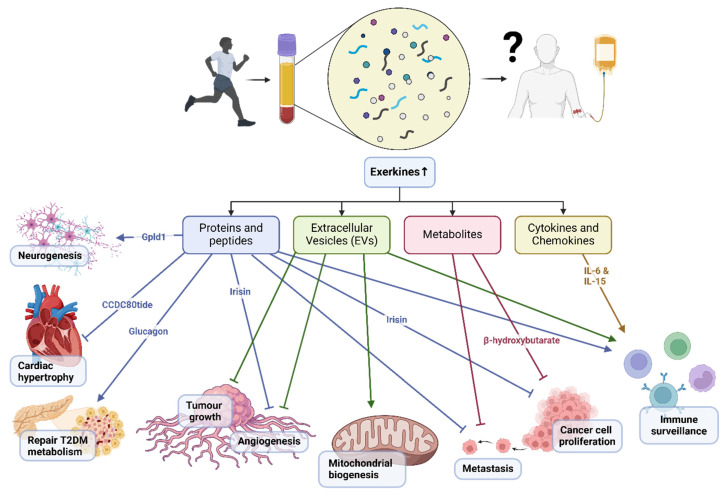 Figure 1
Peer Reviews
No public reviews on file for this paper yet. If you reviewed it on a platform where reviews are public (OpenReview, ICLR, NeurIPS, ICML), you can paste yours below so the community can read it here.
Videos
No videos yet. Explain this paper in a talk, walkthrough, or lecture? Add one.
Taxonomy
TopicsErythropoietin and Anemia Treatment · Cardiovascular and exercise physiology
Chronic diseases, including cancer, cardiovascular diseases, metabolic diseases, and neurodegeneration, pose a significant burden to global health. While conventional pharmacological treatments have been first-line therapeutics for primary, secondary and tertiary prevention, innovative approaches are needed. In the past two decades since the sequencing of the human genome, there has been greater appreciation for the role of physical exercise in improving, maintaining or restoring homeostasis in the human body.
Skeletal muscle contraction during an acute bout of exercise elicits a complex array of molecular responses in multiple organ systems. Such molecular signals continue to persist, after the exercise and thus the long-term accumulation of such exercise sessions culminate in systemic adaptations that extend beyond the musculoskeletal system - remodeling of organ systems occur and improvement in healthspan1. Acute exercise mobilizes thousands of proteins and peptides, mRNA, extracellular vesicles (EVs) and non-coding RNA systemically, transporting them to distant sites, and exert modulatory effects on the organs, including brain, adipose tissue, liver etc2. Recent studies in pre-clinical mouse models reveal promising evidence that plasma obtained after exercise training directly improves physiological outcomes in non-exercised recipients. Transfused plasma from exercised rats improved neuronal viability, decreased cell atrophy and increased neurogenesis by three-fold in transgenic Alzheimer's Disease (AD) rat recipients3. Furthermore, exercised young (three-month old) murine plasma administered intravenously to old (18-month-old) mice resulted in increased proliferation of hippocampal neurons 4. Exciting work on plasmapheresis is being pioneered in the United States of America (USA) and Norway. In the former, young male donors provided 1 unit (~250mL) of fresh frozen plasma (FFP) to patients with AD in a once per week infusion, followed by a 6-week washout period and crossover with saline treatment. The primary endpoints were safety, tolerability and feasibility of the intervention - all of which were met at the conclusion of the trial5. In the latter, the ongoing study involved blood plasma obtained from young, healthy and well-trained (aerobically fit) individuals and transfused intravenously to older adults with Alzheimer's Disease at intervals of 3 months6.
Such recent investigations have given a glimpse of a novel translational application of exercise-induced adaptations for chronic disease management, particularly in oncology and neurology. In the next section, we elaborate on the molecular and cellular mechanisms that underlie the efficacy of exercise-induced plasma therapy, offering insights into its potential applications across diverse chronic disease contexts.
The release of molecular mediators known as exerkines during skeletal muscle contractions are partly responsible for the multi-organ health benefits derived from physical exercise. Broadly, exerkines can be classified into proteins and peptides, cytokines and chemokines, extracellular vesicles (EV), and metabolites.
Proteins and peptides released during exercise may modulate tumor growth and metastasis by regulating angiogenesis, immune surveillance, and tumor cell proliferation. Irisin, for instance, inhibits angiogenesis and suppresses tumor cell proliferation in various cancer models7. Glycosylphosphatidylinositol (GPI)-specific phospholipase D1 (Gpld1) was also identified as an exercise-induced, liver-derived enzyme (hepatokine) that confers cognitive function improvements to recipient aged mice via plasma administration from exercised donor mice4. Gpld1 upregulation was identified in active, elderly human subjects compared with sedentary controls, but it has not been elucidated if it offers cognitive benefits for humans through exercise4. Of note, in vitro culture of murine and human pancreatic islets treated with post-exercise training serum (10% v/v) reduced p16 and p21 cellular senescence markers, with further experiments indicating that, glucagon, behaving as an exerkine, could abate dysfunctional pancreatic metabolism patients with type 2 diabetes mellitus8. Recent advances in peptidomics have added novel candidates to the list of exerkines. For instance, the skeletal muscle-derived peptide, CCDC80tide, was released systemically after a single session of treadmill running in healthy young individuals9. This exerkine attenuated angiotensin II (Ang II)-induced cardiac hypertrophy and fibrosis in mice, primarily by modulating STAT3 phosphorylation.
Exercise-induced changes in cytokine and chemokine expression and release from different organs may exert anti-tumor effects by modulating immune surveillance and tumor microenvironment. IL-6, for instance, has been implicated in promoting anti-tumor immunity through its effects on T cell function and tumor-associated macrophages10. IL-15, with its immunostimulatory properties, enhances the activity of natural killer cells and cytotoxic T lymphocytes, thereby augmenting anti-tumor immune responses11.
EVs released during exercise may exert anti-tumor effects by delivering bioactive cargo, including miRNAs, proteins, and lipids, to recipient cells within the tumor microenvironment. Exercise-induced EVs have been shown to suppress tumor growth and metastasis by inhibiting angiogenesis, promoting immune surveillance, and inducing cancer cell apoptosis12. Moreover, EVs derived from exercised individuals can modulate cellular metabolism through an increase in concentration for proteins such as Suclg1, Sdha, Sdhb, Acly, Idh3b, and Dlat which are involved in mitochondrial biogenesis and β-oxidation13. Further, EVs are also understood to be highly heterogenous in nature making it difficult to isolate proteins or mRNA of interest, however, the encapsuled EV content are more resistant to degradation13.
During acute exercise, the production of metabolic byproducts may influence tumor metabolism and microenvironment, thereby affecting cancer cell proliferation, survival, and metastasis. β-hydroxybutyrate, a ketone body produced during fasting or low-carbohydrate states, has been implicated in suppressing cancer cell proliferation and inducing apoptosis through its effects on cellular metabolism and oxidative stress14.
Despite the therapeutic potential of exercise-conditioned plasma, such an approach requires extensive evaluation of possible complications. Sha et al, demonstrated the safety and tolerability of young FFP transfusion, but other unknown adverse reactions may mirror those experienced by patients in critical care units receiving transfusions such as febrile nonhemolytic transfusion reactions, anaphylactic reactions, transfusion-related acute lung injury (TRALI), transfusion-associated circulatory overload (TACO), etc 5, 15. Thorough medical screening of both donors and recipients especially for cardiac and renal function are necessary to mitigate such reactions 15. In addition, dosing regimens for exercise plasma transfusion are not known. The Alzheimer Symptom Amelioration study showed that weekly infusions of approximately 250 mL of plasma were well-tolerated by elderly Alzheimer's patients but further studies will be needed to uncover the optimal infusion protocol 5.
In summary, the putative molecular mechanisms that underlie the therapeutic effects of exercise-induced plasma transfusion therapy provide a foundation for their potential translational use in cancer, cardiovascular diseases, and neurodegenerative diseases. Furthermore, there is an opportunity to translate the benefits of exercise-induced plasma for bedridden or paralyzed patients who are unable or intolerant to exercise training. In conclusion, we believe it is time for early-phase clinical trials to test exercise-conditioned plasma for different chronic diseases. We envision a future where this therapy could enter mainstream medicine and call for collaborators to discuss multi-country clinical trials to explore this exciting space.
The reference list from the paper itself. Each links out to its DOI / PubMed record.
- 1Goh J Wong E Soh J Maier AB Kennedy BK Targeting the molecular & cellular pillars of human aging with exercise Febs j 2023290649683496800110.1111/febs.16337 · doi ↗ · pubmed ↗
- 2Contrepois K Wu S Moneghetti KJ Hornburg D Ahadi S Tsai MS Molecular Choreography of Acute Exercise Cell 2020181111230 e 163247039910.1016/j.cell.2020.04.043PMC 7299174 · doi ↗ · pubmed ↗
- 3Norevik CS Huuha AM Rosbjorgen RN Hildegard Bergersen L Jacobsen K Miguel-Dos-Santos R Exercised blood plasma promotes hippocampal neurogenesis in the Alzheimer's disease rat brain J Sport Health Sci 202413245553750001010.1016/j.jshs.2023.07.003PMC 10980897 · doi ↗ · pubmed ↗
- 4Horowitz AM Fan X Bieri G Smith LK Sanchez-Diaz CI Schroer AB Blood factors transfer beneficial effects of exercise on neurogenesis and cognition to the aged brain Science 2020369167733264699710.1126/science.aaw 2622 PMC 7879650 · doi ↗ · pubmed ↗
- 5Sha SJ Deutsch GK Tian L Richardson K Coburn M Gaudioso JL Safety, Tolerability, and Feasibility of Young Plasma Infusion in the Plasma for Alzheimer Symptom Amelioration Study: A Randomized Clinical Trial JAMA Neurol 20197635403038309710.1001/jamaneurol.2018.3288 PMC 6439869 · doi ↗ · pubmed ↗
- 6Tari AR Berg HH Videm V Brathen G White LR Rosbjorgen RN Safety and efficacy of plasma transfusion from exercise-trained donors in patients with early Alzheimer's disease: protocol for the Ex Plas study BMJ Open 202212 e 05696410.1136/bmjopen-2021-056964 PMC 945399436538409 · doi ↗ · pubmed ↗
- 7Colaianni G Cuscito C Mongelli T Pignataro P Buccoliero C Liu P The myokine irisin increases cortical bone mass Proc Natl Acad Sci U S A 201511212157622637484110.1073/pnas.1516622112 PMC 4593131 · doi ↗ · pubmed ↗
- 8Carapeto P Iwasaki K Hela F Kahng J Alves-Wagner AB Middelbeek RJW Exercise activates AMPK in mouse and human pancreatic islets to decrease senescence Nature Metabolism 2024619769010.1038/s 42255-024-01130-8PMC 1200509439317751 · doi ↗ · pubmed ↗