Age-related glomerular loss in patients with IgA nephropathy
Hirokazu Marumoto, Nobuo Tsuboi, Takaya Sasaki, Yusuke Okabayashi, Kotaro Haruhara, Go Kanzaki, Takashi Yokoo

Abstract
Genes, proteins, chemicals, diseases, species, mutations and cell lines named across the full text — each resolved to its canonical identifier and authoritative record.
Click any figure to enlarge with its caption.
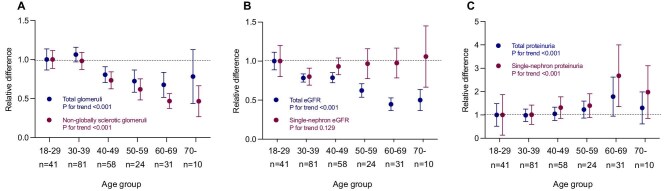 Figure 1
- —Japan Society for the Promotion of Science10.13039/501100001691
Peer Reviews
No public reviews on file for this paper yet. If you reviewed it on a platform where reviews are public (OpenReview, ICLR, NeurIPS, ICML), you can paste yours below so the community can read it here.
Videos
No videos yet. Explain this paper in a talk, walkthrough, or lecture? Add one.
Taxonomy
TopicsRenal Diseases and Glomerulopathies · Chronic Kidney Disease and Diabetes · Systemic Lupus Erythematosus Research
To the Editor,
Elderly patients with immunoglobulin A nephropathy (IgAN) show clinicopathological features associated with poor kidney outcomes, possibly due to age-related declines in glomerular number and function. However, this remains untested clinically owing to methodological limitations. We recently reported estimates of the number of glomeruli per kidney and single-nephron parameters in IgAN patients [1]. As a post hoc analysis of our previous study, we conducted a cross-sectional study to elucidate the relationship between age and nephron-level parameters to determine the effect of aging on these measurements. Detailed methods for measuring the number of glomeruli per kidney and calculating single-nephron parameters have been described previously [1].
This retrospective study included 245 adult Japanese patients diagnosed with primary IgAN by a native kidney biopsy at our hospital between 2007 and 2017. The patients were the same as those in our previous study [1]. Supplemental Table S1 compares total and single-nephron parameters by age group. Figure 1 shows the relative differences in nephron-level parameters among age groups. For each parameter, relative differences from the respective mean values for the younger age group (18–29 years) were calculated to examine trends by age group. With aging, both total glomeruli (the combined number of globally and non-globally sclerotic glomeruli) and non-globally sclerotic glomeruli showed a significant decreasing trend. The total estimated glomerular filtration rate (eGFR) decreased linearly with age, whereas the single-nephron eGFR remained consistent across age groups. Both total and single-nephron proteinuria showed an increasing trend with age. The linear regression model estimated a significant annual decline with the age of 8,700 total glomeruli, including globally sclerotic glomeruli and 11,500 non-globally sclerotic glomeruli per kidney.
Regardless of the cause, globally sclerotic glomeruli resorb over time and eventually disappear without a trace [4]. As observed in our IgAN cohort, a decrease of 8,700 glomeruli per year in the total number of glomeruli per kidney may represent a complete loss. The annual loss of 11,500 non-globally sclerotic glomeruli per kidney in IgAN patients is clearly greater than the 6,200–6,400 loss per year reported in kidney transplant donors [1–3]. These findings suggest that the process of glomerular loss is accelerated in patients with IgAN relative to those with normal aging. In our cohort of patients with IgAN, there was a dissociation between the single-nephron eGFR and single-nephron proteinuria in their age-related changes. Interestingly, the small effect of age on single-nephron eGFR was consistent with that reported in a previous study of kidney transplant donors [5]. The increase in total and single-nephron proteinuria with age may indicate vulnerable changes in the glomeruli in elderly patients with IgAN.
The major limitations of this study include the inability to discuss causal relationships, as it was a cross-sectional study, and the reliance on needle biopsy, which may have introduced a sampling bias. The measured GFR was not available because this measurement is not routinely performed in the clinical care of patients with IgAN. Because estimates of single-nephron parameters are global averages, this method does not allow the assessment of variability in filtration function or destruction of individual glomeruli. This may be of particular concern in cases of IgAN, a disease characterized by heterogeneous glomerular lesions. Finally, it should be noted that estimates of glomerular loss cannot be individualized, as the severity of IgAN varies considerably among patients.
In summary, our findings indicate that patients with IgAN experience more glomerular loss than expected in normal aging and the remaining glomeruli become increasingly vulnerable with age. Further studies based on current findings will provide additional insights into age-related transitions in the pathophysiology of IgAN.
Supplementary Material
sfaf111_Supplemental_File
The reference list from the paper itself. Each links out to its DOI / PubMed record.
- 1Marumoto H, Tsuboi N, D'Agati VD et al. Total nephron number and single-nephron parameters in patients with Ig A nephropathy. Kidney 360 2021;2:828–41. 10.34067/KID.000697202035373063 PMC 8791345 · doi ↗ · pubmed ↗
- 2Denic A, Lieske JC, Chakkera HA et al. The substantial loss of nephrons in healthy human kidneys with aging. J Am Soc Nephrol 2017;28:313–20. 10.1681/ASN.201602015427401688 PMC 5198286 · doi ↗ · pubmed ↗
- 3Sasaki T, Tsuboi N, Kanzaki G et al. Biopsy-based estimation of total nephron number in Japanese living kidney donors. Clin Exp Nephrol 2019;23:629–37. 10.1007/s 10157-018-01686-230635748 · doi ↗ · pubmed ↗
- 4Moritz AR, Hayman JM. The disappearance of glomeruli in chronic kidney disease. Am J Pathol 1934;10:505–518.3. 19970162 PMC 2062860 · pubmed ↗
- 5Denic A, Mathew J, Lerman LO et al. Single-nephron glomerular filtration rate in healthy adults. N Engl J Med 2017;376:2349–57. 10.1056/NEJ Moa 161432928614683 PMC 5664219 · doi ↗ · pubmed ↗