Acanthosis Nigricans in Hypochondroplasia Due to FGFR3 Mutation
Joseph Reed Junkin, Victor Ramirez, Jose Bernardo Quintos

Abstract
Genes, proteins, chemicals, diseases, species, mutations and cell lines named across the full text — each resolved to its canonical identifier and authoritative record.
Click any figure to enlarge with its caption.
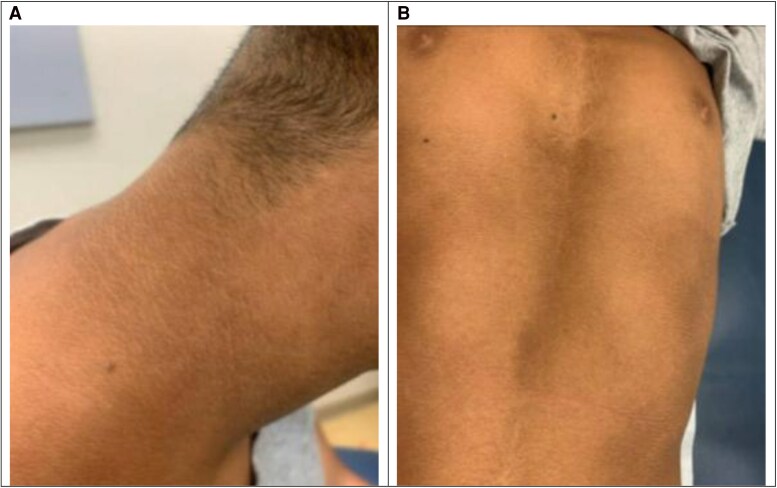 Figure 1
Peer Reviews
No public reviews on file for this paper yet. If you reviewed it on a platform where reviews are public (OpenReview, ICLR, NeurIPS, ICML), you can paste yours below so the community can read it here.
Videos
No videos yet. Explain this paper in a talk, walkthrough, or lecture? Add one.
Taxonomy
TopicsConnective tissue disorders research · Fibroblast Growth Factor Research · Skin Diseases and Diabetes
Image Legend
A 10-year-old boy was referred to endocrinology due to short stature. The father is 158.4 cm and mother 153.7 cm, giving their child a mid-parental height potential of 162.5 cm. On examination, the patient's height was 119.2 cm, below the first percentile (Z = −3.11), with weight at the second percentile (Z = −2.12). The upper-to-lower segment ratio was 1.27 (normal for a 10-year-old is 0.99). Screening laboratory investigations were normal for growth hormone deficiency, thyroid disease, chronic kidney disease, inflammatory bowel disease, and celiac disease. Genetic testing identified a heterozygous pathogenic FGFR3 c.1949A > C (p.Lys650Thr) variant, associated with hypochondroplasia and acanthosis nigricans (AN) [1]. The father tested positive for the mutation, while the mother tested negative. His father has hypochondroplasia, confirming autosomal dominant transmission. Clinical images highlight AN, presenting as A, hyperpigmented, velvety patches on the posterior neck, and B, darkened skin on the medial abdomen (Fig. 1). FGFR3 mutations primarily affect bone growth, but the same molecular mechanisms—dysregulated FGFR3 signaling and downstream pathways—can also stimulate epidermal proliferation, distinguishing it from insulin resistance–associated AN [1, 2]. Recognizing this dermatologic manifestation is crucial for early diagnosis and genetic counseling in the setting of short stature.
Acanthosis nigricans on the neck, abdomen and torso.
The reference list from the paper itself. Each links out to its DOI / PubMed record.
- 1Muguet Guenot L, Aubert H, Isidor B, et al Acanthosis nigricans, hypochondroplasia, and FGFR 3 mutations: findings with five new patients, and a review of the literature. Pediatr Dermatol. 2019;36(2):242‐246.30762251 10.1111/pde.13748 · doi ↗ · pubmed ↗
- 2Alatzoglou KS, Hindmarsh PC, Brain C, Torpiano J, Dattani MT. Acanthosis nigricans and insulin sensitivity in patients with achondroplasia and hypochondroplasia due to FGFR 3 mutations. J Clin Endocrinol Metab. 2009;94(10):3959‐3963.19622626 10.1210/jc.2009-0322 · doi ↗ · pubmed ↗