Endoscopic ultrasound-guided hepaticogastrostomy with antegrade stenting using a catheter-like delivery system: a novel technique completely omitting the fistula dilation step
Tadahisa Inoue, Rena Kitano, Tomoya Kitada, Shun Futagami, Masato Yano, Jun Arai, Kiyoaki Ito

Abstract
Genes, proteins, chemicals, diseases, species, mutations and cell lines named across the full text — each resolved to its canonical identifier and authoritative record.
Click any figure to enlarge with its caption.
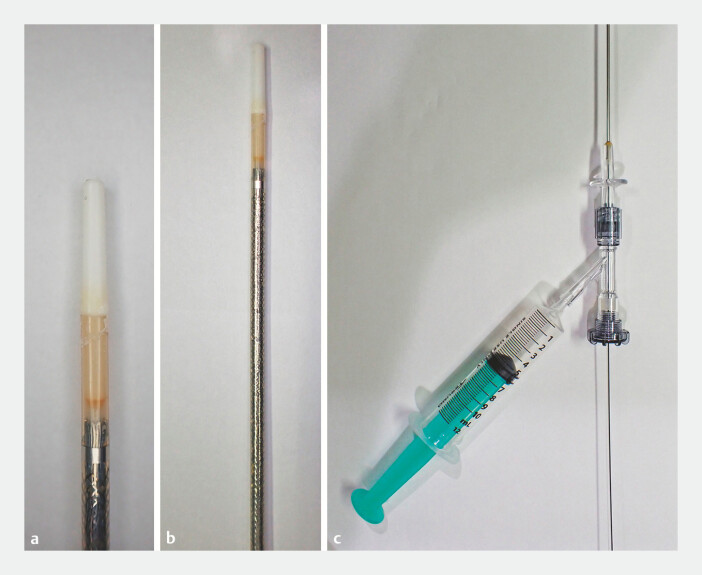 Fig. 1
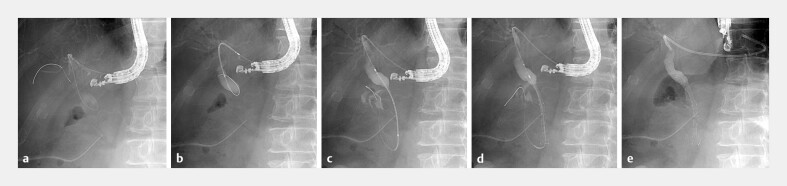 Fig. 2
Peer Reviews
No public reviews on file for this paper yet. If you reviewed it on a platform where reviews are public (OpenReview, ICLR, NeurIPS, ICML), you can paste yours below so the community can read it here.
Videos
No videos yet. Explain this paper in a talk, walkthrough, or lecture? Add one.
Taxonomy
TopicsEsophageal and GI Pathology · Gallbladder and Bile Duct Disorders · Biliary and Gastrointestinal Fistulas
When the transpapillary approach is not feasible, endoscopic ultrasound-guided hepaticogastrostomy (EUS-HGS) is a valuable option for malignant distal biliary obstruction (MDBO) 1 . Recent studies suggest that adding antegrade stenting (AS) to HGS (EUS-HGAS) may provide longer stent patency than HGS alone 2 3 . However, regardless of AS addition, a significant challenge in EUS-guided transgastric drainage is the fistula dilation step. Fistula dilation is technically demanding and time-consuming, in addition the risk of bile leakage between dilation and stent placement is a major concern.
To address this issue, we propose a novel EUS-HGAS technique that completely omits the fistula dilation step using a catheter-like delivery system for metal stents. This novel delivery system allows contrast injection for cholangiography while maintaining sufficient flow, has a diameter equivalent to small-caliber catheters (5.7-Fr), and features a tapered tip for smooth insertion, similar to dilation catheters ( Fig. 1 ).
The catheter-like delivery system (BileRush Selective; Piolax Medical Devices) is preloaded with a 10 mm diameter uncovered metal stent and is compatible with guidewires 0.035 inches in size or smaller. This delivery system has a contrast injection function with a sufficient flow capability and has a diameter equivalent to small-caliber catheters (5.7 Fr). Additionally, it is equipped with a tapered tip that enhances penetration capability, similar to dilation catheters.
A 73-year-old man with MDBO and gastric outlet obstruction due to pancreatic cancer developed obstructive jaundice. The left intrahepatic bile duct was punctured transgastrically with a standard 19-G needle, and a 0.025-inch guidewire was advanced into the common bile duct (CBD). Subsequently, the catheter-like delivery system was inserted without prior fistula dilation, followed by cholangiographic evaluation with contrast injection. The guidewire was manipulated under the delivery system assistance to traverse the stricture and advance into the duodenum. The delivery system was then advanced over the guidewire, which enabled antegrade stent deployment across the stricture from the duodenum to CBD. Finally, a 7-Fr single-pigtail plastic stent was placed across the fistula. Fistula dilation was also unnecessary due to the bougie effect of the catheter-like delivery system ( Fig. 2 , Video 1 ). The patientʼs symptoms improved rapidly without adverse events.
The left intrahepatic bile duct was punctured transgastrically with a standard 19-G needle (EZ shot 3 Plus; Olympus Medical Systems), and a 0.025-inch guidewire (VisiGlide2; Olympus Medical Systems) was advanced into the common bile duct ( a ). Subsequently, the catheter-like delivery system was inserted without prior fistula dilation, followed by cholangiographic evaluation with contrast injection ( b ). The guidewire was manipulated under the delivery system assistance to traverse the stricture and advance into the duodenum. The delivery system was then advanced over the guidewire ( c ), enabling antegrade stent deployment (10 × 80 mm) across the stricture from the duodenum to the common bile duct ( d ). Finally, a 7-Fr single-pigtail plastic stent was placed from the common hepatic duct to the stomach ( e ). Fistula dilation was also unnecessary due to the bougie effect of the catheter-like delivery system.
Endoscopic ultrasound-guided hepaticogastrostomy with antegrade stenting without fistula dilation step, using a catheter-like delivery system.Video 1
This technique represents a fully fistula dilation-free approach to EUS-guided transgastric drainage, which enhances safety by minimizing bile leakage and simplicity with reducing procedural time and step.
Endoscopy_UCTN_Code_TTT_1AS_2AD
The reference list from the paper itself. Each links out to its DOI / PubMed record.
- 1van der Merwe S Wvan Wanrooij RLJ Bronswijk M Therapeutic endoscopic ultrasound: European Society of Gastrointestinal Endoscopy (ESGE) Guideline Endoscopy 20225418520510.1055/a-1717-139134937098 · doi ↗ · pubmed ↗
- 2Ishiwatari H Ogura T Hijioka SEUS-guided hepaticogastrostomy versus EUS-guided hepaticogastrostomy with antegrade stent placement in patients with unresectable malignant distal biliary obstruction: a propensity score-matched case-control study Gastrointest Endosc 2024100667538382887 10.1016/j.gie.2024.02.012 · doi ↗ · pubmed ↗
- 3Itonaga M Ashida R Hatamaru K Endoscopic ultrasound-guided hepaticogastrostomy vs. antegrade metal stent placement keeping an access route in patients with malignant biliary obstruction Int J Clin Oncol 2024291500150838972023 10.1007/s 10147-024-02584-2 · doi ↗ · pubmed ↗