MIF as an oncogenic driver of low‐heterogeneity melanomas
Thuy T. Tran, Gabriela Athziri Sánchez‐Zuno, Rajan P. Kulkarni, Harriet M. Kluger, Richard Bucala

TL;DR
This paper shows that MIF, a cytokine, drives tumor growth and immune resistance in melanomas with low diversity.
Contribution
The study identifies MIF as a key oncogenic driver in low-heterogeneity melanomas and suggests its inhibition as a therapeutic strategy.
Findings
MIF is upregulated in melanomas with low intratumoral heterogeneity and mediates immune resistance.
MIF contributes to an immunosuppressive tumor microenvironment by suppressing T cells and promoting tumor-permissive macrophages.
Abstract
Identifying targets involved in tumor evolution and immune escape is an active area of research in oncology. Macrophage migration inhibitory factor (MIF) is an upstream immunoregulatory cytokine that promotes transformed cell proliferation and survival, and generates a tumor‐permissive immune landscape of immunosuppressive myeloid and T cells. Shvefel and colleagues have identified a key role for MIF in tumor progression in melanoma clones with low tumor heterogeneity. These findings provide important insights into the potential therapeutic utility of MIF antagonists and support ongoing research to utilize MIF pathway inhibitors for improved therapeutic outcomes. Shvefel and colleagues identified tumor‐secreted macrophage migration inhibitory factor (MIF) as an upregulated cytokine that mediates immune resistance in melanomas with low‐intratumoral heterogeneity. MIF and its functional…
Genes, proteins, chemicals, diseases, species, mutations and cell lines named across the full text — each resolved to its canonical identifier and authoritative record.
Click any figure to enlarge with its caption.
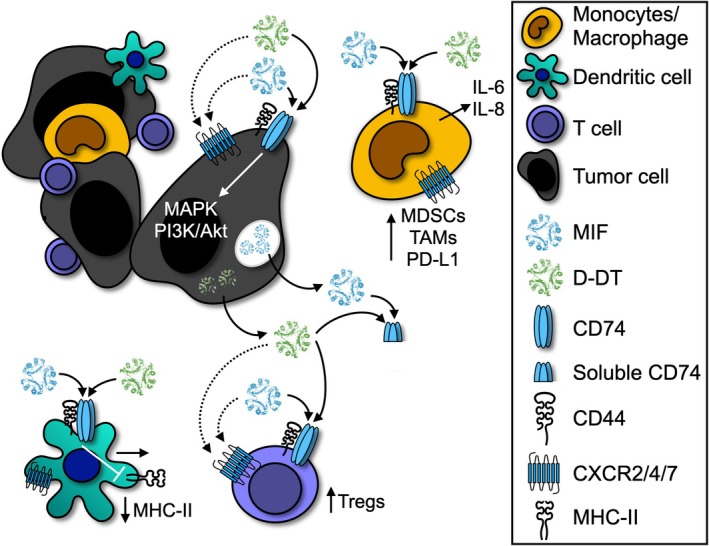 Figure 1
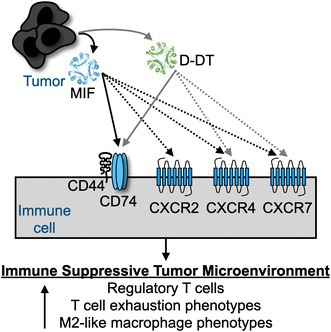 Figure 2
- —U.S. Department of Veterans Affairs 10.13039/100000738
- —Yale SPORE in Skin Cancer
- —Karin Bain and John Kukral Foundation
- —National Institute of Health
- —Yale SPORE in Head and Neck Cancer
- —Kuni Foundation Discovery Grant
Peer Reviews
No public reviews on file for this paper yet. If you reviewed it on a platform where reviews are public (OpenReview, ICLR, NeurIPS, ICML), you can paste yours below so the community can read it here.
Videos
No videos yet. Explain this paper in a talk, walkthrough, or lecture? Add one.
Taxonomy
TopicsMacrophage Migration Inhibitory Factor · Nuclear Receptors and Signaling
Shvefel and colleagues have identified MIF as a prominent upregulated cytokine responsible for mediating immune resistance in melanoma in a detailed multiomics study. The authors used a novel animal model and an unbiased approach to evaluate nonrejected B2905 melanoma single‐cell tumor clones with low genotypic heterogeneity, which is associated with superior survival outcomes in human disease. Tumors were evaluated by a multimodal and longitudinal approach to identify candidate genes, pathways, and cells associated with growth and immune resistance. As expected for melanoma, nonrejected tumors had expanded populations of protumorigenic macrophages and exhausted T‐cell phenotypes. The authors then generated MIF knockout (KO) clones of nonrejected tumor cells and did not find any changes in proliferation in vitro, but MIF KO tumors grew more slowly in immunocompetent mice. Reconstitution of tumors with varying ratios of MIF wild‐type and MIF KO clones led to corresponding changes in tumor volume.
While several prior studies have supported a role for MIF in tumor growth and aggressiveness, there are little data on the complex and dynamic roles of how MIF signaling directly impacts immune cell function, including recruitment, proliferation, and signaling [1]. While MIF is a cytokine, it is important to appreciate that it has both signaling and intracellular functions that promote tumorigenesis. The authors’ conclusions dovetail with those of several recent studies that have used orthogonal approaches to identify MIF as a target of tumor aggressiveness and immune resistance. Tessaro et al. for example found similar results in a sarcoma model [2], and Liao et al. identified MIF as a regulator of anti‐inflammatory mononuclear cells in hepatocellular cancer models [3]. Collectively, these studies demonstrate that the tumor or tumor‐associated fibroblasts are the main contributors of MIF expression, and that MIF pathologically shapes the immune landscape to contribute to an immune suppressive tumor microenvironment. Given that MIF has been implicated as a mediator of macrophage heterogeneity, future studies classifying macrophages in the context of MIF elimination will expand our understanding of the effects of MIF in the tumor microenvironment. The impact of MIF loss or inhibition on tumor cells is also likely cell‐line and context‐dependent, as other tumor models have shown mixed results related to MIF's role in proliferation and tumor growth [4]. Complete inhibition of MIF signaling in immune cells, therefore, may have unexpected consequences in different tumor types given MIF's pleotropic effects on monocyte polarization, proliferation, antigen presentation, and T‐cell activation. Additional work also is needed to determine whether these findings are translatable to more aggressive tumors with high‐intratumoral heterogeneity.
Notably, far less is known about the second MIF family member D‐dopachrome tautomerase (D‐DT or MIF‐2). The two cytokines activate the MIF family cognate receptor CD74 and have a shared but not completely overlapping ability to activate the noncognate chemokine receptors CXCR2, CXCR4, and CXCR7 [5, 6] (Figure 1). Like MIF, D‐DT expression is elevated across multiple tumors where it is implicated in aggressiveness [7], and both mediators are highly correlated at the mRNA and protein levels in the tumor and blood of cancer patients, respectively [8, 9]. Ongoing studies by our group suggest that dual inhibition of MIF and D‐DT may be therapeutically superior in mouse models of immunoresponsive tumors when compared to single cytokine or CD74 inhibition [10].
Thus, the study of MIF is complicated by the near ubiquitous expression of the cytokine and widespread presence of both its cognate and noncognate receptors across tumor and immune cells. Contrary to MIF and D‐DT being associated with poor survival, expression of their cognate receptor CD74 is associated with improved survival and increased intratumoral immune infiltration [9]. Furthermore, the extracellular domain of CD74 can be proteolytically cleaved to generate soluble CD74, which maintains ligand‐binding function and may serve as an antagonist. Elevated levels of soluble CD74 have been associated with improved survival in melanoma patients [11]. Similarly, Shvefel and colleagues found Cd74 to be increased across several time points in the rejected clones and in response to MIF KO tumor clones in their scRNA‐seq analysis. Ongoing studies to evaluate CD74 expressing immune populations and their unique contribution in the tumor microenvironment will be informative, particularly in response to MIF‐pathway inhibition.
Therefore, the study by Shvefel and colleagues is consistent with studies that have demonstrated MIF to be a driver of immune evasion, tumor aggressiveness, and poor clinical outcomes in animal models, as well as in retrospective patient clinical data [9]. Notably, MIF expression in humans is regulated by polymorphisms in its promoter, namely a functional ‐794 CATT(5‐8) microsatellite and a nearby ‐173G/C SNP that occurs in linkage disequilibrium with the microsatellite. It remains unclear how this transcriptional regulation is associated with clinical outcomes, particularly because the microsatellite structural variant is not represented in SNP‐based genome‐wide association studies. This information becomes further noteworthy with inroads being made into MIF allele‐specific transcriptional inhibitors [12].
There is ongoing clinical interest in blocking the MIF signaling pathway, which has been demonstrated to be well‐tolerated [13, 14, 15]. Prior to further clinical investigation, it will be important to understand the direct impact of MIF targeting on immune cells to complement the existing data put forth by Shvefel and colleagues. The present data additionally supports consideration of expanding clinical studies of anti‐CD74 (milatuzumab), which are currently limited to B‐cell malignancies [13].
Further advances in the new era of immune therapy will likely involve combinations of blocking pro‐tumorigenic cytokines such as MIF, increasing immune stimulatory cytokines to promote T‐cell survival and macrophage activation, and traditional immune checkpoint inhibitors. These types of combinations should help improve response rates and address treatment resistance in melanoma and other cancers.
Conflict of interest
RB and TT are co‐inventors on Yale‐managed patents for MIF pathway inhibitors. RB also serves on the advisory board for OncoOne.
Author contributions
TT wrote the commentary and made the figure. GSZ, RK, HK, and RB edited and provided expertise on the content.
The reference list from the paper itself. Each links out to its DOI / PubMed record.
- 1Bucala R , Donnelly SC . Macrophage migration inhibitory factor: a probable link between inflammation and cancer. Immunity. 2007;26:281–285.17376392 10.1016/j.immuni.2007.03.005 · doi ↗ · pubmed ↗
- 2Tessaro FHG , Ko EY , De Simone M , Piras R , Broz MT , Goodridge HS , et al. Single‐cell RNA‐seq of a soft‐tissue sarcoma model reveals the critical role of tumor‐expressed MIF in shaping macrophage heterogeneity. Cell Rep. 2022;39:110977. 10.1016/j.celrep.2022.110977 35732118 PMC 9249098 · doi ↗ · pubmed ↗
- 3Liao Y , Wu C , Li Y , Wen J , Zhao D . MIF is a critical regulator of mononuclear phagocytic infiltration in hepatocellular carcinoma. i Science. 2023;26:107273. 10.1016/j.isci.2023.107273 37520719 PMC 10371853 · doi ↗ · pubmed ↗
- 4Kindt N , Journe F , Laurent G , Saussez S . Involvement of macrophage migration inhibitory factor in cancer and novel therapeutic targets. Oncol Lett. 2016;12:2247–2253. 10.3892/ol.2016.4929 27698786 PMC 5038338 · doi ↗ · pubmed ↗
- 5Kang I , Bucala R . The immunobiology of MIF: function, genetics and prospects for precision medicine. Nat Rev Rheumatol. 2019;15:427–437. 10.1038/s 41584-019-0238-2 31197253 · doi ↗ · pubmed ↗
- 6Schwartz V , Lue H , Kraemer S , Korbiel J , Krohn R , Ohl K , et al. A functional heteromeric MIF receptor formed by CD 74 and CXCR 4. FEBS Lett. 2009;583:2749–2757.19665027 10.1016/j.febslet.2009.07.058PMC 2911026 · doi ↗ · pubmed ↗
- 7Valdez CN , Sanchez‐Zuno GA , Bucala R , Tran TT . Macrophage migration inhibitory factor (MIF) and D‐dopachrome Tautomerase (DDT): pathways to tumorigenesis and therapeutic opportunities. Int J Mol Sci. 2024;25:4849. 10.3390/ijms 25094849 38732068 PMC 11084905 · doi ↗ · pubmed ↗
- 8Merk M , Zierow S , Leng L , Das R , Du X , Schulte W , et al. The D‐dopachrome tautomerase (DDT) gene product is a cytokine and functional homolog of macrophage migration inhibitory factor (MIF). Proc Natl Acad Sci USA. 2011;108:E 577–E 585. 10.1073/pnas.1102941108 21817065 PMC 3161582 · doi ↗ · pubmed ↗