Percutaneous management of acute vascular occlusion after transcatheter aortic valve implantation procedure
Domingo López Vázquez, Fernando Rueda Núñez, Ramón Calviño Santos, Pablo Piñón Esteban, José Manuel Vázquez Rodríguez

Abstract
Genes, proteins, chemicals, diseases, species, mutations and cell lines named across the full text — each resolved to its canonical identifier and authoritative record.
Click any figure to enlarge with its caption.
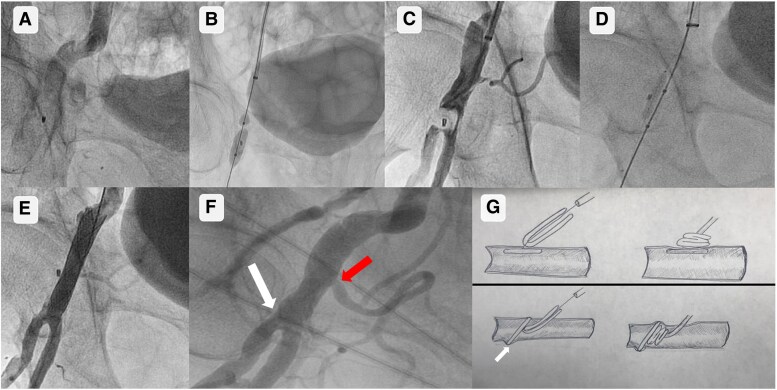 Figure 1
Peer Reviews
No public reviews on file for this paper yet. If you reviewed it on a platform where reviews are public (OpenReview, ICLR, NeurIPS, ICML), you can paste yours below so the community can read it here.
Videos
No videos yet. Explain this paper in a talk, walkthrough, or lecture? Add one.
Taxonomy
TopicsCardiac Valve Diseases and Treatments · Infective Endocarditis Diagnosis and Management
Case description
An 81-year-old male was admitted to our hospital for a transcatheter aortic valve implantation (TAVI) procedure. A balloon expandable aortic prosthesis was implanted through the right femoral artery, without complications. Once the procedure was completed, it was decided to close the right femoral artery with a collagen-based vascular closure device (MANTA) unsuccessful due to acute femoral artery occlusion (Figure 1A, Supplementary material online, Video S1).
(A) Acute femoral artery occlusion due to MANTA failure (white arrow). (B) Percutaneous balloon inflation through the anchor of the MANTA device. (C) Distal embolization of the MANTA device. (D) MANTA being pulled back into the common femoral artery zone. (E) Deployment of a self-expandable coated stent, trapping the MANTA against the artery wall. (F) Common femoral artery in baseline angiography, with a little gap between the femoral bifurcation (white arrow) and the inferior epigastric artery (red arrow). (G) Deployment of MANTA device at the arteriotomy site (top). Intravascular anchor hooked at the origin of the epigastric artery (white arrow) and deploy of the collagen plug through the arteriotomy (bottom).
A peripheral angioplasty balloon was inflated in order to restore flow in the limb and a ‘notch’ was observed, probably related to balloon inflation through the anchor of the MANTA device (Figure 1B). Unfortunately, these manoeuvres caused a distal embolization of the device (Figure 1C, Supplementary material online, Video S2). At that moment, a coronary angioplasty balloon was advanced to the superficial femoral artery, and both the balloon and intracoronary guidewire were withdrawn, successfully pulling the embolized device into the common femoral artery zone (Figure 1D, Supplementary material online, Video S3).
Once the MANTA was placed in the common femoral artery, a peripheral angioplasty balloon was inflated (Figure 1E, Supplementary material online, Video S4), followed by the deployment of a self-expandable coated stent, trapping the MANTA against the artery wall, waiting for the components of the device to be reabsorbed (see Supplementary material online, Videos S4 and S5).
The MANTA is a device with proven safety and efficacy with a technical success rate of more than 96% described,^1^ without significant differences between this or other vascular closure devices after TAVI.^2^ In this case, our suspicion is that the intravascular deployment of the device is related to the fact that the MANTA anchor may have ‘snagged’ at the origin of the inferior epigastric artery (Figure 1F) rather than at the arteriotomy site. Assuming the anchor was against the arteriotomy site, the operator pushed the collagen plug through the arteriotomy into the intravascular space, causing acute arterial occlusion (Figure 1G), being this theoretical source of complication postulated with the Angio-Seal device (Terumo Cardiovascular, Tokyo, Japan).^3^
The patient was discharged from the hospital 3 days after the procedure and remains asymptomatic after 48 months follow-up.
Supplementary Material
ytaf182_Supplementary_Data
The reference list from the paper itself. Each links out to its DOI / PubMed record.
- 1Krajcer Z, Wood DA, Strickman N, Bernardo N, Metzger C, Aziz M, et al Pivotal clinical study to evaluate the safety and effectiveness of the MANTA vascular closure device during percutaneous EVAR and TEVAR procedures. J Endovasc Ther 2020;27:414–420.32193971 10.1177/1526602820912224 · doi ↗ · pubmed ↗
- 2Doshi R, Vasudev R, Guragai N, Patel KN, Kumar A, Majmundar M, et al Clinical outcomes of MANTA vs suture-based vascular closure devices after transcatheter aortic valve replacement: an updated meta-analysis. Indian Heart J 2023;75:59–67.36640840 10.1016/j.ihj.2023.01.007PMC 9986740 · doi ↗ · pubmed ↗
- 3Palmer J, Hennemeyer CT, Woodhead GJ, Patel MV, Ruiz D, Mc Gregor HC. Intravascular deployment of an Angio-Seal device with successful endovascular snare retrieval. J Vasc Interv Radiol 2019;30:1703–1706.31378437 10.1016/j.jvir.2019.04.024 · doi ↗ · pubmed ↗