Correction: LRRK2 kinase plays a critical role in manganese-induced inflammation and apoptosis in microglia
Judong Kim, Edward Pajarillo, Asha Rizor, Deok-Soo Son, Jayden Lee, Michael Aschner, Eunsook Lee

Abstract
Genes, proteins, chemicals, diseases, species, mutations and cell lines named across the full text — each resolved to its canonical identifier and authoritative record.
Click any figure to enlarge with its caption.
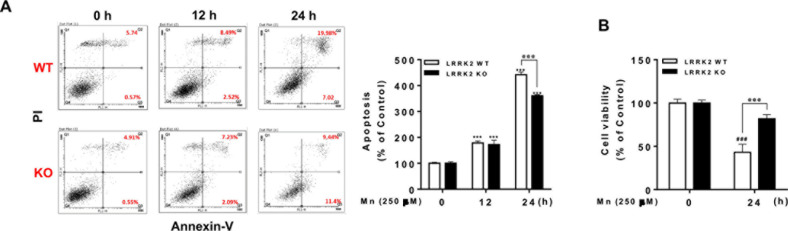 Figure 1
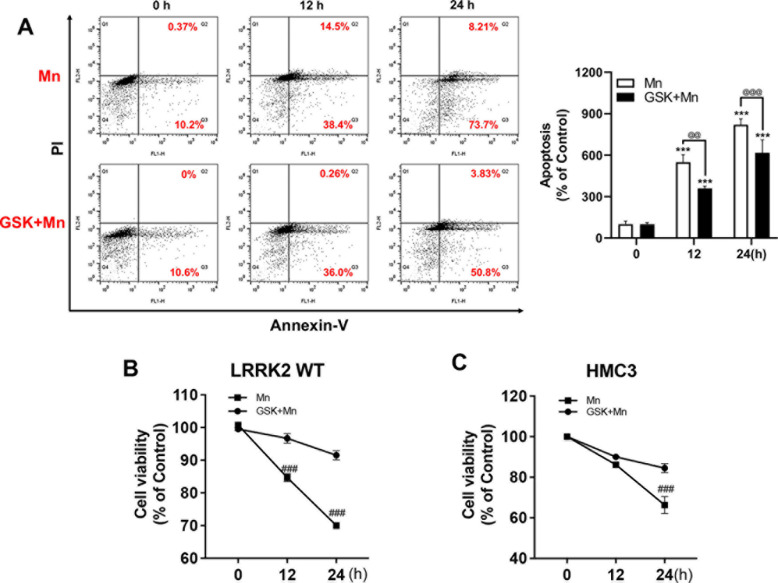 Figure 2
Peer Reviews
No public reviews on file for this paper yet. If you reviewed it on a platform where reviews are public (OpenReview, ICLR, NeurIPS, ICML), you can paste yours below so the community can read it here.
Videos
No videos yet. Explain this paper in a talk, walkthrough, or lecture? Add one.
Taxonomy
TopicsParkinson's Disease Mechanisms and Treatments · Alzheimer's disease research and treatments · Heavy Metal Exposure and Toxicity
Following the Expression of Concern [2] and subsequent Correction [3] published on this article [1], concerns were raised regarding the interpretation of the flow cytometry results presented in Figs 2 and 3.
Specifically, it appears necrotic cells have been included in a count of apoptotic cells in the Q2 population (Annexin V+ PI+).
The authors comment that the flow cytometry machine and program used for the experiment presented the imaging data in a clockwise quadrant image arrangement; Q1 is top left, Q2 is top right, Q3 is bottom right, and Q4 is bottom left, which was not clearly annotated in the original article. Because of the missing quadrant annotation, the published figure legends for Figs 2 and 3 could be misinterpreted. With this notice, Figs 2 and 3 have been updated to include quadrant annotations, and the legends for these figures have been updated to clarify the correct quadrant references.
Additionally, in Fig 3, it was noted that the majority of the cell population falls in Q1 (dead cells/necrotic) cells, even without treatments (0 hrs of Mn2+ treatment). This is due to incorrect gating. This error is corrected in an updated Fig 3 provided here.
The authors’ explanation, the gating strategy (S1 File), and the underlying data provided for Figs 2 and 3 (S2–S4 Files) were reviewed by an independent member of the PLOS One Editorial Board and an independent FACS expert, who concluded that the data provided (S1–S4 Files) appear to support the published results.
The authors apologize for the errors in the published article.
Supporting information
S1 FileGating strategy.(DOCX)
S2 FileFigs 2 raw data.(ZIP)
S3 FileFigs 3 raw data.(ZIP)
The reference list from the paper itself. Each links out to its DOI / PubMed record.
- 1Kim J, Pajarillo E, Rizor A, Son D-S, Lee J, Aschner M, et al. LRRK 2 kinase plays a critical role in manganese-induced inflammation and apoptosis in microglia. P Lo S ONE. 2019;14(1):e 0210248. doi: 10.1371/journal.pone.0210248 30645642 PMC 6333340 · doi ↗ · pubmed ↗
- 2The PLOS ONE Editors. Expression of Concern: LRRK 2 kinase plays a critical role in manganese-induced inflammation and apoptosis in microglia. P Lo S ONE. 2023;18(12):e 0296050. doi: 10.1371/journal.pone.0296050 38091319 PMC 10718406 · doi ↗ · pubmed ↗
- 3Kim J, Pajarillo E, Rizor A, Son D-S, Lee J, Aschner M, et al. Correction: LRRK 2 kinase plays a critical role in manganese-induced inflammation and apoptosis in microglia. P Lo S ONE. 2024;19(3):e 0300095. doi: 10.1371/journal.pone.0300095 38427617 PMC 10906887 · doi ↗ · pubmed ↗