Evaluation of search-enabled pretrained Large Language Models on retrieval tasks for the PubChem database
Ash Sze, Soha Hassoun

TL;DR
This paper explores how ChatGPT-4o can be used to retrieve data from the PubChem database, showing that it can effectively generate programmatic access.
Contribution
The study introduces a methodology for using a search-enabled LLM to access PubChem, demonstrating improved retrieval accuracy.
Findings
Instructing ChatGPT-4o to generate programmatic access yields correct answers more frequently.
A methodology was developed to adapt existing PubChem protocols into LLM prompts.
Iterative prompt refinement enhances the LLM's ability to retrieve accurate data.
Abstract
Databases are indispensable in biological and biomedical research, hosting vast amounts of structured and unstructured data, facilitating the organization, retrieval, and analysis of complex data. Database access, however, remains a manual, tedious, and sometimes overwhelming, task. The availability of Large Language Models (LLMs) has the potential to play a transformative role in accessing databases. We investigate in this study the current state of using a pretrained, search-enabled LLMs (ChatGPT-4o), for data retrieval from PubChem, a flagship database that plays a critical role in biological and biomedical research. We evaluate eight PubChem access protocols that were previously documented. We develop a methodology for adopting the protocols into an LLM-prompt, where we supplement the prompt with additional context through iterative prompt refinement as needed. To further evaluate…
Genes, proteins, chemicals, diseases, species, mutations and cell lines named across the full text — each resolved to its canonical identifier and authoritative record.
Click any figure to enlarge with its caption.
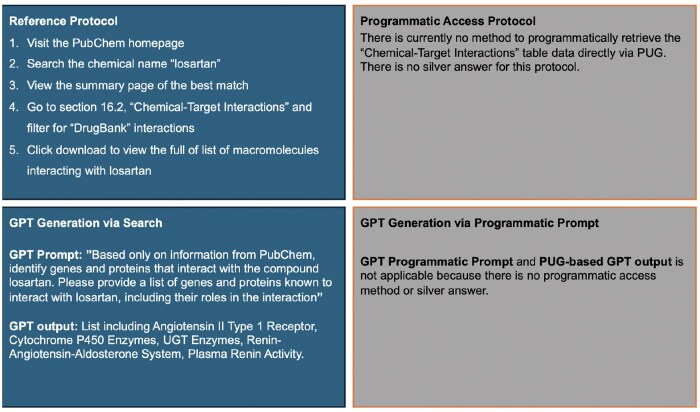 Figure 1
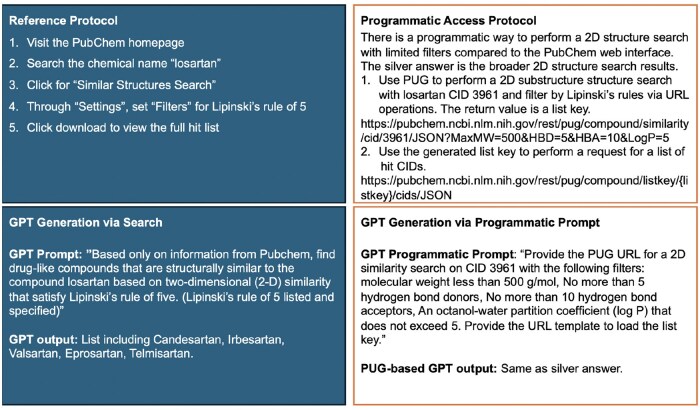 Figure 2
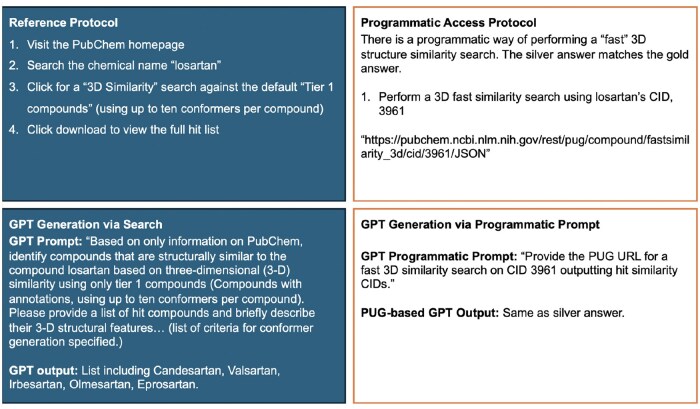 Figure 3
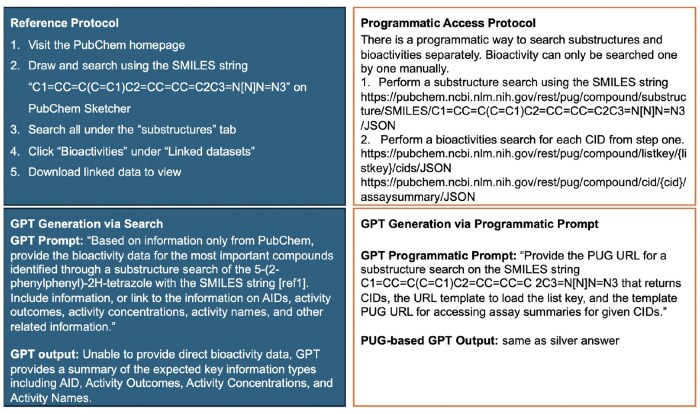 Figure 4
| PubChem access without LLM | GPT-4o | |||||
|---|---|---|---|---|---|---|
| Web interface versus programmatic access | GPT-4o results | Generation of URL for programmatic access | ||||
| Protocol | Gold matches silver answer? | If not, why? | Attained gold with initial prompt? | Attained gold with enhanced prompt? | Generated programmatic access URL? | Generated URL(s) are the silver answer? |
| 1 | No | No programmatic access method. | Partially, incomplete output with extraneous information | No improvement from initial prompt | N/A | N/A |
| 2 | Partially | Filtering through programmatic access yields a different result than filtering through the web interface | No, incorrect answers | No, shortened existing answer | Yes | Yes, but requires multiple steps |
| 3 | Yes | N/A | No, incorrect answers | No improvement from initial prompt | Yes | Yes |
| 4 | Partially | Programmatic access for bioactivity data is different than web access data | No, directed user to search on PubChem | No, created hypothetical data | Yes | Yes, but requires multiple steps |
| 5 | No | No programmatic access method. | Partially, 7 out of 14 drugs identified | No improvement from the initial prompt | No, faulty URL | N/A |
| 6 | Partially | Programmatic access output is different from web output | Partially, unable to provide full answer | No improvement from the initial prompt | N/A | N/A |
| 7 | No | No programmatic access method | No, incorrect answers | No improvement from the initial prompt | N/A | N/A |
| 8 | Yes | N/A | No, incorrect answers | No improvement from the initial prompt | No, faulty URL | N/A |
- —Multidisciplinary University Research Initiative10.13039/100014036
- —National Institutes of Health10.13039/100000002
Peer Reviews
No public reviews on file for this paper yet. If you reviewed it on a platform where reviews are public (OpenReview, ICLR, NeurIPS, ICML), you can paste yours below so the community can read it here.
Videos
No videos yet. Explain this paper in a talk, walkthrough, or lecture? Add one.
Taxonomy
TopicsComputational Drug Discovery Methods · Metabolomics and Mass Spectrometry Studies · Biomedical Text Mining and Ontologies
1 Introduction
Efficient and instantaneous access to comprehensive and well-organized biological databases is crucial for advancing research, development, and innovation (Baxevanis and Bateman 2015). There are now a multitude of such databases, including PubChem, UniProt, PDB, MetaCyc, BRENDA, KEGG, and many others. Despite the tremendous growth in the size and scope of enzymatic and biological databases, finding and linking relevant data within and across such databases is a daunting task that hinders biological discovery and the development of data-driven machine-learning approaches. While the development of programmatic access facilitates this access, it often requires a programming background, which may hinder access to unskilled biological or biomedical researchers. Importantly, the availability of Large Language Models (LLMs) has the potential to play a transformative role in accessing databases. LLMs, which are built using transformer models (Vaswani et al. 2017), tokenize their inputs and learn model parameters based on a training corpus. These models can be used for generative AI: to produce content (text, code, images, and recently video) based on input prompts in natural language. Such generative capabilities have enabled assistive technologies such as GitHub CoPilot for code generation, Grammarly as a virtual writing assistant, Vi Trainer as a virtual health coach, and Microsoft CoPilot to assist with productivity tasks. For databases, LLMs are poised to simplify and streamline access through a natural language interface and provide coherent analytical summaries, thus expediting search and knowledge retrieval. Indeed, while there are tremendous efforts for using LLMs for Information Retrieval (IR) through re-writing queries and expedited retrieval and ranking of results (Zhu et al. 2023), there are currently limited studies on using pretrained LLMs such as GPT-4 for database access or on creating customized LLM-based agents for database access. For example, a recent benchmark, BIRD (a BIgbench for laRge-scale Database) with text-to-SQL tasks spanning 95 databases and 37 professional domains, was evaluated using GPT-4 (Li et al. 2023). A recent specialized GPT-3-based LLM is trained on several database-related tasks including query rewriting and index tuning (Zhou et al. 2024). GeneRAG enhances LLMs such as GPT-4 with gene-related tasks by retrieval augmentation generation (Lin et al. 2024). There are preliminary data supporting the idea that the use of long-context LLMs can even subsume retrieval, RAG, and SQL (Lee et al. 2024).
We investigate in this paper the use of pretrained search-enabled LLMs for data retrieval from the PubChem database. Search-enabled LLMs are recent models that provide the capabilities of internet searching to provide the LLM with the most up-to-date relevant context. For example, OpenAI’s GPT-4 and GPT-4o (“o” is for omni), a faster version of GPT-4, and Google’s Gemini, provide such capabilities. Hence, such models can provide a relevant specific context for a user query. Importantly, a user could instruct such an LLM to primarily rely on data retrieved from a particular database. Here, we select GPT-4o to explore its capabilities in retrieving data from the PubChem database.
Using GPT-4o, we explore retrieval from the PubChem database. PubChem is a flagship public database at the NCBI of the National Library of Medicine (NLM) (Fu et al. 2015; Kim 2016; Kim et al. 2016; Kim et al. 2021; Kim et al. 2023; Kim and Bolton 2024).
While effective, programmatic access to PubChem and other databases requires detailed guidance. To facilitate access to PubChem, a recent paper (Kim 2021) provided a detailed guide on how to effectively use PubChem’s extensive resources and tools for various research purposes. By offering detailed step-by-step instructions, the paper enhances users’ ability to search for and analyze chemical information, perform similarity searches, retrieve bioactivity data, and understand the relationships between chemicals and biological entities. For example, retrieving stereoisomers and isotopomers of a compound requires six detailed steps that include configuring the relevant search options.
Indeed, a detailed examination of the protocols demonstrates that users may find navigating the extensive interface overwhelming, especially with numerous tabs and sections that need to be explored to locate specific information. The vast amount of data retrieved during searches requires further filtering and interpretation to find relevant results. Additionally, setting up effective search parameters, particularly for advanced searches involving chemical structures and similarity scores, demands intimate knowledge of the search parameters. Finally, regularly updating and managing large datasets derived from PubChem for Machine Learning applications can be cumbersome. These challenges are not unique to PubChem; search and programmatic access for other databases such as KEGG or UniProt can also be challenging.
Here, we explore the use of GPT-4o on commonly used PubChem tasks (Kim 2021). The eight tasks include finding genes and proteins that interact with a query compound, finding compounds with various similarity metrics or properties based on 2D or 3D similarity searches, computing similarity searches between compounds, retrieving bioactivity data from a substructure search, finding drugs that target a particular gene, finding compounds with classifications, and retrieving a query compound’s stereoisomers and isotopomers. For example, instead of manually executing many steps, the prompt can be, “Based only on information from PubChem, find stereoisomers and isotopomers of valsartan.” Ideally, the results retrieved via the protocol steps and the prompt should be identical. Our evaluation first generates gold and silver answers for each task. The gold answer is obtained via executing the protocol through PubChem’s interface, while the silver answer is generated from executing the programmatic access for that protocol. In some cases, there are differences between the two due to built-in capabilities within the PubChem web interface (e.g. filtering function) that are not supplied through programmatic access. After converting the reference protocol into a prompt, we instruct GPT-4o to respond to the query or to generate the programmatic access. We compare the results against the gold and silver answers respectively. Our paper is the first to evaluate the ability of GPT-4o in retrieving information from a biological database such as PubChem. The contributions of the paper are:
Assessing the performance of GPT-4o in accessing the PubChem database on eight representative and commonly requested tasks (Kim 2021), and qualitatively and quantitatively comparing the results against those obtained via the PubChem interface and through programmatic access.We show that retrieval through direct prompting is currently not satisfactory for all eight protocols, despite prompt enhancements, reflecting the lack of deep understanding of chemistry and limitation in access and retrieval modalities for the LLM.We show that code generation for the programmatic access is consistently more successful in retrieving the relevant data than prompting for direct retrieval when the programmatic access is available, and report success in 3 out of 5 cases.We outline current values and limitations of using a pretrained general-purpose search-enabled LLMs in accessing databases and outline future directions to improve LLMs for database access.
2 Methods
2.1 The task protocol and its adaptation into a prompt
To evaluate GPT-4o’s capabilities, we used eight PubChem retrieval protocols from Kim (2021). Each of the tasks is outlined in [Figs 1–4](#vbaf064-F1 vbaf064-F2 vbaf064-F3 vbaf064-F4), and Supplementary Figs S1–S4. The reference protocol steps for each task are outlined in the upper left panel of each figure. While the steps in the protocol are generic (applicable to any compound or any gene), each protocol is made specific per the details provided in the reference. For example, Protocol is applied to CID 60846, corresponding to valsartan.
Protocol #1 for finding genes and proteins that interact with a given compound, made specific for losartan.
Protocol #2 for finding drug-like compounds similar to a query compound through 2D similarity search, made specific for losartan filtered through Lipinski’s rule of 5.
Protocol #3 for finding compounds similar to a query compound through 3D similarity search, made specific for losartan.
Protocol #4 for getting the bioactivity data for the hit compounds from substructure search, made specific for C1=CC=C(C=C1)C2=CC=CC=C2C3=N[N]N=N3.
2.1.1 Initial protocol adaptation
Each protocol was formed into a prompt using the following process. The protocol’s specific details were utilized, and steps related to dynamic content handling via the PubChem web interface we ignored. Next, the question within the protocol was rephrased into a single, cohesive query for GPT-4o. To align with the referenced protocol, the prompts instructed GPT-4o to use only data from PubChem, explicitly avoiding external sources to maintain the accuracy and relevance of the retrieved data. In the cases where Python code was generated in response to our first prompt, we modified the prompt to avoid any code generation. The lower left panel in each figure displays the prompts used for each protocol and the summarized GPT-4o output.
2.1.2 Exploration of enhanced protocol
As GPT-4o is interactive, we examined feedback from the initial prompt, and judiciously prompt engineered the query by adding relevant context. Several types of enhancements were made. GPT-4o seemed sensitive to the question; we, therefore, refined our prompts to use certain phrases such as “list” versus “retrieve” to determine the phrasing that yielded the most accurate responses from GPT-4o. Another enhancement was through providing additional information. For instance, Protocol #2 aims to find drug-like compounds similar to a query compound through 2D similarity search and then selects filtering, based on Lipinski’s rule of five, available through the PubChem interface to filter the results. In this case, we provided a detailed description of Lipinski’s rule. We further enhanced the prompt, for example, by removing requests to computationally generate 2D or 3D models, a function available in PubChem but not through GPT-4o. When working with programmatic prompts, certain PubChem key terms such as “3D structure search” in Protocol 3, and “same stereo/isotope” in Protocol #8 needed to be especially emphasized as URL operations, specifically “fast 3D similarity search” and “fast identity search” to generate the correct link. In the case of highly specific PUG operations, such as in Protocol 5, the entire link template for the search from PubChem’s PUG-REST API is needed for a correct output. See the Appendix for all enhanced prompts.
2.2 Protocol adaptation into a prompt with programmatic access
As PubChem provides programmatic access, we explore prompting GPT-4o to retrieve information via programmatic access and compare the retrieval results against our prompts described above that do not specifically instruct the GPT-4o to generate code. First, however, we manually explored PubChem’s PUG capabilities in servicing the protocol. This process allowed us to assess if programmatic access alone (not through the web interface) can secure the results attained through the reference protocols as we expected the PubChem web interface provided additional filtering capabilities not available through programmatic access. The upper right panel in each figure describes the programmatic access available for each protocol. In some cases, such as in Protocol #1, where the aim is to find genes and proteins which interact with a given compound, there is currently no programmatic access to the Chemical-Target interactions table using the PUG-REST, per PubChem web documentation. Such a limitation prevents the GPT-4o from generating programmatic access to retrieve data. The bottom right of each figure specifies the prompt used on GPT-4o to generate URLs for programmatic access.
2.3 Prompt engineering
Prompt engineering is now recognized as essential for obtaining accurate and relevant responses from LLMs (Sahoo et al. 2024). We found that minor changes to the wording of queries significantly impact the model’s behavior. When querying GPT-4o to provide data from PubChem, using terms like “show” or “list” tends to yield better results than “analyze” or “retrieve,” which often lead to differing information or nonfunctional code. In some instances, as for Protocols #3, 4, and 7, the prompt resulted in Python code without the prompt requesting programmatic prompting. With enhanced prompting through interactive refinement, we added contextual information or definitions to clarify some protocols. For example, when enhancing the prompt for Protocol #2, Lipinski’s rule of five was elaborated upon as “a molecular weight less than 500 g/mol, no more than 5 hydrogen bond donors, no more than 10 hydrogen bond acceptors, an octanol-water partition coefficient (log P) that does not exceed 5.” This resulted in the final, enhanced prompt being “Based only on information from Pubchem, find drug-like compounds that are structurally similar to the compound losartan based on two-dimensional (2-D) similarity that satisfy Lipinski’s rule of five. (Lipinski’s rule of 5 listed and specified).” Clarifications were also provided for “tier 1 compounds,” where the following was added to the prompt, “Generate a conformer model for each compound if it satisfies the following criteria: not too large (with 50 non-hydrogen atoms), not too flexible (with 15 rotatable bonds), has fewer than six undefined atom or bond stereocenters, has only a single covalently bonded unit (i.e. not a salt or a mixture), consists of only supported organic elements (H, C, N, O, F, Si, P, S, Cl, Br, and I), and contains only atom types recognized by the MMFF94s force field.” This resulted in the final, enhanced prompt being “Based on only information on PubChem, identify compounds that are structurally similar to the compound losartan based on three-dimensional (3D) similarity using only tier 1 compounds (Compounds with annotations, using up to ten conformers per compound). Please provide a list of hit compounds and briefly describe their 3-D structural features… (list of criteria for conformer generation specified.)” Importantly, adapting the reference protocol into one understandable by GPT-4o, and further enhancing it to yield better outputs or programmatic URLs is a task suited for all researchers, regardless of their coding proficiency.
2.4 Selection of LLM model for evaluation
GPT-4o was selected for this study based on its performance across various metrics and user preferences evaluated on the Chatbot Arena (Chiang et al. 2024). This resource ranks LLM models based on human votes in categories such as overall performance, multi-turn conversations, handling longer queries, hard prompts, and coding capabilities. Users compare outputs from two anonymous models, side-by-side, and vote for the better response. GPT-4o ranks first in key categories, including overall performance, hard prompts (overall and in English), responding to longer queries, and English proficiency. It ranks second to Claude in the multi-turn category, which is essential for maintaining coherent and contextually accurate conversations over multiple interactions, particularly for complex queries requiring step-by-step guidance. Additionally, GPT-4o’s ability to retrieve information from websites offers an advantage for accessing up-to-date data and supporting real-time information needs, which is critical for dynamic databases like PubChem. GPT-4o’s superior performance and user-preferred ranking make it a suitable option for evaluating the retrieval tasks in this study.
2.5 Evaluation method
With the execution of the basic protocol, the GPT-4o prompts (and their enhanced versions if utilized), the programmatic access, and the GPT-4o programmatic prompts, we can compare the results using the four methods. The execution of the basic protocol through the PubChem website per the instructions in Kim (2021) yields the “gold” answers to the queries. The execution of known programmatic access to execute the queries reflects the available answers through such modality, which we label as the “silver” answers. We, therefore, compare the GPT-4o responses to the gold answers when executing the GPT-4o prompts and we also compare the results of running the GPT-4o programmatic prompts to the silver answers. As current GPTs cannot run the generated code, we manually evaluated the generated code.
3 Results
Our study evaluates the responses of GPT-4o in response to prompting and code generation. We provide a summary of our results, highlighting comparisons between the gold and silver answers, the gold answers and the prompts that did not specifically request using the programmatic access, and the silver answers and the prompts that specifically were designed to generate programmatic access.
3.1 Summary of results for using GPT-4o on the protocols
Table 1 provides a summary of running the eight protocols using the four retrieval methods. When comparing the gold and silver answers, we were able to obtain the same answers in two cases, partial overlaps in three cases, and no matches in three cases. The reason for partial or no match is due to additional capabilities available through the web interface that are not available through the programmatic access or the lack of programmatic access.
When examining the output of GPT-4o due to our initial prompting, three cases resulted in partial matches to the gold answers, where only a subset of the results are provided. From examining the GPT-4o response, we noted different search sources were utilized other than PubChem, despite specific instructions to search from only PubChem. In the four other cases, the response was incorrect. In one case (Protocol #4), GPT-4o directed the user to visit the PubChem website. Even with enhanced prompting, such as providing additional information or coaxing GPT-4o with different variations of the prompt, we did not witness material improvements in the responses. In one case (Protocol #4), GPT-4o hallucinated by creating a fictitious table using randomly GPT-4o-generated numbers.
Examining the output of GPT-4o when instructed to generate the URL(s) for programmatic access, there was one case (Protocol #7) where no programmatic access was possible. There were four correct URLs that matched the silver answer. In the remaining three cases, the generated URLs were faulty.
In summary, enhanced prompting did not yield improved results. However, quantitative analysis showed that such results are more useful to prompt follow-up interactions with the GPT-4o. Additionally, GPT-4o was better at generating the relevant URLs than performing search. Our analysis of the gold versus silver answers also revealed a gap in the capabilities of the programmatic access. Currently, GPT-4o is not sufficient to replace manual search on PubChem’s web interface.
3.2 Detailed examples
To enhance the understanding of the prior results, we describe our experiences with GPT-4o in more detail in this section using several protocols. Details of the other protocols are provided in Supplementary File 1.
3.2.1 Protocol 1
The first protocol identifies genes and proteins that interact with losartan. Such data in PubChem originate from several sources, including DrugBank (Wishart et al. 2008), Drug-Gene Interaction database (Freshour et al. 2021), and others. The PubChem web interface guides the user to go to section 16.2 (Chemical-Target Interaction) and filter against DrugBank interactions. The gold results (see full results in the Supplementary Appendix) include several Cytochrome enzymes, UDP-glucuronosyltransferases, and others.
Based on prompting, GPT-4o provides correct yet incomplete results. The response is missing certain entries, for example, Cytochrome P450 2C19, Cytochrome P450 2C8, and ATO-dependent translocase ABCB1. GPT-4o elaborates on each interaction with information external to PubChem and DrugBank such as Wikipedia (see partial results in Fig. 1). The names of some interactions and proteins differ slightly from PubChem, indicating the results were acquired from external sources or training data. While the PubChem protocol had a strict definition of what qualifies as an interaction, and where the interactions must be sourced from, GPT-4o interpreted interactions as broader, and therefore included information about downstream effects of these interactions, listing “RAAS” and “Plasma Renin Activity” in the list of proteins and genes affected. Enhanced prompting for this protocol involved excluding downstream effects and protein or gene information and emphasizing the need for data to be only from PubChem. Unfortunately, any engineering to enhance the prompt led to incorrect answers with non-PubChem sources which strayed further from the established gold answer. There is currently no method to retrieve the same information through programmatic access. Therefore, the silver answer is not available (refer to Fig. 1 for a full protocol summary).
3.2.2 Protocol 2
The second protocol aims to find drug-like compounds similar to losartan based on a two-dimensional (2D) similarity search using PubChem. The PubChem web interface guides users to perform a “Similar Structures Search” and apply Lipinski’s rule of five filters. The gold answer includes a detailed list of compounds that match the specified criteria (see full results in the Supplementary Appendix).
GPT-4o attempts to provide a list of compounds that are structurally similar to losartan while adhering to Lipinski’s rule of five. However, the results are incorrect when compared to the gold answer. None of GPT-4o’s outputs, such as Candesartan and Irbesartan, match the gold answer. Looking into the external links provided by GPT-4o shows that the model interpreted losartan as all types of losartan, including losartan Sodium. Enhanced prompting for this protocol involved specifying losartan as only “losartan” and not other variations of the drug. This enhanced prompt only shortened the output, leaving it with Candesartan, Irbesartan, and Valsartan, which were still incorrect when compared to the gold standard.
To retrieve similar information programmatically, we used PUG to perform a 2D substructure search for losartan with CID 3961 and applied filters for Lipinski’s rule of 5. The programmatic access involved using a URL to perform the search and obtain a list key, which was then used to request a detailed list of hit CIDs. This method provided comprehensive and accurate results that align with PubChem’s standards, but upon comparison with the gold answer, the retrieved information filtered on broader criteria, leading to a longer list of hit targets inclusive of the gold answer. This silver answer highlights a significant difference between searches done on PUG and the PubChem web interface.
We also prompted GPT-4o with a programmatic access approach to provide a PUG link for the 2D similarity search. The prompt included specific criteria, such as molecular weight, hydrogen bond donors and acceptors, and partition coefficient limits according to Lipinski’s rule of five. GPT-4o generated the silver answer PUG URL. Although this is a multi-step protocol, requiring the user to manually input the generated list key for the final result, the programmatic prompt effectively provided the most relevant PUG URL templates for each step for detailed data access (refer to Fig. 2 for a full protocol summary).
3.2.3 Protocol 3
The third protocol aims to find compounds similar to losartan based on a three-dimensional (3D) similarity search using PubChem (Fig. 3). The data originate from PubChem’s chemical database. The PubChem web interface guides users to perform a “3D Similarity” search against the default “Tier 1 compounds” (compounds using up to 10 conformers per compound). The gold standard results include a detailed list of compounds that match the specified criteria (see full results in the Supplementary Appendix).
GPT-4o attempts to provide a list of compounds that are structurally similar to losartan while adhering to the specified 3D similarity criteria. However, the results are incorrect and contain discrepancies. The compounds listed by GPT-4o do not correspond to any of the 28 hit compounds from the gold answer. Additionally, Candesartan and Olmesartan listed by GPT-4o have incorrect CIDs when compared to PubChem. Attempting to enhance the prompt with details on the definition of “tier 1 compounds” (the default search filter applied by PubChem on similarity searches) does not change the correctness of the answer.
To retrieve similar information programmatically, we utilized PUG to perform a “fast” 3D similarity search for losartan using CID 3961. The programmatic access involved using a URL to perform the search and obtain detailed compound data. This method provided comprehensive and accurate results that align with the gold answer.
We also prompted GPT-4o with a programmatic access approach to provide a PUG link for the fast 3D similarity search. GPT-4o generated the correct PUG URL, which corresponds to the silver as well as gold answer. The programmatic prompt effectively provided the necessary link for data access (refer to Fig. 3 for a full protocol summary).
3.2.4 Protocol 4
The fourth protocol aims to get bioactivity data for hit compounds identified through a substructure search using a specific SMILES string in PubChem (Fig 4). The data originate from various sources within PubChem’s database. The PubChem web interface guides users to draw and search using the SMILES string “C1 = CC=C(C=C1)C2 = CC=CC=C2C3 = N[N]N=N3” on the PubChem Sketcher, search under the “substructures” tab, click “Bioactivities” under “Linked datasets,” and download the linked data to view the bioactivity results (see full results in the Supplementary Appendix).
GPT-4o is limited in answering multimodal questions, such as those involving SMILES formulas and drawn structures. When GPT-4o is given the SMILES formula, it cannot directly perform a structure search on PubChem. Instead, it instructs users on how to conduct the search and provides limited information through external links. As a result, GPT-4o can only provide a summary of the expected key information types, including AID, Activity Outcomes, Activity Concentrations, and Activity Names, but not the direct bioactivity data itself. Attempting to enhance the prompt led to code generation which created hypothetical data unrelated to actual PubChem data.
To retrieve similar information programmatically, we utilized PUG to perform a substructure search using the given SMILES string. This was followed by performing a search for bioactivities for each CID from the initial search results. Alternatively, a CSV file of all bioactivities of CIDs can be downloaded if all CIDs are listed in the same link. This method involved using specific URLs to first obtain a list of CIDs from the substructure search and then retrieve detailed bioactivity data for each CID. This approach is labor-intensive and more difficult to interpret than the web interface but provides highly comprehensive results that align with PubChem.
We also prompted GPT-4o with a programmatic access approach to provide a PUG link for the substructure search using the given SMILES string. The prompt included specific criteria to return CIDs, load the list key, and access assay summaries for the given CIDs. GPT-4o generated the correct PUG URLs, allowing for accurate retrieval of compound and bioactivity data, corresponding to the silver answer (refer to Fig. 4 for a full protocol summary).
4 Discussion
4.1 Observed limitations of GPT-based retrieval
In evaluating GPT-4o on the eight protocols, we observed several limitations that contributed to the difficulty of using GPT-4o for retrieval and in realizing the gold and silver answers. One limitation is that GPT-4o was not able to follow instructions. For example, it did not necessarily limit its search to PubChem. GPT-4o searched and cited external sources such as Wikipedia to support its answers. For example, this issue is present in Protocols 1, 5, and 6, where Wikipedia is directly cited. Further, the model could not effectively apply filters or rules, such as the rule of five or Boolean operations, demonstrating limitations in following complex, conditional instructions. Even with enhanced prompting (e.g. specifying Lipinksi’s rule of 5), GPT-4o could not apply such knowledge effectively, indicating the lack of fundamental understanding of chemistry or utilizing this knowledge to effectively filter the results.
Another limitation is the lack of multi-modal capabilities within GPT-4o. Search cannot be performed using drawings of compounds, and we did not observe positive results when using SMILES strings. Another limitation is GPT-4o’s lack of direct access to code bases in modules such as PubChemPy and RDKit. Such modules can aid in filtering and aggregation, capabilities currently built into the PubChem web interface. Even with code generation (not execution), the generated URLs were not always generated correctly. Yet another limitation is the variability in responses due to the input prompt. For example, we observed sensitivity to keywords in the input prompt. When providing partial answers, such as Protocols 1, 5 and 6, GPT-4o arbitrarily selects subsets of results as relevant without clear justification for excluding others. This inconsistency poses a challenge for reproducibility and reliability and potentially reflects the sampling aspect of the LLMs.
4.2 Observed value of GPT-based retrieval
Despite its tremendous shortcomings in generating the gold and silver answers, there were key observed values in utilizing GPT-4o. GPT-4o shows promise in performing semantic searches and presents an advantage over traditional search engines such as Google, especially for queries requiring nuanced understanding or involving multiple search steps. For example, searching Protocol #1 in Google results in hits to multiple pages, including the PubChem page for the relevant compound, published paper, DrugBank, the Rat Genome Database, and others. With the PubChem page hit, a user must visit the various page sections to identify the relevant information. Another perceived advantage is the interactivity between human and GPT while retaining the context and history of a given conversation. Coherent and continuous dialogues enable users to build on previous queries without restarting. This personalized approach is beneficial for complex queries that require step-by-step guidance and contextual understanding (in search and programmatic access). When offering guidance or step-by-step instructions, GPT-4o helps users in understanding of the processes involved in retrieving and analyzing chemical information. For example, in Protocol 4, where GPT-4o could not directly perform a substructure search using a SMILES string, it instead guided users on how to conduct the search manually through the web interface. This instructional capability enhances user comprehension of PubChem’s functions and encourages users to perform complex searches independently.
When prompting GPT-4o for the URLs for programmatic access, the provided links resulted in correct answers in three of the five cases where programmatic access was available. An important outcome is that the programmatic link leads to only PubChem-based information. GPT-4o’s ability to generate partial code promises to enhance user productivity, particularly for a coder unfamiliar with the PubChem programmatic access. The generated code, even if requiring refinement and debugging, provides a foundation that reduces the effort required to set up the basic framework. For example, in Protocol 2, GPT-4o provided Python code for implementing Lipinski’s rule of five. This capability not only accelerates the development process but also allows users to focus more on refining and analyzing data rather than on preliminary coding tasks.
4.3 Future vision for LLMs for PubChem and other databases
There are two potential parallel future directions. One direction is to enhance existing general-purpose pretrained LLMs for database access through various improvements. Fundamentally, intelligently using a general-purpose LLM for accessing biological and chemical databases requires deeper, nuanced understanding of chemistry, biology and biochemistry, and learning the application of these disciplines to the retrieved results. Enhancing different search modalities will enable handling queries involving SMILES notation and structural drawings, as encountered in Protocol 4. Providing the LLM with access to external analytical tools such as RDkit and PubChemPy would guarantee the LLM to carry out searches through the PubChem database rather than external sources. Integrating knowledge graphs that power a database such as PubChem by linking chemical compounds to their properties, interactions, and literature would prevent misinterpretations of key words and operations. Enhancing semantic search capabilities would improve an LLM’s ability to interact with users, handle complex queries, and retrieve data. Designing a system for task decomposition would allow LLMs to break down multi-step queries into manageable sub-tasks, which can then be picked up by humans if any steps go wrong. Personalization for individual users based on experience level and research topic is unique to LLM memory and can provide more tailored and relevant information. In combination with validation mechanisms, users can be sure the retrieved data meet specific criteria even for highly technical searches.
Another possibility is to create chatbots specialized for a specific discipline (biochemist expert) or for specific database(s), for example, a chatbot for PubChem, or a combination thereof. Using a specialized LLM for interactive PubChem search combines the ease of communicating in natural language with the reliable and exact search capabilities of PubChem. Using a specialized chatbot as a copilot in instructing users on how to perform search or providing general links to relevant information on PubChem improves overall accessibility to the database’s resources. These advancements will collectively enhance the functionality and user experience of LLMs in scientific research. Enriching such an LLM with additional biological, chemical, or biochemical knowledge can even yield improved performance.
5 Conclusion
We are in the early stages of exploring the use of LLMs as an integral part of science and discovery. Here, the study evaluated the capabilities and limitations of a pretrained, searched-enabled LLM in accessing and retrieving data from the PubChem database. The results in Table 1 indicate limitations that prevent current LLMs from being sufficient as a standalone PubChem search and retrieval tool. Even with enhanced prompting, GPT-4o lacked the domain knowledge to interpret and filter the results. While GPT-4o was successful in generating some of the URLs for programmatic access, it was not successful in all cases. Our perceived value is that the GPT-4o can fulfill the role of a (sometimes trusted) tutor. This initial study highlights the need for significantly improved LLMs with domain expertise, combined with LLMs specialized in database retrieval. We suspect that the latter agents must understand not just the semantics of the data stored within the database, but the intricate relationships among its entities (e.g. the underlying knowledge graph). In addition, we expect that improvements in general-purpose LLMs, such as instruction following, multi-modal capabilities, and others, can pave the way to smarter chatbots for database access. However, as the technology advances swiftly, perhaps we will be pleasantly surprised within the next decade to have one intelligent agent capable of it all!
Supplementary Material
vbaf064_Supplementary_Data
The reference list from the paper itself. Each links out to its DOI / PubMed record.
- 1Baxevanis AD , Bateman A. The importance of biological databases in biological discovery. Curr Protoc Bioinformatics 2015;50:1.1.1–8.10.1002/0471250953.bi 0101 s 5026094768 · doi ↗ · pubmed ↗
- 2Chiang W-L , Zheng L, Sheng Y et al Chatbot arena: an open platform for evaluating LL Ms by human preference. In: International Conference on Machine Learning, 2024.
- 3Freshour SL , Kiwala S, Cotto KC et al Integration of the drug–gene interaction database (DG Idb 4.0) with open crowdsource efforts. Nucleic Acids Res 2021;49:D 1144–51.33237278 10.1093/nar/gkaa 1084 PMC 7778926 · doi ↗ · pubmed ↗
- 4Fu G , Batchelor C, Dumontier M et al Pubchemrdf: towards the semantic annotation of pubchem compound and substance databases. J Cheminform 2015;7:34.26175801 10.1186/s 13321-015-0084-4PMC 4500850 · doi ↗ · pubmed ↗
- 5Kim S. Getting the most out of pubchem for virtual screening. Expert Opin Drug Discov 2016;11:843–55.27454129 10.1080/17460441.2016.1216967 PMC 5045798 · doi ↗ · pubmed ↗
- 6Kim S. Exploring chemical information in pubchem. Curr Protoc 2021;1:e 217.34370395 10.1002/cpz 1.217PMC 8363119 · doi ↗ · pubmed ↗
- 7Kim S , Bolton EE. 2024. Pubchem: a large‐scale public chemical database for drug discovery. Open Access Databases and Datasets for Drug Discovery, pages 39–66.
- 8Kim S , Chen J, Cheng T et al Pubchem in 2021: new data content and improved web interfaces. Nucleic Acids Res 2021;49:D 1388–95.33151290 10.1093/nar/gkaa 971PMC 7778930 · doi ↗ · pubmed ↗