Squaramide-Catalyzed Asymmetric Michael Addition/Cyclization Reaction for the Synthesis of Chiral Bisspiro Barbituric Acid–Oxindole Derivatives
De-Jun Qiao, Da-Ming Du

TL;DR
A new method was developed to efficiently create chiral bisspiro compounds using a squaramide catalyst, achieving high yields and excellent stereoselectivity.
Contribution
A novel squaramide-catalyzed tandem reaction for synthesizing chiral bisspiro barbituric acid–oxindole derivatives with high stereoselectivity.
Findings
The reaction achieved good-to-high yields (up to 97%) with excellent stereoselectivities (up to >99% ee, >20:1 dr).
The method was successfully applied on a gram scale, demonstrating its practicality.
Abstract
An efficient stereoselective strategy for the synthesis of chiral bisspiro barbituric acid–oxindole derivatives was developed. The asymmetric Michael addition/cyclization tandem reaction between benzylidene barbituric acids and oxindolylmalonitriles was catalyzed by squaramide catalyst, and the corresponding spirocyclic products were obtained in good-to-high yields (up to 97%) with excellent stereoselectivities (up to >99% ee, >20:1 dr). At the same time, the practicality of the reaction was verified by the gram-scale preparation reaction.
Genes, proteins, chemicals, diseases, species, mutations and cell lines named across the full text — each resolved to its canonical identifier and authoritative record.
Click any figure to enlarge with its caption.
 Scheme 1
Peer Reviews
No public reviews on file for this paper yet. If you reviewed it on a platform where reviews are public (OpenReview, ICLR, NeurIPS, ICML), you can paste yours below so the community can read it here.
Videos
No videos yet. Explain this paper in a talk, walkthrough, or lecture? Add one.
Taxonomy
TopicsAsymmetric Synthesis and Catalysis · Axial and Atropisomeric Chirality Synthesis · Chemical synthesis and alkaloids
1. Introduction
Barbituric acid was first discovered and named by German chemist Adolf von Baeyer in 1864 [1]. The methylene group at the C5 position of barbituric acid is highly reactive [pka_(DMSO)_ 8.4] due to the influence of two adjacent electron-withdrawing carbonyl groups, so many chemical reactions take place at this position, such as the common Michael addition reaction, substitution reaction, chelation reaction, and Knoevenagel condensation reaction [2]. The biological activity of a series of barbiturates has attracted the attention of many scientists in the field of medicinal chemistry. Barbituric acid derivatives are widely used as anesthetics [3] and sedatives [4] and have anti-convulsant [5], anti-diabetic [6], anti-bacterial [7], anti-cancer [8], and other properties (Figure 1a). When the two H atoms of methylene at 5-position of barbituric acid are replaced by hydrocarbon groups or heterocycles, they can also be used as drug intermediates, such as barbiturates involved in the treatment of certain types of epilepsy [9]. Meanwhile, alkylidene barbituric acids are good Michael acceptors (Figure 1b), which can be applied for constructing many other barbituric acid derivatives [10]. In addition to being biologically active, the photophysical properties of barbiturate derivatives [11] have also been used for colorimetric or thermal detection [12] and have provided some promising dyes or fluorescent probes [13,14]. These applications indicate that barbiturate derivatives have very broad potential value.
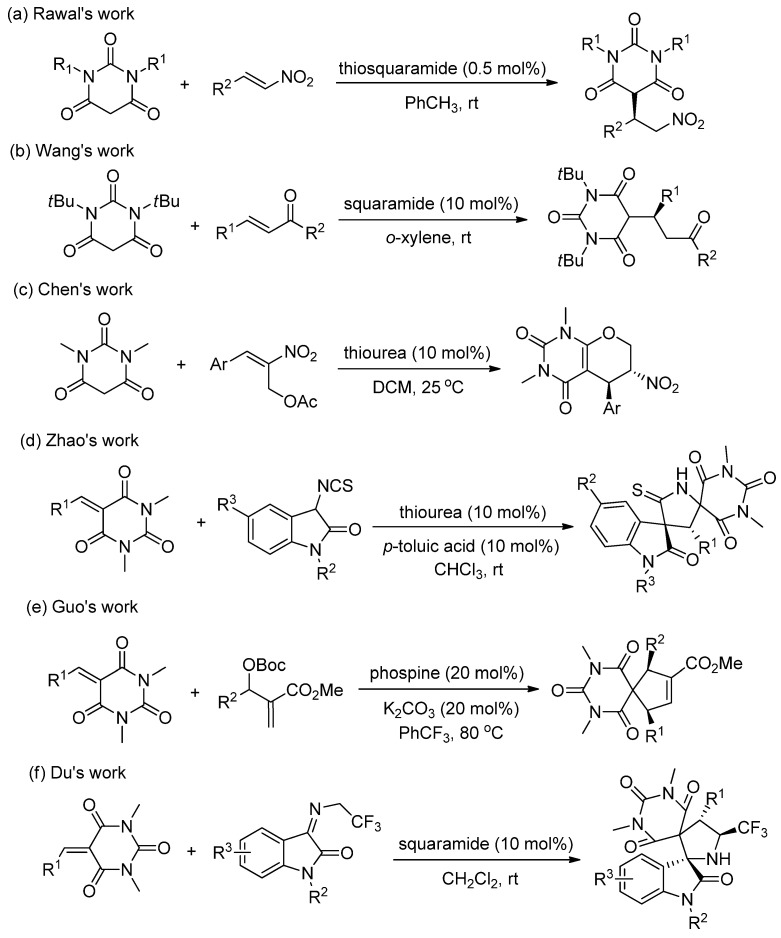
As mentioned above, barbituric acid derivatives are easily deprotonated owing to their rather low pKa value. Catalytic asymmetric transformations of barbituric acid derivatives have received much attention in recent years for synthesis of chiral barbituric acid derivatives [10]. For example, Rawal et al. reported an enantioselective Michael addition of N,N′-disubstituted barbituric acid derivatives to β-nitro olefins using chiral thiosquaramide as a bifunctional organocatalyst (Scheme 1a) [15]. The addition products were obtained in high yields with excellent enantioselectivity at catalyst loading as low as 0.5 mol% in toluene at room temperature. Wang and co-workers [16] developed an enantioselective organocatalytic Michael addition of N,N′-dialkylbarbituric acid derivatives to enones using 10 mol% quinine-derived squaramide catalyst, a series of Michael adducts were obtained in 44–99% yields with 91–99% ee in o-xylene at room temperature (Scheme 1b). Chen and co-workers [17] developed a tertiary amine-thiourea-catalyzed domino Michael-oxa-Michael addition reaction of N,N′-dimethyl barbituric acid and Morita–Baylis-Hillman (MBH) acetate of nitroalkene; the corresponding tetrahydropyrano bicycles were obtained up to 95% yields with dr > 19:1 and up to 95% ee in CH_2_Cl_2_ at 25 °C (Scheme 1c).
Alkylidene barbituric acids as reactive electron-poor alkene derivatives also attracted the attention of researchers in recent years; for example, Zhao’s group reported on a racemic [3 + 2] cycloaddition between alkylidene barbiturates and 3-isothiocyanato oxindoles catalyzed by Et_3_N [18]. In 2016, Zhao et al. developed an epi-quinine-thiourea-based thiourea-catalyzed enantioselective version in chloroform, and the corresponding spirobarbiturates were obtained in 80–99% yield with 9:1 to >20:1 dr and 18–99% ee [19]. Guo and co-worker an enantioselective phosphine-catalyzed [3 + 2] annulation of alkylidene barbiturates with MBH adducts, and spirobarbiturates were obtained in excellent diastereoselectivities (4;1–>20:1 dr) and high-to-excellent enantioselectivities (81–99% ee) (Scheme 1e) [20]. Our group developed a squaramide-catalyzed asymmetric Michael/Mannich [3 + 2] cycloaddition reaction of N-2,2,2-trifluoroethyl isatin ketimines and barbiturate-based olefins. The corresponding dispirobarbituric acid derivatives were obtained in excellent yields (up to 99% yield) and excellent stereoselectivities (up to 99:1 dr and >99% ee) (Scheme 1f) [21].
Examples for asymmetric synthesis of barbituric acid derivatives. (a) Rawal’s work [15], (b) Wang’s work [16], (c) Chen’s work [17], (d) Zhao’s work [19], (e) Guo’s work [20], and (f) Du’s work [21].
In the above-mentioned reports [19,21], the oxindole skeleton also played a crucial role, as these reagents are prone to undergo the tandem reaction with electron-deficient alkenes to construct spirooxindole derivatives. The catalytic asymmetric synthesis of chiral spirooxindoles has also received wide attention in recent years [22]. Continuing on our research project for squaramide-catalytic asymmetric reactions [23], herein, the asymmetric Michael addition/cyclization tandem reaction between barbituric acid derivatives and oxindole derivatives was developed using chiral squaramide as catalyst in order to obtain chiral bisspiro barbituric acid–oxindole derivatives, which may provide potential candidates for future drug design and biological activity research.
2. Results and Discussion
2.1. Optimization of Reaction Conditions
To verify our hypothesis, the asymmetric Michael/cyclization reaction of substrates 1a and 2a in the presence of quinine-derived squaramide C1 was selected as the model reaction. We were pleased to find that the asymmetric Michael/cyclization reaction could be completed within 8 h in the presence of 10 mol% C1 at room temperature and obtained the desired product 3aa in 88% yield with excellent stereoselectivity (>20:1 dr, 86% ee) (Table 1, entry 1). Encouraged by these excellent results, we screened several organocatalysts with different frameworks for this asymmetric Michael/cyclization reaction (Figure 2) (Table 1, entries 2–12). However, the catalytic yields using catalysts C2, C3, and C9 were low (Figure 2) (Table 1, entries 2–12), and the remaining catalysts achieved high yields (>80%) and stereoselectivity (>20:1 dr, >75% ee) (Table 1, entry 2–12). Considering yield and stereoselectivity, C5 has the best catalytic effect (Table 1, entry 5).
In order to further improve the reaction efficiency, squaramide C5 was used as a catalyst to optimize other reaction conditions. The effects of solvent, catalyst loading, and reaction temperature on the reaction were evaluated in detail (Table 1, entries 13−19). Solvents play an integral role in the reaction, so we evaluated five other organic solvents, acetonitrile, toluene, THF, chloroform, and methyl tert-butyl ether (MTBE) (Table 1, entries 13−17). However, a series of results show that dichloromethane is still the best solvent. Then, we studied the effect of catalyst loading on the reaction. As the amount of catalyst was halved, the yield and stereoselectivity of the product unfortunately decreased (Table 1, entry 18). As the reaction temperature decreased, the yield of the product did not increase, and its enantioselectivity gradually decreased (Table 1, entry 19). By comparison, the optimal conditions were determined to be benzylidenebarbituric acid and oxindolylmalonitrile as raw materials in the molar ratio of 1.2:1, with 10 mol% C5 as catalyst, in CH_2_Cl_2_ solvent, at room temperature for 8 h.
2.2. Substrate Scope
After the optimum reaction conditions were obtained, the applicability of different substrates to the asymmetric Michael/cyclization reaction was investigated. The result is shown in Scheme 2. Firstly, the effect of benzylidene barbituric acid substrate on the reaction was studied, and the effect of different substitution groups on the reaction was explored. The results show that steric hindrance had a great effect on the reaction. When benzene rings in benzylidenes were meta-substituted or para-substituted, the reaction occurred normally (3aa–ja), but when benzene rings in benzylidenes were ortho-substituted, the corresponding substrates did not react with 2a (3la–oa). The electron effect of substituents also affected the course of the reaction. For electron-withdrawing groups, the substituted substrates bearing bromo- or chloro-substituents showed good yield and stereoselectivity. The substrate with a para-substituted fluoro group was an exception, and the stereoselectivity of the corresponding product was relatively poor, which was considered to be due to the strong electron-withdrawing withdrawing of fluorine. For electron-donating groups, methyl- or methoxy-substituted substrates behaved generally similarly as compared to the bromo-substituted substrate. In addition, the comparison of the yield and enantioselectivity of thienyl-, furanyl-, and pyridinyl-substituted substrates is very interesting. The reaction yield and enantioselectivity of thienyl-substituted substrate were very good (3da), the yield and enantioselectivity of furanyl-substituted substrate were moderate (3fa), and the reaction of pyridinyl-substituted substrate did not occur (3na). This may be ascribed to the electronic effect of these three different heterocycles.
After studying the effect of benzylidene substituents of benzylidene barbituric acids on the reaction, the effect of the N-protecting group of oxindolylmalonitriles on the reaction was studied. When R^1^ was a benzyl group or a methyl group, the reaction maintained high selectivity and high efficiency (3aa and 3ab). Subsequently, the different substituents on the phenyl rings of oxindolylmalonitriles were studied. We found that the stereoselectivity of substrates bearing electron-withdrawing substituted indole-phenyl rings was generally better than that of substrates bearing electron-donating substituents. Among the electron-withdrawing groups as substituents (3ac, 3ae–aj), all of them maintained excellent yields and stereoselectivities except for the 2-fluoro-substituent. As for the electron-donating groups, the dimethyl-substituted substrate performed better than the monomethyl-substituted substrate (3ad, 3ak).
2.3. Scaled-Up Synthesis
In order to further demonstrate the application value of this synthetic method, the gram-scale experiment was conducted under optimized conditions. As shown in Scheme 3, the gram-scale asymmetric Michael/cyclization reaction of 1a and 2a proceeded smoothly, and the product 3aa was obtained in 88% yield with excellent stereoselectivity (>20:1 dr, 95% ee).
2.4. Absolute Configuration
The absolute configuration of the chiral product 3ha was determined by X-ray diffraction analysis and was found to be (2′R,3S) (CCDC 2431390) (Figure 3). The absolute configurations of other chiral products were assigned by analogy.
2.5. Reaction Mechanism
According to the absolute configuration of the tandem product 3ha and the catalytic mode of the chiral bifunctional squaramide for a similar reaction [24], a possible transition state model of the catalytic reaction was proposed (Scheme 4). On the one hand, oxindolylmalonitrile 2a is partially deprotonated by the tertiary amine of catalyst C5. On the other hand, benzylidene barbituric acid 1a is activated by forming two hydrogen bonds in the N-H of the squaramide part. Subsequently, the deprotonated-activated oxindolylmalonitrile attacks the Si-face of the electron-deficient unsaturated barbituric acid 1a through the transition state A, and the intermolecular Michael addition reaction occurs. At the same time, the resulting Michael addition intermediates undergo further intramolecular cyclization reaction to obtain B. Finally, the molecular isomerization reaction occurs to obtain the desired bisspirocyclic product 3aa, and the bifunctional squaramide catalyst C5 is regenerated to enter the next catalytic cycle of reaction.
3. Materials and Methods
3.1. General Information
Commercially available compounds were used without further purification. Solvents were dried according to standard procedures. Column chromatography was performed with silica gel (200−300 mesh). Melting points were determined with a WRX-4 melting-point apparatus and were uncorrected. ^1^H NMR spectra were measured with Bruker Ascend 400 MHz spectrometer and Bruker Ascend 700 MHz spectrometer (Bruker, Karlsurhe, Germany); chemical shifts were reported in δ (ppm) units relative to tetramethylsilane (TMS) as internal standard. ^13^C NMR spectra were measured at 101 MHz with 400 MHz spectrometer and measured at 176 MHz with 700 MHz spectrometer; chemical shifts are reported in ppm relative to tetramethylsilane and referenced to solvent peak (CDCl_3_, δC = 77.00; DMSO, δC = 39.43). High-resolution mass spectra (Electron spray ionization) were measured with an Agilent 6520 Accurate-Mass Q-TOF MS system (Agilent, Santa Clara, CA, USA) equipped with an electrospray ionization (ESI) source. Optical rotations were measured with a Krüss P8000 polarimeter (Krüss, Hamburg, Germany). Optical rotations at the indicated concentration with the units of g/100 mL. Enantiomeric excesses were determined by chiral HPLC analysis using an Agilent 1200 LC instrument (Agilent, Santa Clara, CA, USA) with a Daicel Chiralpak ADH, IA, or IC column (Daicel, Beijing, China).
3.2. Experimental Materials for Tandem Reactions
First, 1a–1j were prepared according to literature reported by Neumann and co-workers [25]. Then, 2a–2k were prepared according to literature reported by Lin and co-workers [24]. The chiral organocatalysts were prepared by following the reported procedures [26,27,28,29].
3.3. Procedure for the Synthesis of Racemates of 3
To a dried small vial, benzylidene barbituric acid 1 (0.24 mmol), oxindolylmalonitrile 2 (0.2 mmol), Et_3_N (1.0 mg, 0.01 mmol, 0.05 equiv.), and CH_2_Cl_2_ (1 mL) were added. After stirring at room temperature under air without gas protection for 8 h, the reaction mixture was concentrated and directly purified by silica gel column chromatography to afford the racemates of 3.
3.4. Procedure for the Asymmetric Michael/Cyclization Reaction
To a dried small vial, barbituric acid 1 (0.24 mmol), oxindolylmalonitrile 2 (0.2 mmol), chiral organocatalyst C5 (5.08 mg, 0.01 mmol, 0.05 equiv), and CH_2_Cl_2_ (1.0 mL) were added. After stirring at room temperature under air without gas protection for 8 h, the reaction mixture was concentrated and directly purified by silica gel column chromatography (200–300 mesh) using ethyl acetate/petroleum ether (1:2) as eluent to afford the desired products 3.
(2′R,3S)-4′-Amino-1,1″,3″-trimethyl-2,2″,4″,6″-tetraoxo-2′-phenyl-1″,3″,4″,6″-tetrahydro-2″H-dispiro[indoline-3,1′-cyclopentane-3′,5″-pyrimidin]-4′-ene-5′-carbonitrile (3aa). According to the general procedure from 1a (58.6 mg, 0.24 mmol) and 2a (42.2 mg, 0.2 mmol) to obtain 85.6 mg (94% yield) compound 3aa as a yellow solid, m.p. 192−195 °C. HPLC (Daicel Chiralpak ADH, n-hexane/2-propanol = 70:30, flow rate 1.0 mL/min, detection at 254 nm): tR = 9.2 min (major), >99% ee. [α]D^25^ = +9.9 (c = 0.5, CH_2_Cl_2_). ^1^H NMR (700 MHz, DMSO-d_6_): δ 8.05 (dd, J1 = 7.7 Hz, J2 = 0.7 Hz, 1H), 7.28 (td, J1 = 7.7 Hz, J2 = 1.4 Hz 1H), 7.15–7.18 (m, 4H), 7.06 (t, J = 8.0 Hz, 2H), 6.86 (d, J = 7.7 Hz, 1H), 6.76 (d, J = 7.0 Hz, 2H), 4.24 (s, 1H), 3.07 (s, 3H), 2.99 (s, 3H), 2.87 (s, 3H) ppm. ^13^C NMR (176 MHz, DMSO-d_6_): δ 176.5, 168.6, 167.8, 158.4, 149.8, 143.0, 131.1, 129.4, 129.3, 129.0, 128.3, 128.0, 127.3, 122.3, 116.3, 108.7, 78.5, 68.1, 64.8, 63.4, 28.5, 28.3, 26.4 ppm. (see Supplementary Materials) HRMS (ESI): m/z calcd. for C_25_H_22_N_5_O_4_ [M + H]^+^ 456.1666, found 456.1686.
(2′R,3S)-4′-Amino-2′-(4-chlorophenyl)-1,1″,3″-trimethyl-2,2″,4″,6″-tetraoxo-1″,3″,4″,6″-tetrahydro-2″H-dispiro[indoline-3,1′-cyclopentane-3′,5″-pyrimidin]-4′-ene-5′-carbonitrile (3ba). According to the general procedure from 1b (66.7 mg, 0.24 mmol) and 2a (42.2 mg, 0.2 mmol) to obtain 82.2 mg (84% yield) compound 3ba as a yellow solid, m.p. 183–185 °C. HPLC (Daicel Chiralpak IC, n-hexane/2-propanol = 70:30, flow rate 1.0 mL/min, detection at 254 nm): tR = 6.8 min (minor), tR = 9.4 min (major), 86% ee. [α]D^25^ = +12.2 (c = 0.34, CH_2_Cl_2_). ^1^H NMR (400 MHz, CDCl_3_): δ 8.12 (d, J = 7.2 Hz, 1H), 7.29–7.25 (m, 1H), 7.17 (td, J1 = 7.6 Hz, J2 = 0.8 Hz, 1H), 7.01 (d, J = 8.4 Hz, 2H), 6.78 (d, J = 8.8 Hz, 2H), 6.67 (d, J = 7.6 Hz, 1H), 5.65 (s, 2H), 4.37 (s, 1H), 3.20 (s, 3H), 3.03 (s, 3H), 2.98 (s, 3H) ppm. ^13^C NMR (101 MHz, CDCl_3_): δ 176.8, 168.6, 167.1, 158.0, 149.8, 143.9, 135.6, 131.1, 129.8, 129.3, 128.5, 128.2, 127.3, 123.2, 115.3, 108.7, 83.2, 68.6, 64.6, 63.9, 29.3, 28.9, 26.8 ppm. HRMS (ESI): m/z calcd. for C_25_H_21_ClN_5_O_4_ [M + H]^+^ 490.1277, found 490.1301.
(2′R,3S)-4′-Amino-1,1″,3″-trimethyl-2′-(naphthalen-2-yl)-2,2″,4″,6″-tetraoxo-1″,3″,4″,6″-tetrahydro-2″H-dispiro[indoline-3,1′-cyclopentane-3′,5″-pyrimidin]-4′-ene-5′-carbonitrile (3ca). According to the general procedure from 1c (70.6 mg, 0.24 mmol) and 2a (42.2 mg, 0.2 mmol) to obtain 93.0 mg (92% yield) compound 3ca as a yellow solid, m.p. 201–203 °C. HPLC (Daicel Chiralpak IC, n-hexane/2-propanol = 70:30, flow rate 1.0 mL/min, detection at 254 nm): tR = 13.0 min (minor), tR = 16.7 min (major), 83% ee. [α]D^25^ = +16.5 (c = 0.5, CH_2_Cl_2_). ^1^H NMR (400 MHz, DMSO-d_6_): δ 8.18 (d, J = 7.6 Hz, 1H), 7.85 (d, J = 8.0 Hz, 1H), 7.76 (t, J = 9.4 Hz, 2H), 7.61 (td, J1 = 7.6 Hz, J2 = 1.0 Hz, 1H), 7.50 (t, J = 7.4 Hz, 1H), 7.32–7.22 (m, 4H), 7.12 (t, J = 7.8 Hz, 1H), 7.01 (d, J = 7.2 Hz, 1H), 6.83 (d, J = 7.6 Hz, 1H), 5.49 (s, 1H), 2.88 (s, 3H), 2.81 (s, 3H), 2.60 (s, 3H) ppm. ^13^C NMR (101 MHz, DMSO-d_6_): δ 176.5, 168.7, 168.0, 158.5, 149.4, 143.1, 133.0, 131.9, 129.4, 129.3, 129.1, 128.5, 127.5, 127.2, 126.7, 125.9, 123.8, 122.5, 120.7, 116.3, 108.9, 79.1, 68.3, 63.6, 55.9, 28.3, 26.4 ppm. HRMS (ESI): m/z calcd. for C_29_H_24_N_5_O_4_ [M + H]^+^ 506.1823, found 506.1818.
(2′R,3S)-4′-Amino-1,1″,3″-trimethyl-2,2″,4″,6″-tetraoxo-2′-(thiophen-2-yl)-1″,3″,4″,6″-tetrahydro-2″H-dispiro[indoline-3,1′-cyclopentane-3′,5″-pyrimidin]-4′-ene-5′-carbonitrile (3da). According to the general procedure from 1d (60.0 mg, 0.24 mmol) and 2a (42.2 mg, 0.2 mmol) to obtain 75.6 mg (82% yield) compound 3da as a brown solid, m.p. 214–215 °C. HPLC (Daicel Chiralpak IA, n-hexane/2-propanol/ethyl acetate = 80:10:10, flow rate 1.0 mL/min, detection at 254 nm): tR = 19.3 min (minor), tR = 26.4 min (major); >99% ee. [α]D^25^ = +18.5 (c = 0.4, CH_2_Cl_2_). ^1^H NMR (700 MHz, DMSO-d_6_): δ 8.06 (d, J = 7.7 Hz, 1H), 7.36–7.32 (m, 2H), 7.20–7.16 (m, 3H), 6.94 (d, J = 7.7 Hz, 1H), 6.78 (dd, J1 = 4.9 Hz, J2 = 4.2 Hz, 1H), 6.68 (d, J = 3.5 Hz, 1H), 4.62 (s, 1H), 3.18 (s, 3H), 3.05 (s, 3H), 2.85 (s, 3H) ppm. ^13^C NMR (176 MHz, DMSO-d_6_): δ 176.2, 168.3, 167.3, 158.0, 150.0, 143.4, 132.5, 129.8, 129.4, 128.2, 128.0, 127.8, 126.3, 122.4, 116.2, 108.7, 78.5, 68.4, 63.0, 59.7, 28.7, 28.6, 26.5 ppm. HRMS (ESI): m/z calcd. for C_23_H_20_N_5_O_4_S [M + H]^+^ 462.1231, found 462.1253.
(2′R,3S)-4′-Amino-1,1″,3″-trimethyl-2,2″,4″,6″-tetraoxo-2′-(m-tolyl)-1″,3″,4″,6″-tetrahydro-2″H-dispiro[indoline-3,1′-cyclopentane-3′,5″-pyrimidin]-4′-ene-5′-carbonitrile (3ea). According to the general procedure from 1e (61.92 mg, 0.24 mmol) and 2a (42.2 mg, 0.2 mmol) to obtain 79.7 mg (85% yield) compound 3ea as a white solid, m.p. 194–196 °C. HPLC (Daicel Chiralpak ADH, n-hexane/2-propanol = 70:30, flow rate 1.0 mL/min, detection at 254 nm): tR = 6.5 min (minor), tR = 11.5 min (major), 78% ee. [α]D^25^ = +14.8 (c = 0.5, CH_2_Cl_2_). ^1^H NMR (400 MHz, DMSO-d_6_): δ 8.06 (dd, J1 = 7.6 Hz, J2 = 0.8 Hz, 1H), 7.28 (td, J = 7.6 Hz, J2 = 1.2 Hz, 1H), 7.17 (t, J = 7.2 Hz, 3H), 6.98–6.91 (m, 2H), 6.85 (d, J = 7.6 Hz, 1H), 6.58 (s, 1H), 6.54 (d, J = 7.2 Hz, 1H), 4.20 (s, 1H), 3.08 (s, 3H), 2.98 (s, 3H), 2.86 (s, 3H), 2.03 (s, 3H) ppm. ^13^C NMR (101 MHz, DMSO-d_6_): δ 176.5, 168.6, 167.8, 158.4, 149.8, 143.0, 137.2, 131.1, 130.1, 129.5, 129.2, 128.4, 127.8, 127.3, 126.4, 122.1, 116.3, 108.7, 78.5, 68.1, 64.7, 63.4, 28.5, 28.3, 26.4, 20.5. ppm. HRMS (ESI): m/z calcd. for C_26_H_24_N_5_O_4_ [M + H]^+^ 470.1823, found 470.1812.
(2′R,3S)-4′-Amino-2′-(furan-2-yl)-1,1″,3″-trimethyl-2,2″,4″,6″-tetraoxo-1″,3″,4″,6″-tetrahydro-2″H-dispiro[indoline-3,1′-cyclopentane-3′,5″-pyrimidin]-4′-ene-5′-carbonitrile (3fa). According to the general procedure from 1f (56.2 mg, 0.24 mmol) and 2a (42.2 mg, 0.2 mmol) to obtain 64.1 mg (72% yield) compound 3fa as a brown solid, m.p. 174–176 °C. HPLC (Daicel Chiralpak IA, n-hexane/2-propanol = 70:30, flow rate 1.0 mL/min, detection at 254 nm): tR = 6.6 min (minor), tR = 8.2 min (major), 55% ee. [α]D^25^ = −2.0 (c = 0.33, CH_2_Cl_2_). ^1^H NMR (700 MHz, DMSO-d_6_): δ 7.93 (dd, J = 7.7 Hz, 1H), 7.38 (d, J = 1.4 Hz, 1H), 7.32 (td, J1 = 7.7 Hz, J2 = 0.7 Hz, 1H), 7.17–7.12 (m, 3H), 6.97 (d, J = 7.7 Hz, 1H), 6.15 (dd, J1 = 3.2 Hz, J2 = 1.8 Hz, 1H), 5.74 (d, J = 2.8 Hz, 1H), 4.41 (s, 1H), 3.19 (s, 3H), 3.10 (s, 3H), 2.94 (s, 3H) ppm. ^13^C NMR (176 MHz, DMSO-d_6_): δ 176.0, 168.2, 167.2, 157.7, 150.2, 145.9, 144.0, 142.9, 129.3, 128.2, 127.4, 122.3, 116.0, 110.7, 110.4, 108.6, 78.8, 66.9, 61.7, 56.5, 28.7, 28.6, 26.5 ppm. HRMS (ESI): m/z calcd. for C_23_H_20_N_5_O_5_ [M + H]^+^ 446.1459, found 446.1472.
(2′R,3S)-4′-Amino-2′-(4-fluorophenyl)-1,1″,3″-trimethyl-2,2″,4″,6″-tetraoxo-1″,3″,4″,6″-tetrahydro-2″H-dispiro[indoline-3,1′-cyclopentane-3′,5″-pyrimidin]-4′-ene-5′-carbonitrile (3ga). According to the general procedure from 1g (62.9 mg, 0.24 mmol) and 2a (42.2 mg, 0.2 mmol) to obtain 80.4 mg (85% yield) compound 3ga as a pink solid, m.p. 178–179 °C. HPLC (Daicel Chiralpak IA, n-hexane/2-propanol/ethyl acetate = 80:15:5, flow rate 1.0 mL/min, detection at 254 nm): tR = 13.4 min (minor), tR = 21.9 min (major); 59% ee. [α]D^25^ = +9.0 (c = 0.8, CH_2_Cl_2_). ^1^H NMR (700 MHz, DMSO-d_6_): δ 8.03 (d, J = 7.0 Hz, 1H), 7.30 (t, J = 7.7 Hz, 1H), 7.20–7.16 (m, 3H), 6.94–6.88 (m, 3H), 6.83–6.80 (m, 2H), 4.25 (s, 1H), 3.09 (s, 3H), 3.01 (s, 3H), 2.91 (s, 3H) ppm. ^13^C NMR (176 MHz, DMSO-d_6_): δ 176.4, 168.5, 167.7, 162.1 (^1^JC–F = 246.9 Hz), 158.3, 149.9, 143.0, 131.5 (^3^JC–F = 8.3 Hz), 129.4, 128.1, 127.3 (^4^JC–F = 2.6 Hz), 127.2, 122.4, 116.2, 115.0 (^2^JC–F = 21.5 Hz), 108.8, 78.3, 67.9, 63.7, 63.4, 28.6, 28.4, 26.4 ppm. ^19^F NMR (659 MHz, DMSO-d_6_): δ −112.1. HRMS (ESI): m/z calcd. for C_25_H_21_FN_5_O_4_ [M + H]^+^ 474.1572, found 474.1587.
(2′R,3S)-4′-Amino-2′-(3-bromophenyl)-1,1″,3″-trimethyl-2,2″,4″,6″-tetraoxo-1″,3″,4″,6″-tetrahydro-2″H-dispiro[indoline-3,1′-cyclopentane-3′,5″-pyrimidin]-4′-ene-5′-carbonitrile (3ha). According to the general procedure from 1h (77.3 mg, 0.24 mmol) and 2a (42.2 mg, 0.2 mmol) to obtain 103.4 mg (97% yield) compound 3ha as a pink solid, m.p. 194–195 °C. HPLC (Daicel Chiralpak ADH, n-hexane/2-propanol = 75:25, flow rate 1.0 mL/min, detection at 254 nm): tR = 11.8 min (minor), tR = 14.5 min (major); 89% ee. [α]D^25^ = +14.9 (c = 0.5, CH_2_Cl_2_). ^1^H NMR (700 MHz, DMSO-d_6_): δ 8.03 (d, J = 7.7 Hz, 1H), 7.39 (d, J = 8.4 Hz, 1H), 7.32 (t, J = 7.7 Hz, 1H), 7.23–7.18 (m, 3H), 7.07 (t, J = 8.0 Hz, 1H), 6.93 (s, 1H), 6.90 (d, J = 7.7 Hz, 1H), 6.85 (d, J = 7.7 Hz, 1H), 4.20 (s, 1H), 3.10 (s, 3H), 3.01 (s, 3H), 2.92 (s, 3H) ppm. ^13^C NMR (176 MHz, DMSO-d_6_): δ 176.2, 168.2, 167.7, 158.2, 149.8, 143.0, 133.5, 131.9, 131.6, 130.3, 129.5, 129.1, 127.9, 127.1, 122.3, 121.0, 116.2, 109.0, 78.2, 67.9, 63.6, 63.3, 28.6, 28.3, 26.4 ppm. HRMS (ESI): m/z calcd. for C_25_H_21_^79^BrN_5_O_4_ [M + H]^+^ 534.0771, found 534.0786; calcd. for C_25_H_21_^81^BrN_5_O_4_ [M + H]^+^ 536.0751, found 536.0770.
(2′R,3S)-4′-Amino-2′-(3,4-dimethoxyphenyl)-1,1″,3″-trimethyl-2,2″,4″,6″-tetraoxo-1″,3″,4″,6″-tetrahydro-2″H-dispiro[indoline-3,1′-cyclopentane-3′,5″-pyrimidin]-4′-ene-5′-carbonitrile (3ia). According to the general procedure from 1i (73.0 mg, 0.24 mmol) and 2a (42.2 mg, 0.2 mmol) to obtain 90.2 mg (93% yield) compound 3ia as a yellow solid, m.p. 203–205 °C. HPLC (Daicel Chiralpak ADH, n-hexane/2-propanol = 80:20, flow rate 1.0 mL/min, detection at 254 nm): tR = 19.0 min (minor), tR = 21.3 min (major), 73% ee. [α]D^25^ = +49.1 (c = 0.7, CH_2_Cl_2_). ^1^H NMR (700 MHz, DMSO-d_6_): δ 8.10 (d, J = 7.7 Hz, 1H), 7.31 (t, J = 7.7 Hz, 1H), 7.18 (t, J = 7.7 Hz, 3H), 6.90 (d, J = 7.7 Hz, 1H), 6.65 (d, J = 8.4 Hz, 1H), 6.37 (dd, J1 = 8.0 Hz, J2 = 1.4 Hz, 1H), 6.21 (s, 1H), 4.17 (s, 1H), 3.61 (s, 3H), 3.33 (s, 3H), 3.11 (s, 3H), 3.00 (s, 3H), 2.87 (s, 3H) ppm. ^13^C NMR (176 MHz, DMSO-d_6_): δ 176.6, 168.7, 167.9, 158.5, 150.0, 148.9, 147.5, 143.2, 129.2, 128.8, 127.2, 123.0, 122.8, 122.1, 116.4, 111.5, 110.7, 108.9, 78.3, 68.2, 64.5, 63.5, 55.1, 55.0, 28.6, 28.4, 26.4 ppm. HRMS (ESI): m/z calcd. for C_27_H_26_N_5_O_6_ [M + H]^+^ 516.1878, found 516.1895.
(2′R,3S)-4′-Amino-2′-(4-bromophenyl)-1,1″,3″-trimethyl-2,2″,4″,6″-tetraoxo-1″,3″,4″,6″-tetrahydro-2″H-dispiro[indoline-3,1′-cyclopentane-3′,5″-pyrimidin]-4′-ene-5′-carbonitrile (3ja). According to the general procedure from 1j (77.3 mg, 0.24 mmol) and 2a (42.2 mg, 0.2 mmol) to obtain 98.1 mg (92% yield) compound 3ja as a pink solid, m.p. 217–219 °C. HPLC (Daicel Chiralpak IA, n-hexane/2-propanol = 70:30, flow rate 1.0 mL/min, detection at 254 nm): tR = 7.5 min (minor), tR = 12.4 min (major); 84% ee. [α]D^25^ = +27.4 (c = 0.9, CH_2_Cl_2_). ^1^H NMR (400 MHz, DMSO-d_6_): δ 8.01 (dd, J1 = 7.6 Hz, J2 = 0.8 Hz, 1H), 7.32–7.27 (m, 3H), 7.20–7.15 (m, 3H), 6.88 (d, J = 8.0 Hz, 1H), 6.72 (d, J = 8.8 Hz, 2H), 4.22 (s, 1H), 3.09 (s, 3H), 3.01 (s, 3H), 2.93 (s, 3H) ppm. ^13^C NMR (176 MHz, DMSO-d_6_): δ 176.4, 168.5, 167.8, 158.4, 149.9, 143.0, 131.5, 131.1, 130.5, 129.5, 128.0, 127.3, 122.6, 122.5, 116.3, 108.9, 78.4, 67.8, 63.9, 63.4, 28.7, 28.5, 26.5 ppm. HRMS (ESI): m/z calcd. for C_25_H_21_^79^BrN_5_O_4_ [M + H]^+^ 534.0771, found 534.0793; calcd. for C_25_H_21_^81^BrN_5_O_4_ [M + H]^+^ 536.0751, found 536.0777.
(2′R,3S)-4′-Amino-1-benzyl-1″,3″-dimethyl-2,2″,4″,6″-tetraoxo-2′-phenyl-1″,3″,4″,6″-tetrahydro-2″H-dispiro[indoline-3,1′-cyclopentane-3′,5″-pyrimidin]-4′-ene-5′-carbonitrile (3ab). According to the general procedure from 1a (58.6 mg, 0.24 mmol) and 2b (57.4 mg, 0.2 mmol) to obtain 100.9 mg (95% yield) compound 3ab as a yellow solid, m.p. 165–167 °C. HPLC (Daicel Chiralpak IC, n-hexane/2-propanol = 70:30, flow rate 1.0 mL/min, detection at 254 nm): tR = 40.3 min (minor), tR = 24.9 min (major), >99% ee. [α]D^25^ = −11.4 (c = 0.4, CH_2_Cl_2_). ^1^H NMR (400 MHz, CDCl_3_): δ 8.17 (dd, J1 = 6.4 Hz, J2 = 1.4 Hz, 1H), 7.24–7.20 (m, 1H), 7.17–7.00 (m, 7H), 6.82 (d, J = 7.6 Hz, 2H), 6.61 (d, J = 7.6 Hz, 2H), 6.41 (d, J = 7.2 Hz, 1H), 5.60 (s, 2H), 5.02 (d, J = 16.4 Hz, 1H), 4.49 (d, J = 16.4 Hz, 1H), 4.44 (s, 1H), 3.13 (s, 3H), 2.93 (s, 3H) ppm. ^13^C NMR (101 MHz, CDCl_3_): δ 177.2, 168.6, 167.2, 158.2, 149.8, 142.3, 134.4, 130.5, 123.0, 129.55, 129.52, 128.5, 128.30, 128.27, 127.7, 127.2, 126.1, 123.1, 115.5, 109.5, 83.3, 68.8, 66.1, 64.1, 43.8, 29.1, 28.8 ppm. HRMS (ESI): m/z calcd. for C_31_H_26_N_5_O_4_ [M + H]^+^ 532.1979, found 532.2000.
(2′R,3S)-4′-Amino-6-chloro-1,1″,3″-trimethyl-2,2″,4″,6″-tetraoxo-2′-phenyl-1″,3″,4″,6″-tetrahydro-2″H-dispiro[indoline-3,1′-cyclopentane-3′,5″-pyrimidin]-4′-ene-5′-carbonitrile (3ac). According to the general procedure from 1a (58.6 mg, 0.24 mmol) and 2c (49.0 mg, 0.2 mmol) to obtain 90.0 mg (92% yield) compound 3ac as a yellow solid, m.p. 172–174 °C. HPLC (Daicel Chiralpak ADH, n-hexane/2-propanol = 70:30, flow rate 1.0 mL/min, detection at 254 nm): tR = 8.0 min (minor), tR = 15.6 min (major), 91% ee. [α]D^25^ = −30.9 (c = 0.4, CH_2_Cl_2_). ^1^H NMR (700 MHz, DMSO-d_6_): δ 8.04 (d, J = 8.4 Hz, 1H), 7.25 (dd, J1 = 8.0 Hz, J2 = 2.2 Hz, 3H), 7.19 (t, J = 7.4 Hz, 1H), 7.11 (t, J = 7.7 Hz, 2H), 7.04 (d, J = 1.4 Hz, 1H), 6.75 (d, J = 7.7 Hz, 2H), 4.23 (s, 1H), 3.07 (s, 3H), 3.01 (s, 3H), 2.89 (s, 3H) ppm. ^13^C NMR (176 MHz, DMSO-d_6_): δ 176.6, 168.5, 167.9, 158.7, 149.8, 144.5, 133.8, 130.8, 129.3, 129.2, 128.6, 128.2, 127.2, 122.1, 116.1, 109.3, 77.9, 67.9, 64.7, 63.2, 28.6, 28.4, 26.6 ppm. HRMS (ESI): m/z calcd. for C_25_H_21_ClN_5_O_4_ [M + H]^+^ 490.1277, found 490.1300.
(2′R,3S)-4′-amino-1,1″,3″,5,7-pentamethyl-2,2″,4″,6″-tetraoxo-2′-phenyl-1″,3″,4″,6″-tetrahydro-2″H-dispiro[indoline-3,1′-cyclopentane-3′,5″-pyrimidin]-4′-ene-5′-carbonitrile (3ad). According to the general procedure from 1a (58.6 mg, 0.24 mmol) and 2d (47.8 mg, 0.2 mmol) to obtain 86.9 mg (90% yield) compound 3ad as a white solid, m.p. 181–182 °C. HPLC (Daicel Chiralpak IC, n-hexane/2-propanol = 70:30, flow rate 1.0 mL/min, detection at 254 nm): tR = 56.3 min (minor), tR = 40.3 min (major), 90% ee. [α]D^25^ = −40.6 (c = 0.4, CH_2_Cl_2_). ^1^H NMR (700 MHz, DMSO-d_6_): δ 7.76 (s, 1H), 7.16 (t, J = 7.4 Hz, 1H), 7.13 (s, 2H), 7.07 (t, J = 7.7 Hz, 2H), 6.83 (s, 1H), 6.76 (d, J = 7.7 Hz, 2H), 4.22 (s, 1H), 3.23 (s, 3H), 3.07 (s, 3H), 2.84 (s, 3H), 2.33 (s, 3H), 2.31 (s, 3H) ppm. ^13^C NMR (176 MHz, DMSO-d_6_): δ 177.1, 168.7, 167.8, 158.2, 149.8, 138.5, 133.3, 131.3, 130.8, 129.5, 129.1, 128.9, 128.0, 126.0, 119.3, 116.5, 79.2, 68.2, 65.0, 63.0, 29.6, 28.5, 28.4, 20.7, 18.3 ppm. HRMS (ESI): m/z calcd. for C_27_H_26_N_5_O_4_ [M + H]^+^ 484.1979, found 484.1992.
(2′R,3S)-4′-Amino-6-fluoro-1,1″,3″-trimethyl-2,2″,4″,6″-tetraoxo-2′-phenyl-1″,3″,4″,6″-tetrahydro-2″H-dispiro[indoline-3,1′-cyclopentane-3′,5″-pyrimidin]-4′-ene-5′-carbonitrile (3ae). According to the general procedure from 1a (58.6 mg, 0.24 mmol) and 2e (45.8 mg, 0.2 mmol) to obtain 79.5 mg (84% yield) compound 3ae as a white solid, m.p. 173–175 °C. HPLC (Daicel Chiralpak IC, n-hexane/2-propanol = 70:30, flow rate 1.0 mL/min, detection at 254 nm): tR = 9.4 min (minor), tR = 11.8 min (major), 82% ee. [α]D^25^ = −62.8 (c = 1, CH_2_Cl_2_). ^1^H NMR (700 MHz, DMSO-d_6_): δ 8.04 (dd, J1 = 7.7 Hz, J2 = 5.6 Hz, 1H), 7.23 (s, 2H), 7.18 (t, J = 7.4 Hz, 1H), 7.10 (t, J = 7.4 Hz, 2H), 7.01–6.98 (m, 1H), 6.86 (d, J = 9.1 Hz, 1H), 6.75 (d, J = 8.4 Hz, 2H), 4.22 (s, 1H), 3.07 (s, 3H), 3.00 (s, 3H), 2.88 (s, 3H) ppm. ^13^C NMR (176 MHz, DMSO-d_6_): δ 176.9, 168.6, 167.9, 162.8 (d, ^1^JC–F = 243.8 Hz), 158.5, 149.8, 144.8 (d, ^2^JC–F = 12.1 Hz), 130.9, 129.4, 129.1, 128.8 (d, ^3^JC–F = 9.7 Hz), 128.1, 124.0 (d, ^4^JC–F = 2.5 Hz), 116.2, 108.4 (d, ^2^JC–F = 22.2 Hz), 97.5 (d, ^2^JC–F = 27.6 Hz), 78.1, 68.0, 64.7, 63.1, 28.6, 28.4, 26.7 ppm. ^19^F NMR (659 MHz, DMSO-d_6_): δ −110.9. HRMS (ESI): m/z calcd. for C_25_H_21_FN_5_O_4_ [M + H]^+^ 474.1572, found 474.1602.
(2′R,3S)-4′-Amino-6-bromo-1,1″,3″-trimethyl-2,2″,4″,6″-tetraoxo-2′-phenyl-1″,3″,4″,6″-tetrahydro-2″H-dispiro[indoline-3,1′-cyclopentane-3′,5″-pyrimidin]-4′-ene-5′-carbonitrile (3af). According to the general procedure from 1a (58.6 mg, 0.24 mmol) and 2f (57.8 mg, 0.2 mmol) to obtain 101.3 mg (95% yield) compound 3af as a white solid, m.p. 161–163 °C. HPLC (Daicel Chiralpak IC, n-hexane/2-propanol = 70:30, flow rate 1.0 mL/min, detection at 254 nm): tR = 17.9 min (major); >99% ee. [α]D^25^ = −42.4 (c = 0.5, CH_2_Cl_2_). ^1^H NMR (700 MHz, DMSO-d_6_): δ 7.97 (d, J = 7.7 Hz, 1H), 7.39 (dd, J1 = 8.0 Hz, J2 = 1.8 Hz, 1H), 7.25 (s, 2H), 7.19 (t, J = 7.4 Hz, 1H), 7.16 (d, J = 1.4 Hz, 1H), 7.11 (t, J = 7.7 Hz, 2H), 6.75 (d, J = 7.7 Hz, 2H), 4.23 (s, 1H), 3.07 (s, 3H), 3.01 (s, 3H), 2.89 (s, 3H) ppm. ^13^C NMR (176 MHz, DMSO-d_6_): δ 176.4, 168.5, 167.8, 158.7, 149.8, 144.6, 130.8, 129.3, 129.2, 129.0, 128.2, 127.6, 125.0, 122.2, 116.1, 112.1, 77.9, 67.9, 64.3, 63.2, 28.6, 28.4, 26.6 ppm. HRMS (ESI): m/z calcd. for C_25_H_21_^79^BrN_5_O_4_ [M + H]^+^ 534.0771, found 534.0785; calcd. for C_25_H_21_^81^BrN_5_O_4_ [M + H]^+^ 536.0751, found 536.0765.
(2′R,3S)-4′-Amino-5-fluoro-1,1″,3″-trimethyl-2,2″,4″,6″-tetraoxo-2′-phenyl-1″,3″,4″,6″-tetrahydro-2″H-dispiro[indoline-3,1′-cyclopentane-3′,5″-pyrimidin]-4′-ene-5′-carbonitrile (3ag). According to the general procedure from 1a (58.6 mg, 0.24 mmol) and 2g (45.8 mg, 0.2 mmol) to obtain 89.9 mg (95% yield) compound 3ag as a white solid, m.p. 201–203 °C. HPLC (Daicel Chiralpak ADH, n-hexane/2-propanol = 70:30, flow rate 1.0 mL/min, detection at 254 nm): tR = 18.7 min (minor), tR = 20.2 min (major); 95% ee. [α]D^25^ = −58.6 (c = 0.5, CH_2_Cl_2_). ^1^H NMR (700 MHz, DMSO-d_6_): δ 7.91 (dd, J1 = 8.8 Hz, J2 = 2.4 Hz, 1H), 7.28 (s, 2H), 7.20–7.15 (m, 2H), 7.12 (t, J = 7.7 Hz, 2H), 6.90 (dd, J1 = 8.4 Hz, J2 = 4.2 Hz, 1H), 6.76 (d, J = 7.7 Hz, 2H), 4.26 (s, 1H), 3.07 (s, 3H), 3.00 (s, 3H), 2.91 (s, 3H) ppm. ^13^C NMR (176 MHz, DMSO-d_6_): δ 176.2, 168.5, 168.0, 158.8, 158.3 (^1^JC–F = 237.4 Hz), 149.8, 139.4, 130.8, 130.2 (^3^JC–F = 8.3 Hz), 129.23, 129.19, 128.3, 116.1, 115.7 (^2^JC–F = 23.4 Hz), 114.8 (^2^JC–F = 25.7 Hz), 109.8 (^3^JC–F = 8.3 Hz), 78.1, 67.9, 64.6, 63.8, 29.9, 28.6, 28.4, 26.6 ppm. ^19^F NMR (659 MHz, DMSO-d_6_) δ −120.1. HRMS (ESI): m/z calcd. for C_25_H_21_FN_5_O_4_ [M + H]^+^ 474.1572, found 474.1595.
(2′R,3S)-4′-Amino-5-bromo-1,1″,3″-trimethyl-2,2″,4″,6″-tetraoxo-2′-phenyl-1″,3″,4″,6″-tetrahydro-2″H-dispiro[indoline-3,1′-cyclopentane-3′,5″-pyrimidin]-4′-ene-5′-carbonitrile (3ah). According to the general procedure from 1a (58.6 mg, 0.24 mmol) and 2h (57.8 mg, 0.2 mmol) to obtain 101.3 mg (95% yield) compound 3ah as a white solid, m.p. 192–194 °C. HPLC (Daicel Chiralpak IA, n-hexane/2-propanol = 80:20, flow rate 1.0 mL/min, detection at 254 nm): tR = 14.1 min (minor), tR = 11.3 min (major), >99% ee. [α]D^25^ = −211.6 (c = 0.8, CH_2_Cl_2_). ^1^H NMR (700 MHz, DMSO-d_6_): δ 8.23 (d, J = 2.1 Hz, 1H), 7.50 (dd, J1 = 8.4 Hz, J2 = 2.1 Hz, 1H), 7.30 (s, 2H), 7.19 (t, J = 7.4 Hz, 1H), 7.12 (t, J = 7.7 Hz, 2H), 6.87 (d, J = 8.4 Hz, 1H), 6.75 (d, J = 7.0 Hz, 2H), 4.24 (s, 1H), 3.07 (s, 3H), 2.99 (s, 3H), 2.90 (s, 3H) ppm. ^13^C NMR (176 MHz, DMSO-d_6_): δ 176.0, 168.4, 167.9, 158.8, 149.7, 142.3, 132.0, 130.8, 130.7, 130.0, 129.23, 129.18, 128.3, 116.1, 114.2, 110.8, 77.9, 67.8, 64.6, 63.5, 28.6, 28.4, 26.6 ppm. HRMS (ESI): m/z calcd. for C_25_H_21_^79^BrN_5_O_4_ [M + H]^+^ 534.0771, found 534.0786; calcd. for C_25_H_21_^81^BrN_5_O_4_ [M + H]^+^ 536.0751, found 536.0769.
(2′R,3S)-4′-Amino-5-chloro-1,1″,3″-trimethyl-2,2″,4″,6″-tetraoxo-2′-phenyl-1″,3″,4″,6″-tetrahydro-2″H-dispiro[indoline-3,1′-cyclopentane-3′,5″-pyrimidin]-4′-ene-5′-carbonitrile (3ai). According to the general procedure from 1a (58.6 mg, 0.24 mmol) and 2i (49.0 mg, 0.2 mmol) to obtain 90.0 mg (92% yield) compound 3ai as a white solid, m.p. 201–204 °C. HPLC (Daicel Chiralpak IA, n-hexane/2-propanol = 90:10, flow rate 1.0 mL/min, detection at 254 nm): tR = 45.7 min (minor), tR = 32.5 min (major); >99% ee. [α]D^25^ = −100.6 (c = 0.5, CH_2_Cl_2_). ^1^H NMR (700 MHz, DMSO-d_6_): δ 8.11 (d, J = 2.8 Hz, 1H), 7.37 (dd, J1 = 8.4 Hz, J2 = 2.8 Hz, 1H), 7.30 (s, 2H), 7.19 (t, J = 7.7 Hz, 1H), 7.12 (t, J = 7.7 Hz, 2H), 6.92 (d, J = 7.7 Hz, 1H), 6.75 (dd, J1 = 8.4 Hz, J2 = 1.4 Hz, 2H), 4.25 (s, 1H), 3.08 (s, 3H), 3.00 (s, 3H), 2.91 (s, 3H) ppm. ^13^C NMR (176 MHz, DMSO-d_6_): δ 176.1, 168.4, 168.0, 158.8, 149.74, 142.0, 130.7, 130.4, 129.23, 129.19, 128.3, 127.2, 126.5, 116.1, 110.4, 77.9, 67.8, 64.6, 63.6, 28.6, 28.4, 26.6 ppm. HRMS (ESI): m/z calcd. for C_25_H_21_ClN_5_O_4_ [M + H]^+^ 490.1277, found 490.1304.
(2′R,3S)-4′-Amino-1,1″,3″-trimethyl-2,2″,4″,6″-tetraoxo-2′-phenyl-7-(trifluoromethyl)-1″,3″,4″,6″-tetrahydro-2″H-dispiro[indoline-3,1′-cyclopentane-3′,5″-pyrimidin]-4′-ene-5′-carbonitrile (3aj). According to the general procedure from 1a (58.6 mg, 0.24 mmol) and 2j (55.8 mg, 0.2 mmol) to obtain 88.9 mg (85% yield) compound 3aj as a white solid, m.p. 177–179 °C. HPLC (Daicel Chiralpak IA, n-hexane/2-propanol = 70:30, flow rate 1.0 mL/min, detection at 254 nm): tR = 5.6 min (minor), tR = 7.6 min (major); 83% ee. [α]D^25^ = −60.8 (c = 0.5, CH_2_Cl_2_). ^1^H NMR (700 MHz, DMSO-d_6_): δ 8.37 (d, J = 7.0 Hz, 1H), 7.64 (dd, J1 = 8.0 Hz, J2 = 1.0 Hz, 1H), 7.38 (t, J = 8.0 Hz, 3H), 7.17 (t, J = 7.4 Hz, 1H), 7.07 (t, J = 7.7 Hz, 2H), 6.67 (d, J = 7.0 Hz, 2H), 4.22 (s, 1H), 3.14 (s, 3H), 3.08 (s, 3H), 2.89 (s, 3H) ppm. ^13^C NMR (176 MHz, DMSO-d_6_): δ 178.0, 168.5, 167.8, 159.3, 149.8, 140.6, 131.4, 131.3, 130.4, 129.2, 128.1, 127.3, 127.2 (q, ^3^JC–F = 5.5 Hz), 123.2 (q, ^1^JC–F = 271.2 Hz), 122.2, 116.0, 110.9 (q, ^2^JC–F = 32.7 Hz), 77.2, 67.8, 65.3, 62.2, 29.0 (q, JC–F = 5.8 Hz), 28.6, 28.4 ppm. ^19^F NMR (659 MHz, DMSO-d_6_): δ −52.1. HRMS (ESI): m/z calcd. for C_26_H_21_F_3_N_5_O_4_ [M + H]^+^ 524.1540, found 524.1559.
(2′R,3S)-4′-Amino-1,1″,3″,7-tetramethyl-2,2″,4″,6″-tetraoxo-2′-phenyl-1″,3″,4″,6″-tetrahydro-2″H-dispiro[indoline-3,1′-cyclopentane-3′,5″-pyrimidin]-4′-ene-5′-carbonitrile (3ak). According to the general procedure from 1a (58.6 mg, 0.24 mmol) and 2k (45.0 mg, 0.2 mmol) to obtain 89.1 mg (95% yield) compound 3ak as a white solid, m.p. 182–185 °C. HPLC (Daicel Chiralpak IA, n-hexane/2-propanol = 70:30, flow rate 1.0 mL/min, detection at 254 nm): tR = 7.5 min (minor), tR = 9.3 min (major); 82% ee. [α]D^25^ = 23.4 (c = 0.4, CH_2_Cl_2_). ^1^H NMR (700 MHz, DMSO-d_6_): δ 7.92 (d, J = 6.3 Hz, 1H), 7.18–7.14 (m, 3H), 7.08–7.01 (m, 3H), 6.75 (d, J = 7.7 Hz, 2H), 4.23 (s, 1H), 3.27 (s, 3H), 3.07 (s, 3H), 2.84 (s, 3H), 2.38 (s, 3H) ppm. ^13^C NMR (176 MHz, DMSO-d_6_): δ 177.2, 168.7, 167.8, 158.3, 149.8, 140.8, 132.9, 131.2, 129.5, 129.0, 128.0, 125.4, 122.1, 119.7, 116.4, 79.0, 68.2, 65.0, 62.9, 29.6, 28.5, 28.3, 18.4 ppm. HRMS (ESI): m/z calcd. for C_26_H_24_N_5_O_4_ [M + H]^+^ 470.1823, found 470.1834.
3.5. Gram-Scale Synthesis of 3aa
To a dried 50 mL round-bottom flask, benzylidene barbituric acid 1a (1.17 g, 4.8 mmol), oxindolylmalonitrile 2a (0.84 g, 4.0 mmol), chiral organocatalyst C5 (101.6 mg, 0.2 mmol, 0.05 equiv), and CH_2_Cl_2_ (20 mL) were added. After stirring at room temperature for 8 h, the reaction mixture was concentrated and directly purified by silica gel column chromatography (200–300 mesh) using ethyl acetate/petroleum ether (1:2) as eluent to afford the desired product 3aa (1.6 g, 88% yield).
4. Conclusions
In summary, we developed an efficient and practical asymmetric Michael/cyclization reaction of benzylidene barbituric acids with oxindolylmalonitriles at room temperature. Using a squaramide catalyst, a series of chiral bisspiro barbituric acid derivatives were obtained in high yields (72–97%) with high-to-excellent stereoselectivities (up to >99% ee and >20:1 dr). In addition, the practicability of the reaction was verified by the preparation of the product at the gram-scale.
The reference list from the paper itself. Each links out to its DOI / PubMed record.
- 1Carter M.K. The story of Barbituric acid J. Chem. Edu.19512852452610.1021/ed 028p 524 · doi ↗
- 2Hu X. Long Q. The application of barbituric acid in drug synthesis Chin. J. Synth. Chem.19942512
- 3Sandberg F. Anaesthetic properties of some new N-substituted and N,N′-disubstituted derivatives of 5,5-diallyl-barbituric acid Acta Phys. Scand.19512472610.1111/j.1748-1716.1951.tb 00823.x 14877580 · doi ↗ · pubmed ↗
- 4Kliethermes C.L. Metten P. Belknap J.K. Buck K.J. Crabbe J.C. Selection for pentobarbital withdrawal severity: Correlated differences in withdrawal from other sedative drugs Brain Res.20041009172510.1016/j.brainres.2004.02.04015120579 · doi ↗ · pubmed ↗
- 5Archana Srivastava V.K. Kumar A. Synthesis of some newer derivatives of substituted quinazolinonyl-2-oxo/thiobarbituric acid as potent anticonvulsant agents Bioorg. Med. Chem.2004121257126410.1016/j.bmc.2003.08.03514980637 · doi ↗ · pubmed ↗
- 6Hese S.V. Meshram R.J. Kamble R.D. Mogle P.P. Patil K.K. Kamble S.S. Gacche R.N. Dawane B.S. Antidiabetic and allied biochemical roles of new chromeno-pyrano pyrimidine compounds: Synthesis, in vitro and in silico analysis Med. Chem. Res.20172680581810.1007/s 00044-017-1794-0 · doi ↗
- 7Dhorajiya B.D. Dholakiya B.Z. Mohareb R.M. Hybrid probes of aromatic amine and barbituric acid: Highly promising leads for anti-bacterial, anti-fungal and anti-cancer activities Med. Chem. Res.2014233941395210.1007/s 00044-014-0973-5 · doi ↗
- 8Hu Y.Q. Gao C. Zhang S. Xu L. Xu Z. Feng L.S. Wu X. Zhao F. Quinoline hybrids and their antiplasmodial and antimalarial activities Eur. J. Med. Chem.2017139224710.1016/j.ejmech.2017.07.06128800458 · doi ↗ · pubmed ↗