CD274 (PD-L1) Polymorphisms as Predictors of Efficacy in First-Line Platinum-Based Chemotherapy for Extensive-Stage Small Cell Lung Cancer
Andrés Barba, Laura López-Vilaró, Malena Ferre, Sergio Martinez-Recio, Margarita Majem, Ivana Sullivan, Juliana Salazar

TL;DR
This study finds that genetic variations in CD274 and CTLA4 genes may predict how well patients with extensive-stage small cell lung cancer respond to first-line chemotherapy.
Contribution
The study identifies specific CD274 and CTLA4 polymorphisms as potential predictive biomarkers for chemotherapy efficacy in extensive-stage small cell lung cancer.
Findings
Three CD274 polymorphisms (rs2297136, rs2282055, rs822336) and one CTLA4 polymorphism (rs231775) were associated with improved progression-free survival.
CD274 rs2297136 and rs822336 were linked to increased platinum sensitivity in patients.
CD274 rs2297136 was associated with better overall survival, though not significant after adjusting for covariates.
Abstract
The cornerstone of first-line treatment in extensive-stage small cell lung cancer (ES-SCLC) is platinum- and etoposide-based chemotherapy. Platinum compounds could immunomodulate the tumor microenvironment in addition to their cytotoxic effect. Genetic variation in immune checkpoint (IC) pathways may predict chemotherapy efficacy. Polymorphisms in the IC genes were determined, and their association with survival was analyzed in 78 patients with ES-SCLC treated with chemotherapy. PD-L1 protein expression in tumor tissue was determined. Three variants in CD274 were associated with better median progression-free survival (mPFS): rs2297136 (hazard ratio [HR] 0.52, 95% CI 0.29–0.93; p = 0.03), rs2282055 (HR 0.23, 95% CI 0.09–0.64; p = 0.005), and rs822336 (HR 0.41, 95% CI 0.23–0.73; p = 0.002). CTLA4 rs231775 was also associated with mPFS (HR 0.30, 95% CI 0.14–0.63; p = 0.002). The variants…
Genes, proteins, chemicals, diseases, species, mutations and cell lines named across the full text — each resolved to its canonical identifier and authoritative record.
Click any figure to enlarge with its caption.
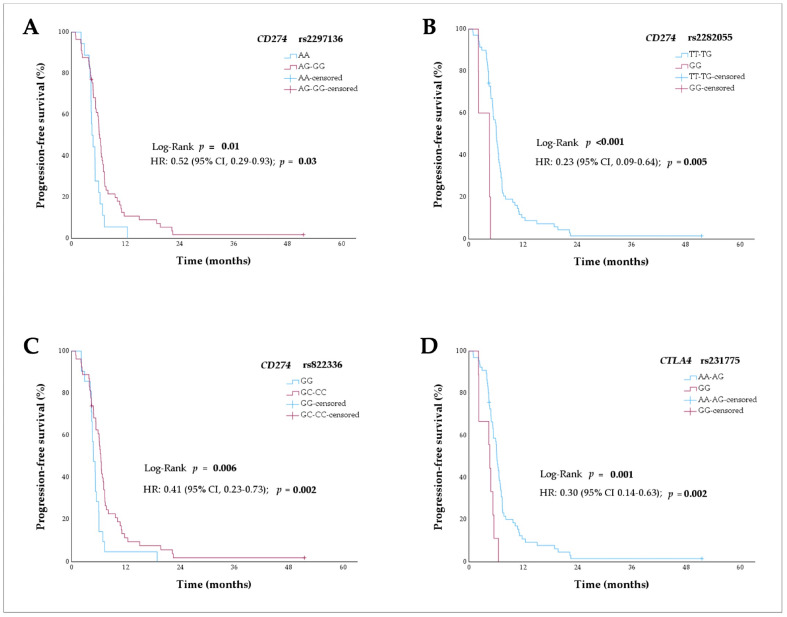 Figure 1
Peer Reviews
No public reviews on file for this paper yet. If you reviewed it on a platform where reviews are public (OpenReview, ICLR, NeurIPS, ICML), you can paste yours below so the community can read it here.
Videos
No videos yet. Explain this paper in a talk, walkthrough, or lecture? Add one.
Taxonomy
TopicsLung Cancer Research Studies · Peptidase Inhibition and Analysis · Neuroendocrine Tumor Research Advances