Extracellular Vesicle Abundance, but Not a High Aggregation-Prone Peptide Cargo, Is Associated with Dihydroartemisinin Exposure in Plasmodium falciparum
Kwesi Z. Tandoh, Yunuen Avalos-Padilla, Prince Ameyaw, Elisabeth K. Laryea-Akrong, Gordon A. Awandare, Michael David Wilson, Neils B. Quashie, Xavier Fernàndez-Busquets, Nancy O. Duah-Quashie

TL;DR
This study explores how Plasmodium falciparum responds to artemisinin drugs by examining extracellular vesicles and their cargo, finding that vesicle abundance increases with drug exposure but does not strongly support a specific resistance mechanism.
Contribution
The study provides new evidence that EV abundance increases with dihydroartemisinin exposure but does not strongly support the EV export hypothesis regarding aggregation-prone peptides.
Findings
Dihydroartemisinin exposure is positively correlated with extracellular vesicle abundance in Plasmodium falciparum.
A non-constitutive DHA-induced EV biogenesis pathway is suggested based on PfVps60KO producing the most EVs under DHA exposure.
Only one of nine identified parasite peptides in EV cargo has a high aggregation-prone index, not strongly supporting the EV export hypothesis.
Abstract
Our understanding of the molecular mechanisms undergirding artemisinin (ART) resistance in Plasmodium falciparum is currently based on two organizing principles: reduced hemoglobin trafficking into the digestive food vacuole, resulting in lower levels of activated ART, and increased tolerance to ART-induced oxidative stress in the infected erythrocyte. We had previously proposed an extracellular vesicle (EV) export model of ART resistance in P. falciparum. This model predicts that EV abundance will be altered by ART exposure and that the peptide cargo of EVs from the ART-exposed condition will be enriched with aggregation-prone peptides. We tested the predictions of the EV export hypothesis in this study using in vitro culture assays of an ART-resistant transgenic line engineered on a 3D7 background (R561H) and a 3D7 knock-out line (PfVps60KO) with deficient EV production phenotype. EV…
Genes, proteins, chemicals, diseases, species, mutations and cell lines named across the full text — each resolved to its canonical identifier and authoritative record.
Click any figure to enlarge with its caption.
 Figure 1
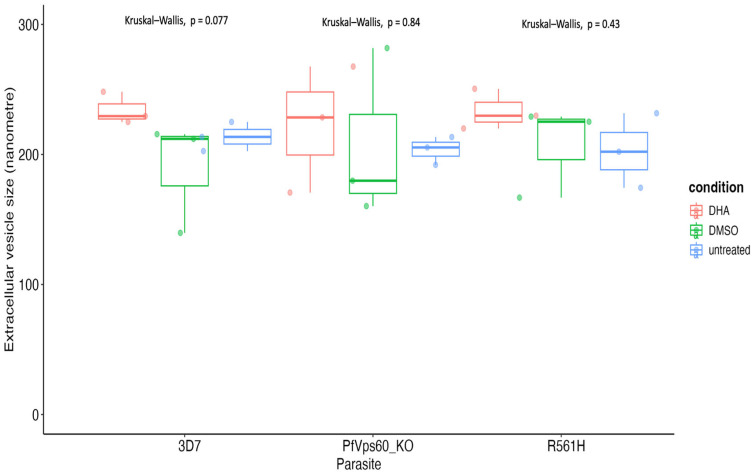 Figure 2
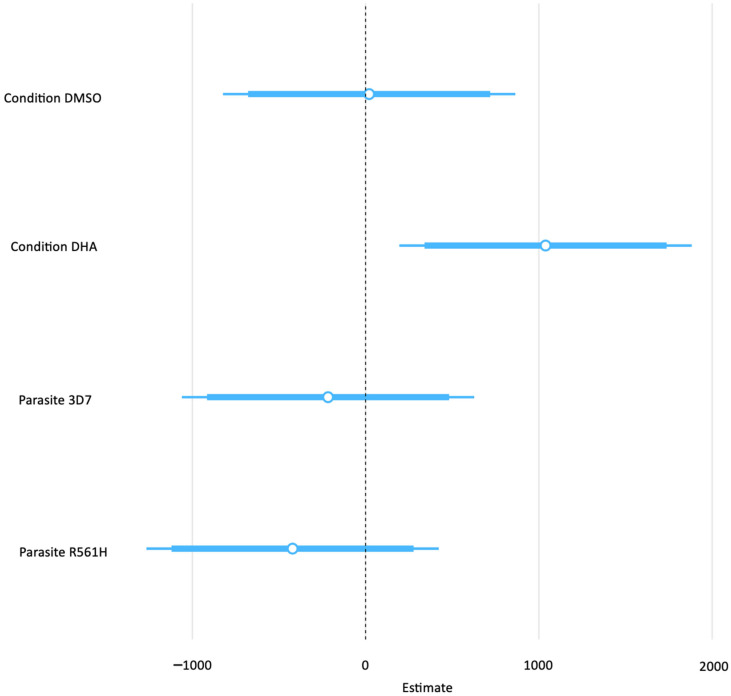 Figure 3
Peer Reviews
No public reviews on file for this paper yet. If you reviewed it on a platform where reviews are public (OpenReview, ICLR, NeurIPS, ICML), you can paste yours below so the community can read it here.
Videos
No videos yet. Explain this paper in a talk, walkthrough, or lecture? Add one.
Taxonomy
TopicsMalaria Research and Control · HIV Research and Treatment · Complement system in diseases