A Novel Chiral Molecularly Imprinted Electrochemical Sensor Based on β-CD Functionalized Graphene Quantum Dots for Enantioselective Detection of D-Carnitine
Feng Yang, Xin Qi, Yan Chen, Kai Tang, Mengyang Fang, Yanwei Song, Jiufen Liu, Lianming Zhang

TL;DR
A new sensor using graphene quantum dots and cyclodextrin improves detection of D-carnitine with high selectivity and accuracy.
Contribution
A novel chiral sensor using β-CD functionalized GQDs in MIPs for enantioselective detection of D-carnitine is developed.
Findings
The sensor detects D-carnitine with a detection limit of 2.35 × 10⁻¹³ mol/L.
The sensor shows a 7.15-fold improvement in selectivity for D-carnitine recognition.
Real sample tests achieved recovery rates of 98.5% to 103.0% for D-carnitine.
Abstract
In this study, β-cyclodextrin (β-CD) functionalized graphene quantum dots (GQDs) was employed to augment the array of chiral recognition sites, thereby enhancing the affinity of GQDs/β-CD composite for imprinting molecules and realizing heightened chiral selectivity. The incorporation of GQDs/β-CD into the synthesis of molecularly imprinted polymers (MIPs), synergizing with the host-guest inclusion properties of β-CD and the abundant carboxyl groups of GQDs, enhanced the chiral recognition capacity of MIPs materials. Consequently, a novel MIPs/(GQDs/β-CD) sensor with chiral recognition capabilities tailored for D-carnitine was successfully fabricated. The binding mechanism between GQDs/β-CD and D-carnitine was elucidated via Ultraviolet-visible spectroscopy and Fourier transform infrared spectroscopy. The variation in the response signal (ΔI) of the probe molecule exhibited a linear…
Genes, proteins, chemicals, diseases, species, mutations and cell lines named across the full text — each resolved to its canonical identifier and authoritative record.
Click any figure to enlarge with its caption.
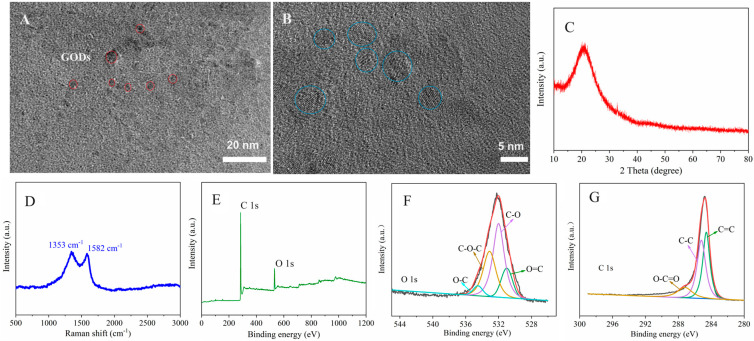 Figure 1
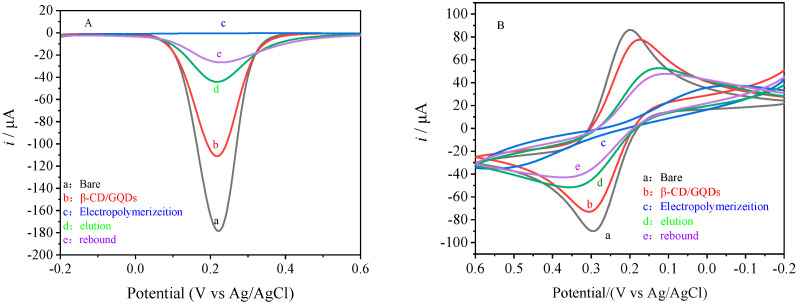 Figure 2
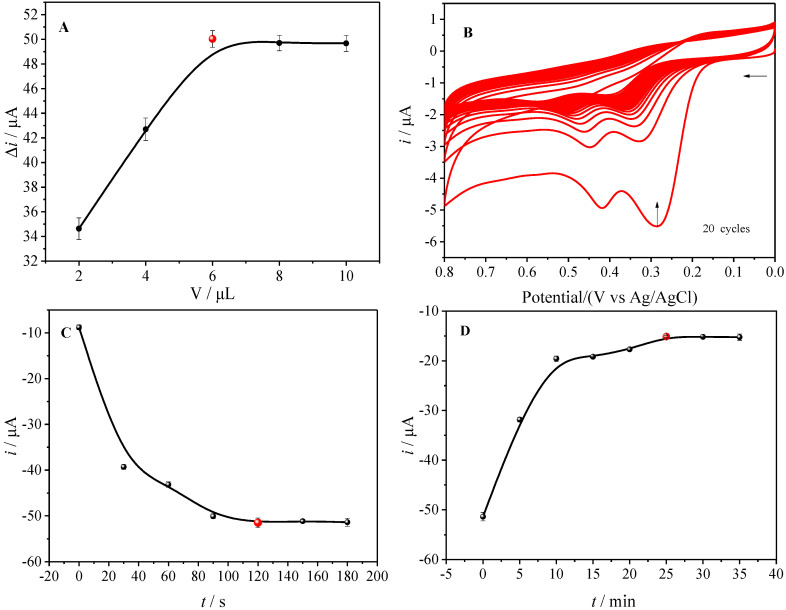 Figure 3
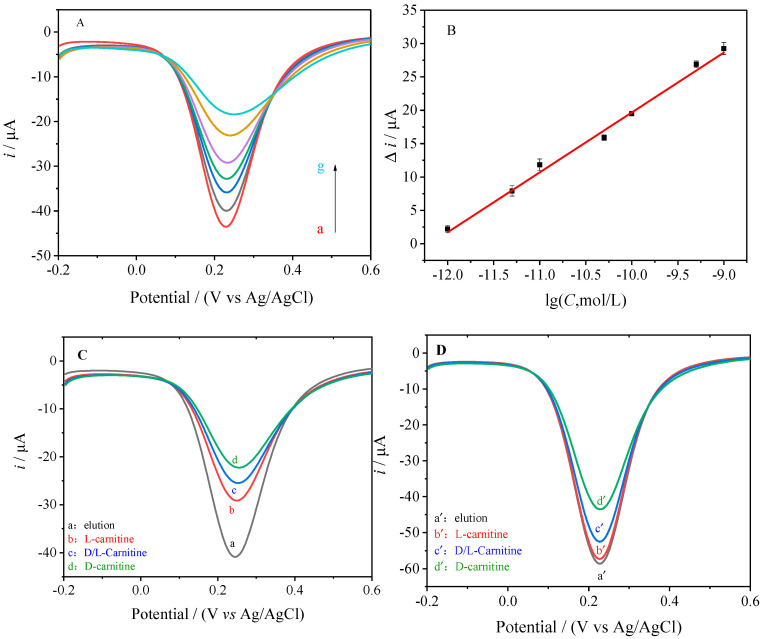 Figure 4
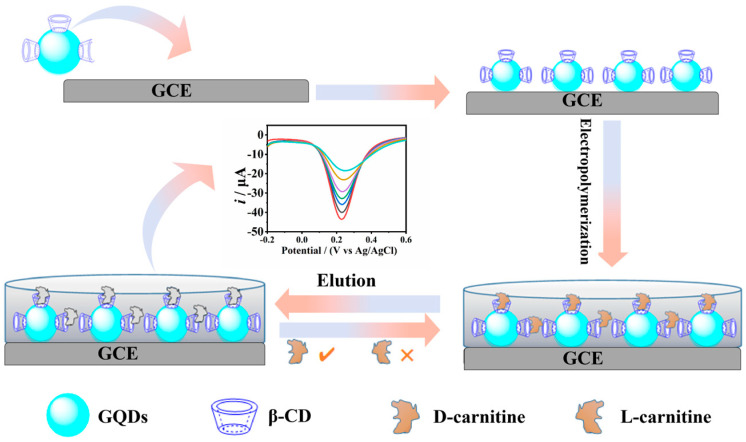 Figure 5
Peer Reviews
No public reviews on file for this paper yet. If you reviewed it on a platform where reviews are public (OpenReview, ICLR, NeurIPS, ICML), you can paste yours below so the community can read it here.
Videos
No videos yet. Explain this paper in a talk, walkthrough, or lecture? Add one.
Taxonomy
TopicsCarbon and Quantum Dots Applications · Molecular Sensors and Ion Detection · Electrochemical sensors and biosensors