STAG1 Disease, Central Precocious Puberty, and Bone Fragility—A Case Report
Rebecca-Cristiana Șerban, Andreea-Mădălina Mituț-Velișcu, Andrei Costache, Luminița-Nicoleta Cima, Carmen Niculescu, Aritina Moroșanu, Anca-Lelia Riza, Ioana Streață

TL;DR
A case report describes a girl with a STAG1 gene variant, intellectual disability, early puberty, and bone fragility, highlighting the complex and poorly understood nature of cohesinopathies.
Contribution
This case adds to the understanding of STAG1-related cohesinopathies by highlighting unusual features like central precocious puberty and bone fragility.
Findings
The patient had a pathogenic STAG1 variant and features like intellectual disability and early puberty.
Current molecular tools struggle to fully explain overlapping and seemingly unrelated clinical features in cohesinopathy cases.
The case suggests the need for further investigation into the clinical spectrum of STAG1-related disorders.
Abstract
Background: Previously reported STAG1 gene-related cohesinopathies describe a range of clinical features, typically including intellectual disability (ID), facial dysmorphisms, and limb anomalies. Case presentation: We present the case of an 8-year-old girl with main findings including ID, central precocious puberty (CPP), and bone fragility. Panel genetic testing revealed a pathogenic STAG1 variant, NM_005862.3:c.2116del p.(Asp706Ilefs*15), which can only partially explain the clinical phenotype. Reports of STAG1-related cohesinopathies, including ours, have consistently described developmental and intellectual disabilities. In our case, the etiology of CPP and bone fragility remains unexplained. We discuss the challenges and limitations of current molecular tools in assessing cases with overlapping, apparently unlinked phenotypes, while speculating whether the common occurrence could…
Genes, proteins, chemicals, diseases, species, mutations and cell lines named across the full text — each resolved to its canonical identifier and authoritative record.
Click any figure to enlarge with its caption.
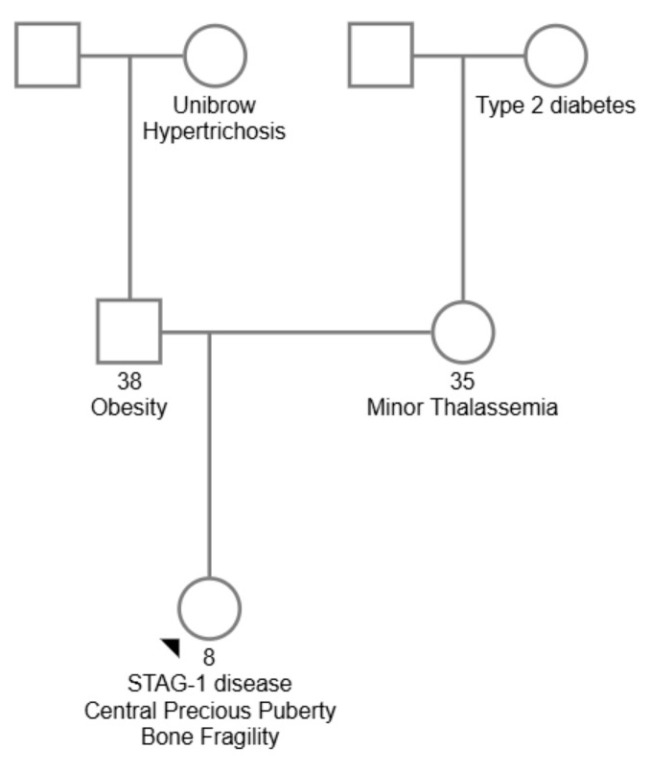 Figure 1
 Figure 2
Peer Reviews
No public reviews on file for this paper yet. If you reviewed it on a platform where reviews are public (OpenReview, ICLR, NeurIPS, ICML), you can paste yours below so the community can read it here.
Videos
No videos yet. Explain this paper in a talk, walkthrough, or lecture? Add one.
Taxonomy
TopicsConnective tissue disorders research · Wnt/β-catenin signaling in development and cancer · Digestive system and related health