Tandem Administration of Prostaglandin F2α and Gonadotropin-Releasing Hormone in Beef Heifers and Cows as a Convergent Presynchronization Method in the 7 & 7 Synch Protocol
Lucas J. Palcheff, Genevieve M. VanWye, Kimberly R. Ricardo, Kendal L. Green, Franklin J. Even, Samantha R. Roberts, Adella B. Lonas, Christine M. Spinka, Scott E. Poock, Saulo Menegatti Zoca, Jessica N. Drum, Jordan M. Thomas

TL;DR
This study tested a new method to synchronize estrus in beef cattle using hormones, but found it didn't improve pregnancy rates despite better ovarian responses.
Contribution
A presynchronization strategy using GnRH and PG was evaluated to improve estrus synchronization in acyclic females within the 7 & 7 Synch protocol.
Findings
Tandem administration of GnRH and PG generated a convergent ovarian response among females with varying pretreatment luteal status.
Pregnancy rates following fixed-time artificial insemination did not differ between treatment groups.
Multiparous females treated with 7 & 7 + G + P showed higher behavioral estrus expression prior to insemination.
Abstract
In the cow–calf industry, estrus synchronization and artificial insemination are reproductive technologies that improve conception rates early in the breeding season. These technologies concentrate calving earlier in the season, increasing calf weaning weights and enhancing producer profitability. A recently developed estrus synchronization protocol, 7 & 7 Synch, has demonstrated improvements in pregnancy rates resulting from artificial insemination. However, improvements in pregnancy results using 7 & 7 Synch may be limited to cyclic females. Acyclic females (i.e., females not already undergoing regular estrous cycles prior to the initiation of the synchronization protocol) lack a functional corpus luteum, rendering them unresponsive to the prostaglandin F2α administered at the initiation of 7 & 7 Synch. Commercial cow–calf herds often consist of a mix of acyclic and cycling females,…
Genes, proteins, chemicals, diseases, species, mutations and cell lines named across the full text — each resolved to its canonical identifier and authoritative record.
Click any figure to enlarge with its caption.
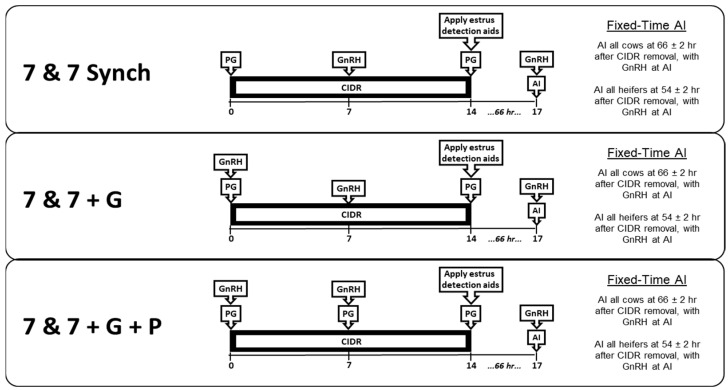 Figure 1
- —United States Department of Agriculture (USDA), National Institute of Food and Agriculture (NIFA)
- —USDA North-Central 1201 Multi-State Project
Peer Reviews
No public reviews on file for this paper yet. If you reviewed it on a platform where reviews are public (OpenReview, ICLR, NeurIPS, ICML), you can paste yours below so the community can read it here.
Videos
No videos yet. Explain this paper in a talk, walkthrough, or lecture? Add one.
Taxonomy
TopicsReproductive Physiology in Livestock · Genetic and phenotypic traits in livestock · Ruminant Nutrition and Digestive Physiology
1. Introduction
A significant challenge with estrus synchronization (ES) protocols designed for beef cattle, such as the 7-day CO-Synch + CIDR, is the inconsistent response to gonadotropin-releasing hormone (GnRH) administered at protocol initiation to induce a new follicular wave. When administered at a random point of the estrous cycle, GnRH induces ovulation in approximately 66% of cows [1]. The failure of some females to ovulate results in subsets of individuals with divergent ovarian presentations, leading to greater variability in the timing of estrus and ovulation, potentially reducing the pregnancy rate to fixed-time artificial insemination (P/AI). Presynchronization strategies aim to manage the stage of cycle prior to GnRH and, thus, increase the proportion of females responding to GnRH [2]. However, in the beef industry, protocols with several additional animal handling events (i.e., presynchronization strategies like Double Ovsynch, used in dairy cattle) are less practical.
The 7 & 7 Synch protocol introduces two presynchronization components to the 7-day CO-Synch + CIDR protocol in a single handling event, as follows: an administration of prostaglandin F2α (PG) and treatment with an intravaginal progesterone-releasing device (CIDR) prior to the administration of GnRH. Administering PG prior to GnRH can increase the proportion of females presenting with a GnRH-responsive follicle [3]. In the absence of a corpus luteum (CL), subluteal progesterone (P4) concentrations from the CIDR allow for a pulsatile pattern of luteinizing hormone (LH) release with adequate frequency to stimulate follicular growth and support continued dominance [4,5]. Compared to the 7-day CO-Synch + CIDR protocol, the 7 & 7 Synch protocol increased the largest follicle diameter (LFD) at GnRH administration, reduced variation in luteal status on Day 14 [6,7], increased the proportion of females expressing behavioral estrus, and improved P/AI in some [7,8,9], but not all [10,11], studies. Differing observations related to P/AI raises questions, particularly with respect to the influence of cyclicity status and ovarian presentation at the start of treatment.
The administration of PG is only effective in inducing luteolysis in cycling females between Days 6 and 16 of the estrous cycle [12]; therefore, females on Days 1 to 5 of the estrous cycle at the start of the 7 & 7 Synch protocol are likely to maintain CL and, rather than forming a persistent follicle, have a variable LFD when GnRH is administered 7 days later. Acyclic females (i.e., anestrous cows and peripubertal heifers) of course lack CL and, thus, also do not undergo luteolysis in response to PG. Variance among females in ovarian response is a source of potential variance in the timing of estrus and ovulation, which can affect P/AI when FTAI is performed.
Modern protocols used to facilitate FTAI have a reasonable degree of efficacy across females of varying cyclicity status [1,13]. However, the objective of this experiment was to achieve more uniform control over luteal and follicular dynamics and improve the proportion of acyclic females conceiving to FTAI. Incorporating GnRH at presynchronization initiation can induce ovulation in a proportion of acyclic females [14,15,16], forming CL and initiating a new synchronized follicular wave. Therefore, we hypothesized that the tandem administration of GnRH and PG on Days 0 and 7 of the 7 & 7 Synch protocol would reduce variation in luteal and follicular status on Day 14, increase the proportion of females expressing behavioral estrus prior to FTAI, and improve P/AI.
2. Materials and Methods
2.1. Animals and Estrus Synchronization
Beginning in the spring breeding season of 2022 and ending in the fall of 2023, estrus was synchronized in 2320 beef females (n = 575 nulliparous; n = 338 primiparous; n = 1407 multiparous) across locations (n = 13) in Missouri, South Dakota, and Tennessee (Table 1). Pre-treatment ovarian status was assessed on Day 0 via transrectal ovarian ultrasonography, with an assessment of luteal status, after which females without CL were classified as non-luteal, and females with CL were classified as luteal. Within each location, females were blocked based on parity and pre-treatment luteal status and were randomly assigned, within a block, to one of three treatments (Figure 1). The number of females by parity and treatment, as well as their pre-treatment luteal status classification by treatment and parity, is summarized in Table 2. Pre-treatment luteal status did not differ across treatments.
Females assigned to the 7 & 7 Synch treatment received a 1.38 g CIDR (EAZI-Breed CIDR^®^ Zoetis, Madison, NJ, USA) coincident with the administration of PG (500 µg cloprostenol sodium i.m.; Estrumate; Merck Animal Health, Madison, NJ; or 25 mg dinoprost tromethamine i.m.; Lutalyse; Zoetis, Madison, NJ; consistent across treatments within the location) on Day 0, administration of GnRH (100 µg gonadorelin acetate i.m.; Fertagyl; Merck Animal Health, Madison, NJ; or 100 µg gonadorelin hydrochloride i.m.; Factrel; Zoetis, Madison, NJ; consistent across treatments within the location) on Day 7, and administration of PG with CIDR removal on Day 14. Concurrent with PG administration and CIDR removal, all females had an estrus detection patch (Estrotect; Rockway Inc, Spring Valley, WI, USA) placed on their tail-head. At FTAI on Day 17, all females were administered GnRH. Females assigned to the 7 & 7 + G treatment received the same treatment schedule as females treated with 7 & 7 Synch, with the modification that GnRH was administered in tandem with PG on Day 0. Females assigned to the 7 & 7 + G + P treatment received the same treatment schedule as females treated with 7 & 7 Synch, with the modification that GnRH was administered in tandem with PG on both Day 0 and Day 7 of the treatment schedule. Females were exposed to bulls for natural service beginning 14 days after FTAI.
2.2. Ovarian Ultrasonography
Transrectal ovarian ultrasonography was performed on Days 7 and 14 using a Sonosite EDGE equipped with an L52 10.0–5.0 MHz linear-array transducer (SonoSite Inc., Bothwell, WA, USA) in locations 3, 4, 6, 10, 11, and 13, and an Ibex EVO II equipped with a 2.0–14.0 MHz linear-array transducer (Ibex, Washington, DC, USA) in locations 7, 8, 9, and 12. Transrectal ovarian ultrasonography was used to determine the LFD measurement and presence and number of CL. The LFD was determined based on the average height and width of the follicular measurement, as assessed via a caliper tool in each ultrasound machine. The CL status was determined by observing one or more distinct luteal structures, with the number of CL noted when more than one was present.
On Days 7 and 14, CL status was recorded for all females in locations 6, 8, and 12. When time and labor were constrained, transrectal ovarian ultrasonography was performed on Days 7 and 14 to determine CL status on a representative subset of females from each treatment. This subset included locations 3, 4, 7, 9, 10, 11, and 13 for Day 7 CL status, and locations 3, 7, 9, 10, 11, and 13 for Day 14 CL status. A measurement of LFD was collected for all females in locations 6 and 12 on Days 7 and 14; and on a representative subset in locations 3, 4, and 10–13 on Day 7 and in locations 3 and 10–13 on Day 14.
2.3. Estrus Detection and Artificial Insemination
Estrus detection aids (Estrotect, Rockway Inc, Spring Valley, WI, USA) were applied to all females on Day 14 at the time of final PG administration and CIDR removal and secured using a spray adhesive. Estrus detection aid (patch) activation was recorded at the time of FTAI. Patch “activation”, or removal of the coating from the Estrotect patch, was scored on a scale of 0 to 4 (0 = missing patch; 1 = 0–25% of patch activated; 2 = 25–50% of patch activated; 3 = 50–75% of patch activated; 4 = 75–100% of patch activated) [17]. Females were classified as having expressed behavioral estrus if 50% or more of the patch was activated (score = 3 or 4) or if the patch was missing (score = 0). Females were classified as non-estrous if less than 50% of their patch was activated (score = 1 or 2).
On Day 17, FTAI was performed at 54 ± 2 h after PG administration for nulliparous females and at 66 ± 2 h after PG administration for primiparous and multiparous females. Females were inseminated with either conventional (n = 2083) or sex-sorted (n = 236) semen, with semen type being balanced across treatments within each location. Multiple technicians performed insemination, with technicians being balanced by location, treatment, and semen type.
2.4. Pregnancy Diagnosis
Pregnancy rate to AI was determined 60 to 100 days after FTAI with transrectal ultrasonography, using a SonoSite EDGE equipped with an L52 10.0–5.0 MHz linear-array transducer (SonoSite Inc., Bothwell, WA, USA) in locations 1–6, 10, 11, and 13; and with an Ibex EVO II equipped with a 2.0–14.0 MHz linear-array transducer (Ibex, Washington, DC, USA) in locations 7–9 and 12. Experienced diagnosticians evaluated fetal size measurements and development to accurately distinguish pregnancies resulting from FTAI and those from subsequent natural service, which was made possible by the lack of natural service bull exposure for two weeks after FTAI.
2.5. Statistical Analysis
Statistical analyses were performed using a Statistical Analysis System (SAS 9.4 Inst. Inc., Cary, NC, USA). Mixed models (GLIMMIX procedure of SAS) using the binomial distribution link logit function were used to analyze CL status on Day 7 and Day 14, the proportion of females expressing behavioral estrus prior to FTAI, and P/AI. A mixed model (GLIMMIX procedure of SAS) was used to analyze the continuous variable response of LFD. Location was included as a random effect in all models.
For the analysis of Day 7 CL status and Day 7 LFD, the fixed effects included in these models were treatment, pre-treatment luteal status, and parity. All two-way and three-way interactions were tested for inclusion in these models, and non-significant interaction effects (p > 0.10) were eliminated from the model in a backwards elimination process. When appropriate for tests of certain hypotheses, the 7 & 7 Synch treatment was compared to the pooled treatments of 7 & 7 + G and 7 & 7 + G + P, as they were identical until Day 7 of the treatment schedule. For the analysis of Day 14 LFD, the fixed effects included in the model were treatment, pre-treatment luteal status, and Day 14 CL status. All two-way and three-way interactions were included in this model. For the analysis of Day 14 CL status and estrus, the fixed effects included in these models were treatment, pre-treatment luteal status, and parity. All two-way and three-way interactions were included in these models. For the analysis of P/AI, the fixed effects included in the model were estrus, treatment, Day 14 CL status, parity, and semen type. All two-way and three-way interactions were tested for potential inclusion in the model, and non-significant interaction effects (p > 0.10) involving parity and semen type were eliminated from the model in a backwards elimination process. As a result, the final model for the analysis of P/AI included all two-way and three-way interactions for the fixed effects of estrus, treatment, and Day 14 CL status.
3. Results
3.1. Largest Follicle Diameter
Day 7 LFD was affected by pre-treatment luteal status (p = 0.0005), parity (p < 0.0001), and the interaction of treatment and parity (p = 0.01). The two-way interactions of pre-treatment luteal status and parity, pre-treatment luteal status and treatment, as well as the three-way interaction of treatment, parity, and pre-treatment luteal status, did not influence Day 7 LFD (p = 0.94, p = 0.16, p = 0.55, respectively). Day 7 LFD measurements, recorded via transrectal ovarian ultrasonography, are summarized by treatment and parity in Table 3, and by treatment and pre-treatment luteal status in Table 4. Females classified as luteal on Day 0 had a larger (p = 0.0005) Day 7 LFD (12.2 ± 0.17 mm) compared to females that were non-luteal on Day 0 (11.2 ± 0.21 mm). Additionally, Day 7 LFD was larger (p < 0.0001) among multiparous (12.6 ± 0.23 mm) and primiparous (11.8 ± 0.39 mm) females compared to nulliparous females (10.6 ± 0.26 mm). Multiparous females treated with 7 & 7 Synch presented with a larger (p < 0.01) Day 7 LFD (13.1 ± 0.29 mm) compared to females treated with the modified treatments 7 & 7 + G (12.2 ± 0.20 mm) or 7 & 7 + G + P (12.4 ± 0.20 mm). Treatment did not affect Day 7 LFD in primiparous (p = 0.39) or nulliparous (p = 0.44) females.
Day 14 LFD tended (p = 0.08) to be influenced by the interaction of pre-treatment luteal status and Day 14 CL status. Pre-treatment luteal status and Day 14 CL status did not impact Day 14 LFD (p = 0.50 and p = 0.43, respectively). The two-way interactions of pre-treatment luteal status and treatment, treatment and Day 14 CL status, as well as the three-way interaction of pre-treatment luteal status, treatment, and Day 14 CL status, did not affect Day 14 LFD (p = 0.60, p = 0.22, p = 0.29, respectively). Day 14 LFD is summarized by treatment and parity in Table 3, and by treatment and pre-treatment luteal status in Table 4. Females classified as luteal on Day 0 and without CL on Day 14 presented with a larger (p = 0.03) LFD on Day 14 (11.7 ± 0.40 mm) when compared to females that were non-luteal on Day 0 and with CL on Day 14 (11.1 ± 0.36 mm). In addition, females classified as luteal on Day 0 and without CL on Day 14 had a larger (p = 0.03) LFD on Day 14 (11.7 ± 0.40 mm) when compared to females that were luteal on Day 0 and presenting with multiple CL on Day 14 (10.0 ± 0.56 mm). Day 14 LFD was not further impacted by the interaction of pre-treatment luteal status and Day 14 CL status (p > 0.05).
3.2. Corpora Lutea Status
Day 7 CL status was affected by treatment (p < 0.0001) and parity (p < 0.0001). Pre-treatment luteal status did not influence Day 7 CL status (p = 0.27). The two-way interactions of pre-treatment luteal status and parity, pre-treatment luteal status and treatment, treatment and parity, as well as the three-way interaction of treatment, parity, and pre-treatment luteal status, did not affect Day 7 CL status (p = 0.79, p = 0.75, p = 0.13, p = 0.37, respectively). Day 7 CL status, as assessed via transrectal ovarian ultrasonography, is summarized by treatment and parity in Table 3, and by treatment and pre-treatment luteal status in Table 4. A greater proportion (p < 0.0001) of females presented with CL on Day 7 when treated with the modified treatments 7 & 7 + G or 7 & 7 + G + P (63%) when compared to females treated with 7 & 7 Synch (38%). Additionally, a greater proportion (p < 0.0001) of females were observed with CL on Day 7 if primiparous (71%) or multiparous (68%) compared to those that were nulliparous (38%).
Day 14 CL status was affected by parity (p < 0.0001) and tended to be influenced by pre-treatment luteal status (p = 0.06) and the interaction of treatment and parity (p = 0.09). The two-way interactions of pre-treatment luteal status and parity, pre-treatment luteal status and treatment, as well as the three-way interaction of treatment, parity, and pre-treatment luteal status did not affect Day 14 CL status (p = 0.82, p = 0.17, p = 0.47, respectively). Day 14 CL status, as assessed via transrectal ovarian ultrasonography, is summarized by treatment and parity in Table 3, and by treatment and pre-treatment luteal status in Table 4. Pre-treatment luteal status tended to positively influence Day 14 CL status (p = 0.06), with a tendency for a greater proportion of females to have CL on Day 14 if having also presented as luteal on Day 0 (80%), as compared to those that were non-luteal on Day 0 (68%). Additionally, Day 14 CL status increased by ascending parity (p < 0.0001), with a greater proportion of multiparous (86%) and primiparous (71%) females presenting with CL on Day 14, as compared to nulliparous females (56%). Lastly, the proportion of multiparous females with CL on Day 14 tended to be greater following treatment with 7 & 7 Synch or 7 & 7 + G (90% and 87%, respectively), as compared to females treated with 7 & 7 + G + P (82%; p = 0.09). There was a tendency (p = 0.08) for a greater proportion of primiparous females treated with 7 & 7 Synch to present with CL on Day 14 when compared to primiparous females treated with 7 & 7 + G (74% vs. 69%, respectively), whereas, in nulliparous females, Day 14 CL status was not impacted by treatment (p > 0.30).
3.3. Expression of Behavioral Estrus
The proportion of females expressing behavioral estrus prior to FTAI was affected by pre-treatment luteal status (p < 0.0001) and the interaction of treatment and parity (p = 0.002). The two-way interactions of pre-treatment luteal status and parity, pre-treatment luteal status and treatment, as well as the three-way interaction of treatment, parity, and pre-treatment luteal status, did not influence estrus (p = 0.35, p = 0.60, p = 0.55, respectively). The proportion of females expressing behavioral estrus prior to FTAI is summarized by treatment and parity in Table 5. A greater proportion (p < 0.0001) of females classified as luteal on Day 0 expressed behavioral estrus prior to FTAI (84%) when compared to non-luteal females (64%). A greater proportion of multiparous females expressed behavioral estrus prior to FTAI when treated with 7 & 7 + G + P (90%), as compared to multiparous females treated with 7 & 7 + G (79%; p < 0.002) or 7 & 7 Synch (78%; p = 0.0004). In nulliparous females, estrus prior to FTAI was not influenced by treatment (p = 0.37).
3.4. Pregnancy Rate to Fixed-Time Artificial Insemination
Pregnancy rate to FTAI was affected by the interaction of estrus and Day 14 CL status (p < 0.03) and tended (p = 0.06) to be influenced by the interaction of treatment and Day 14 CL status. Treatment, parity, and semen type did not impact P/AI (p = 0.20, p = 0.13, p = 0.52, respectively). The two-way interaction between estrus and treatment, as well as the three-way interaction of treatment, estrus, and Day 14 CL status, did not affect P/AI (p = 0.29 and p = 0.79, respectively). Pregnancy rate to FTAI is summarized by treatment and Day 14 CL status in Table 6. Females that had no CL on Day 14 after treatment with 7 & 7 + G tended to have poorer pregnancy rates to FTAI (43%; p = 0.06) compared to females across treatments that had CL on Day 14. Greater P/AI was observed among females expressing behavioral estrus prior to FTAI compared to females failing to express behavioral estrus (59% vs. 35%; p < 0.0001), but there was further separation within estrous and non-estrous animals due to the interaction with Day 14 CL status. Among females that expressed behavioral estrus prior to FTAI, greater P/AI was observed among females that had CL on Day 14 (62%) compared to those without CL on Day 14 (56%; p < 0.03). Females that failed to express behavioral estrus prior to FTAI and that did not present with CL on Day 14 had reduced P/AI (28%; p < 0.005) compared to all other groups within the estrus and Day 14 CL status interaction model.
4. Discussion
We hypothesized that the tandem administration of GnRH and PG on Days 0 and 7 of the 7 & 7 Synch protocol would reduce variation in luteal and follicular status on Day 14, increase the proportion of females expressing behavioral estrus prior to FTAI, and improve P/AI; however, the results observed suggest no meaningful improvements in these responses. In practice, ES is used in beef herds consisting of both cycling and acyclic females, due to variation in days postpartum, body condition, and nutritional status, as well as pubertal status in heifers [14,18,19]. We hypothesized that the incorporation of both PG and GnRH in the presynchronization portion of the 7 & 7 Synch protocol would improve control over ovarian dynamics among cows of varying cyclicity status. Minimizing variation among females in luteal status and follicular maturity results in more synchronous estrus and ovulation, leading to greater P/AI when using FTAI [20]. The results observed support the hypothesis that the inclusion of GnRH, as an ovulatory stimulus at the start of the 7 & 7 Synch treatment, can be performed without compromising the control obtained among cycling females; however, the overall pregnancy outcomes were not meaningfully improved for acyclic females.
The present results for CL status on Day 7 in the modified treatments indicate that a large proportion of females ovulated in response to the GnRH administered on Day 0. There was no significant interaction of pre-treatment luteal status and treatment, suggesting that a high ovulation rate was obtained even among acyclic cows. Although some reports in dairy cattle have indicated a reduced effect of both PG and GnRH when administered in tandem [21], Yousuf [22] reported that the administration of both PG and GnRH on the same day, seven days prior to the start of Ovsynch, was a simple and effective presynchronization strategy. For females ovulating in response to GnRH on Day 0 and subsequently recruiting a new follicular wave, the seven days between GnRH administrations should allow sufficient time for the maturation of an LH-responsive dominant follicle [23,24]. For females failing to ovulate in response to GnRH on Day 0, yet undergoing luteolysis in response to PG, the reduction in circulating P4 concentrations combined with the subluteal P4 from the CIDR should prevent atresia of the dominant follicle [6]; moreover, if the dominant follicle of such a female were already static or regressing, the seven-day interval before GnRH should provide adequate time for the maturation of a dominant follicle from the subsequent follicular wave [23]. Observations of a large proportion of cows presenting with CL on Day 14 in the 7 & 7 + G and even in the 7 & 7 + G + P treatments suggest a high ovulation rate in response to GnRH administered on Day 7 of the treatment schedule.
Across parities and pre-treatment luteal status classifications, treatment with GnRH on Day 0 resulted in a greater proportion of females presenting with CL on Day 7 when treated with the modified treatments (63%) when compared to females treated with 7 & 7 Synch (38%), in which luteolysis is induced intentionally for a large proportion of females. Because females treated with the standard 7 & 7 Synch protocol primarily have subluteal circulating concentrations of P4 levels over the following seven days, a greater frequency of LH release is anticipated to result in greater follicular size [25]. This may explain our observation of multiparous females treated with the modified treatments presenting with smaller Day 7 LFD (7 & 7 + G: 12.2 ± 0.20 mm; 7 & 7 + G + P: 12.4 ± 0.20 mm) compared to multiparous females treated with 7 & 7 Synch (13.1 ± 0.29 mm). It is worth noting, however, that mean follicle sizes in all treatments would generally be considered inducible to ovulate via GnRH administration (>10.5 mm) [26].
The inclusion of the 7 & 7 + G + P treatment in this experimental design allowed for the testing of hypotheses related to CL number on Day 14 and resulting potential effects on the expression of behavioral estrus and P/AI. While previous research reported no difference in P/AI between females that present with a single versus multiple CL at CIDR removal, females presenting with multiple CL have elevated circulating progesterone concentrations [27] and differ in the timing of onset of estrus [28]. Maximizing the proportion of females that synchronously express behavioral estrus prior to FTAI is a high research priority, as females expressing behavioral estrus prior to FTAI have significantly greater P/AI [29]. Although, in theory, the inclusion of an ovulatory stimulus on Days 0 and 7 increased the likelihood of multiple CL and, thus, greater circulating P4 concentrations in females treated with the 7 & 7 + G protocol, the proportion of females expressing estrus prior to FTAI and the pregnancy rates resulting from FTAI in this treatment suggest minimal cause for concern. It should also be noted that Day 14 LFD was similar across treatments, suggesting minimal impact on follicular maturity. Previous reports indicate the follicle sizes observed in all treatments would be capable of ovulating in response to GnRH administration [26,30].
The parity effects and interactions observed in this experiment highlight the greater likelihood of multiparous beef cows having favorable responses during estrus synchronization. Multiparous cows were more likely to be estrous cycling prior to the start of the protocol, were more likely to present with CL on Day 14 of the protocol, and were more likely to express behavioral estrus prior to FTAI. Across treatments and parities, females that expressed behavioral estrus prior to FTAI had greater P/AI (59%) when compared with females that failed to express estrus (35%). The proportion of multiparous females expressing behavioral estrus prior to FTAI was greatest among females treated with 7 & 7 + G + P (90%) when compared to those treated with 7 & 7 Synch (78%) or 7 & 7 + G (79%). Generally, a greater proportion of females expressing behavioral estrus prior to FTAI would be anticipated to result in greater P/AI, so long as the fertility of estrous females is not otherwise compromised (e.g., ovulation of a persistent follicle or poor timing of insemination for a subset of females). Thus, an increase in the proportion of females expressing estrus without an associated increase in P/AI raises questions. It is important to note that, among multiparous females treated with 7 & 7 + G + P, there was a lower proportion with CL on Day 14 (82%) when compared to those treated with 7 & 7 Synch (90%) or 7 & 7 + G (87%). Day 14 CL response in this experiment is of practical significance, as females failing to present with CL at CIDR removal are likely to vary with respect to timing of estrus onset in comparison to luteal females. Additionally, in theory, this subset of animals may potentially ovulate a persistent follicle [25]. Oocytes from persistent follicles have reduced fertility due to their extended exposure to an increased frequency of LH pulses, which causes the premature resumption of meiosis [25,31,32]. However, although a notable proportion of females on the 7 & 7 + G + P treatment presented with no luteal tissue on Day 14 (27%; 124/464), these females achieved P/AI comparable to that observed among females presenting with no luteal tissue on Day 14 in other treatments (7 & 7 Synch: 64% if estrous, 33% if non-estrous; 7 & 7 + G: 49% if estrous, 11% if non-estrous; 7 & 7 + G + P: 56% if estrous, 33% if non-estrous).
5. Conclusions
In conclusion, tandem administration of GnRH and PG at the start of the 7 & 7 Synch protocol was effective from an ovarian response standpoint, in that this presynchronization strategy resulted in convergent ovarian presentation among females with initially varying luteal status pretreatment. These hormones perform two distinct physiological functions and, thus, create potential for initially divergent ovarian responses (i.e., Day 7 ovarian presentation) among females administered both GnRH and PG in tandem at the start of the protocol. However, follicular maturity at the time of GnRH administration on Day 7 of the protocol clearly allowed for successful reconvergence of ovarian presentation by Day 14 of the protocol. However, incorporating the administration of GnRH in the presynchronization portion of the protocol failed to meaningfully enhance overall pregnancy rates to FTAI. The effects of incorporating PG administration in tandem with GnRH on Day 7 of the treatment schedule may require further investigation, as this resulted in an increased proportion of multiparous females expressing behavioral estrus prior to FTAI but with no accompanying increase in P/AI.
The reference list from the paper itself. Each links out to its DOI / PubMed record.
- 1Geary T.W. Downing E.R. Bruemmer J.E. Whittier J.C. Ovarian and Estrous Response of Suckled Beef Cows to the Select Synch Estrous Synchronization Protocol Prof. Anim. Sci.2000161510.15232/S 1080-7446(15)31653-3 · doi ↗
- 2Wiltbank M.C. Pursley J.R. The cow as an induced ovulator: Timed AI after synchronization of ovulation Theriogenology 20148117018510.1016/j.theriogenology.2013.09.01724274420 · doi ↗ · pubmed ↗
- 3Grant J.K. Abreu F.M. Hojer N.L. Fields S.D. Perry B.L. Perry G.A. Influence of inducing luteal regression before a modified controlled internal drug-releasing device treatment on control of follicular development J. Anim. Sci.2011893531354110.2527/jas.2011-385221666008 · doi ↗ · pubmed ↗
- 4Savio J.D. Thatcher W.W. Morris G.R. Entwistle K. Drost M. Mattiacci M.R. Effects of induction of low plasma progesterone concentrations with a progesterone-releasing intravaginal device on follicular turnover and fertility in cattle J. Reprod. Fertil.199398778410.1530/jrf.0.09800778345482 · doi ↗ · pubmed ↗
- 5Small J.A. Colazo M.G. Kastelic J.P. Mapletoft R.J. Effects of progesterone presynchronization and e CG on pregnancy rates to Gn RH-based, timed-AI in beef cattle Theriogenology 20097169870610.1016/j.theriogenology.2008.09.04518977520 · doi ↗ · pubmed ↗
- 6Bonacker R.C. Gray K.R. Breiner C.A. Anderson J.M. Patterson D.J. Spinka C.M. Thomas J.M. Comparison of the 7 & 7 Synch protocol and the 7-day CO-Synch + CIDR protocol among recipient beef cows in an embryo transfer program Theriogenology 202015849049610.1016/j.theriogenology.2020.09.03333080452 · doi ↗ · pubmed ↗
- 7Bonacker R.C. Stoecklein K.S. Locke J.W.C. Ketchum J.N. Knickmeyer E.R. Spinka C.M. Poock S.E. Thomas J.M. Treatment with prostaglandin F 2α and an intravaginal progesterone insert promotes follicular maturity in advance of gonadotropin-releasing hormone among postpartum beef cows Theriogenology 202015735035910.1016/j.theriogenology.2020.08.01832858443 · doi ↗ · pubmed ↗
- 8Mercadante V.R.G.R.G. Lamb G.C.C. Oosthuizen N. Wege Dias N.W. Pancini S. Haines H. Currin J. Clark S. Stewart J.L. Pent G.J. 233 Estrus Response and Pregnancy Rates of Beef Replacement Heifers Enrolled in Two Fixed-time Artificial Insemination Protocols, With or Without Pre-synchronization J. Anim. Sci.202199(Suppl. S 3)12512610.1093/jas/skab 235.228 · doi ↗