Pressure‐Driven Reactivity in Dense Methane‐Nitrogen Mixtures
Hannah A. Shuttleworth, Mikhail A. Kuzovnikov, Lewis J. Conway, Huixin Hu, Jinwei Yan, Samuel Gallego‐Parra, Israel Osmond, Tomas Marqueño, Michael Hanfland, Dominique Laniel, Eugene Gregoryanz, Andreas Hermann, Miriam Peña‐Alvarez, Ross T. Howie

TL;DR
This study shows how methane and nitrogen can form complex compounds under high pressure and temperature, revealing new chemical reactions in planetary conditions.
Contribution
The paper demonstrates pressure-driven reactivity in CH4-N2 mixtures, forming new compounds and breaking stable molecular bonds under extreme conditions.
Findings
At pressures above 7 GPa, (CH4)5N2 and (CH4)7(N2)8 compounds form via van der Waals interactions.
Above 140 GPa, N2 triple bonds break, leading to C−N−H networks and methane dissociation.
High temperatures reduce required pressure for reactivity, forming NH3 and hydrocarbons at 14 GPa and 670 K.
Abstract
Carbon, nitrogen, and hydrogen are among the most abundant elements in the solar system, and our understanding of their interactions is fundamental to prebiotic chemistry. CH4 and N2 are the simplest archetypical molecules formed by these elements and are both markedly stable under extremes of pressure. Through a series of diamond anvil cell experiments supported by density functional theory calculations, we observe diverse compound formation and reactivity in the CH4‐N2 binary system at high pressure. Above 7 GPa two concentration‐dependent molecular compounds emerge, (CH4)5N2 and (CH4)7(N2)8, held together by weak van der Waals interactions. Strikingly, further compression at room temperature irreversibly breaks the N2 triple bond, inducing the dissociation of CH4 above 140 GPa, with the near‐quenched samples revealing distinct spectroscopic signatures of strong covalently bonded…
Genes, proteins, chemicals, diseases, species, mutations and cell lines named across the full text — each resolved to its canonical identifier and authoritative record.
Click any figure to enlarge with its caption.
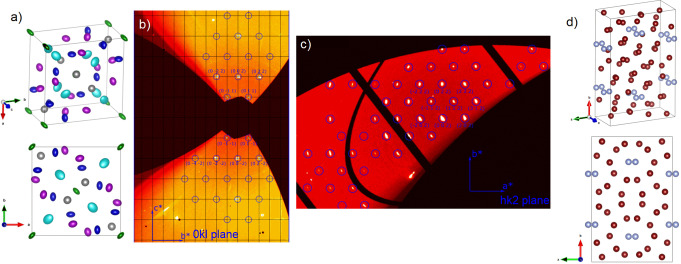 Figure 1
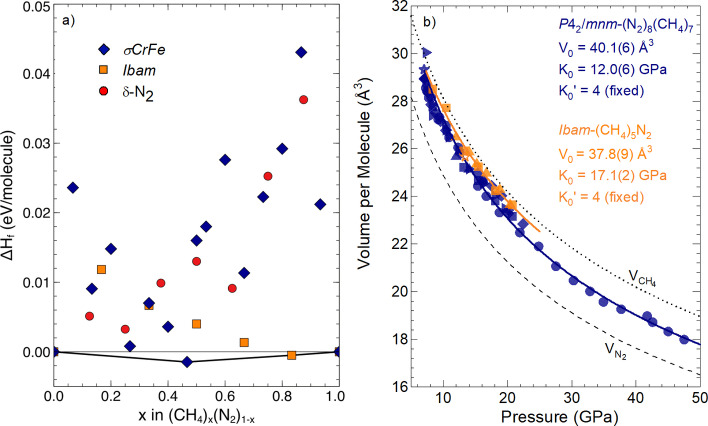 Figure 2
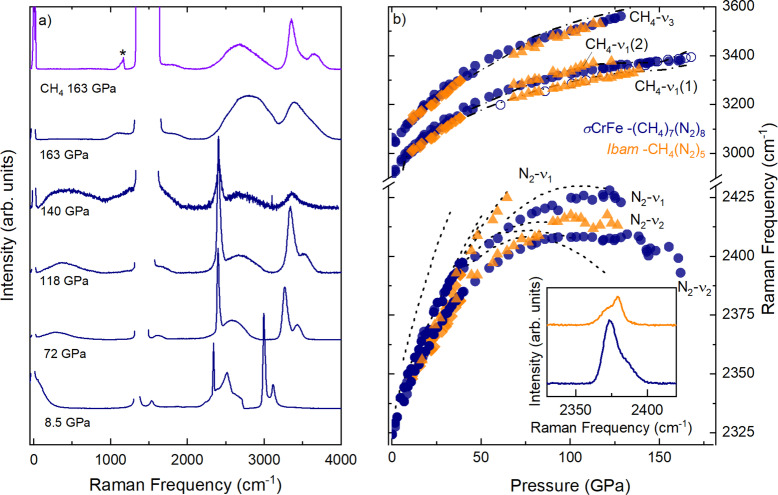 Figure 3
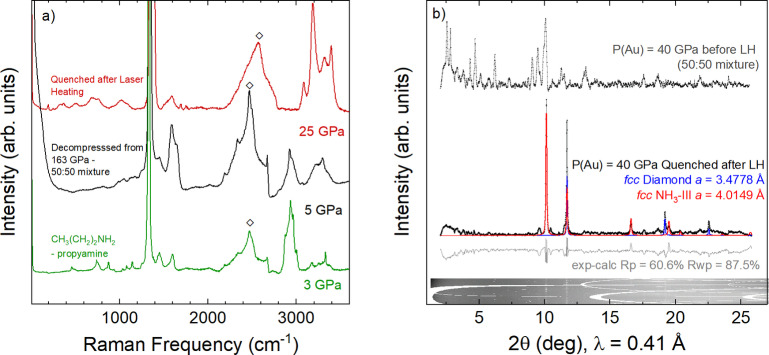 Figure 4
- —HORIZON EUROPE European Research Council 10.13039/100019180
- —UK Research and Innovation 10.13039/100014013
Peer Reviews
No public reviews on file for this paper yet. If you reviewed it on a platform where reviews are public (OpenReview, ICLR, NeurIPS, ICML), you can paste yours below so the community can read it here.
Videos
No videos yet. Explain this paper in a talk, walkthrough, or lecture? Add one.
Taxonomy
TopicsHigh-pressure geophysics and materials · Astro and Planetary Science · Advanced Chemical Physics Studies
Introduction
Carbon, nitrogen, and hydrogen constitute some of the most prevalent elements in the solar system, and exploring their chemical interactions is crucial to understanding the origin of life.[1] To explore the chemical interplay between these elements at planetary relevant conditions, the effect of pressure must be considered in addition to temperature‐induced chemistry. By altering molecular orbitals and interactions, high pressure serves as a clean chemical method for the synthesis of novel materials that would otherwise be unstable at ambient pressure.[2, 3, 4, 5, 6, 7, 8, 9, 10, 11, 12] A key example of this is how the stability and reactivity of molecular materials evolve upon compression. Due to the extremely strong N≡N triple bond, molecular N_2_ is one of the least reactive molecules under ambient conditions. However, high pressure has been shown to induce the formation of numerous non‐molecular phases of nitrogen, requiring the breaking of the triple bond.[13, 14, 15, 16, 17, 18, 19, 20, 21, 22] The potential chemistry of N_2_ at high pressure is further enhanced with temperature, resulting in the synthesis of novel polynitrides, which are of key interest due to their potential as high energy density compounds.[4, 10, 23, 24, 25, 26, 27, 28]
Like nitrogen, methane is another example of a simple molecular system that undergoes a series of physical and structural changes under pressure, with crucial implications in understanding physical processes within planetary interiors.[29, 30, 31] Both theoretical and experimental studies have demonstrated that the decomposition of methane into longer hydrocarbons and diamond is favored when compressed and heated.[29, 32, 33, 34, 35, 36, 37, 38] Additionally, it is theorized that at room temperature and pressures approaching 300 GPa, methane will dissociate into diamond and H_2_, which is of great interest regarding the mantle region of planets such as Neptune and Uranus, where methane is abundant.[33, 39, 40, 41, 42]
There is observational evidence that reactions occur between CH_4_ and N_2_ in the atmosphere of the satellite Titan, whereby hydrocarbon‐nitrile aerosol compounds, named “tholins”, have formed from CH_4_‐N_2_ mixtures at low pressures and temperatures in the presence of solar ultraviolet radiation.[43, 44, 45, 46, 47] Recent theoretical works also predict that under dense planetary conditions, exotic organic chemistry occurs within the C−N−H system.[48, 49] A variety of stable C−N−H compounds are predicted to emerge at pressures up to 50 GPa.[48] Most notably, two high energy density compounds were predicted: CN_2_H_4_ and CH_4_N_4_, stable at 11 GPa and 41 GPa respectively, the latter of which is predicted to be stable to ambient conditions upon quenching. With a calculated energy release of 6.43 KJg^−1^ upon decomposition back into molecular N_2_ and CH_4_, this is a promising high energy density compound.[48]
At ambient pressure, experiments have shown that CH_4_ and N_2_ can react, though require combinations of high‐temperature, electric discharge, microwave radiation, and catalysts.[50, 51, 52, 53] Most experimental approaches investigating the C−N−H system at high pressure have used complex precursors rather than the simplest archetypical molecules originating from the ternary system: CH_4_ and N_2_.[54, 55, 56, 57] There has been only one experimental study on CH_4_‐N_2_ mixtures up to 16 GPa, presenting evidence of compound formation retaining N_2_ and CH_4_ molecular units; however, the structural characterization was unsuccessful.[58] Surprisingly, whether the combination of high pressure and temperature can facilitate a reaction between CH_4_ and N_2_ has yet to be explored experimentally.
In this work, we investigate pressure and temperature‐induced chemistry in the dense CH_4_‐N_2_ system. We report the formation of two CH_4_‐N_2_ van der Waals compounds above 7 GPa at room temperature from binary CH_4_‐N_2_ fluid mixtures. Through a combination of X‐ray diffraction and first principle calculations, these are identified as P4_2_/mnm‐(CH_4_)7(N_2_)8 and Ibam ‐(CH_4_)5_N_2. Remarkably, upon room temperature compression of either compound, we observe the irreversible pressure‐induced dissociation and the reaction of N_2_ and CH_4_ molecules above 140 GPa. Decompression of the reaction products to near‐ambient conditions reveals spectroscopic signatures of strong covalently bonded C−N−H networks. The application of high temperature can induce a reaction at substantially lower pressures, where we observe the formation of NH_3_, together with longer‐chain hydrocarbons at 670 K (at 14 GPa), the latter of which decomposes into powdered diamond when temperatures exceed 1200 K at 25 GPa.
Results and Discussion
Synthesis, Characterization and Stability of CH4‐N2 Molecular Compounds
Two representative CH_4_‐N_2_ gas mixtures (50 : 50 CH_4_ : N_2_ and 67 : 33 CH_4_ : N_2_) were loaded into diamond anvil cells at 0.2 GPa (see Supporting Information for a complete description of the experimental procedure). Upon compression above 2 GPa, the fluid mixtures solidified into A‐CH_4_+δ‐N_2_.[59, 60, 61, 62, 63] Compression of the 50 : 50 mixture above 7 GPa resulted in the formation of a new compound. Single crystal X‐ray diffraction (SCXRD) data were obtained. These datasets were successfully refined to a crystal structure isomorphic to σ‐CrFe (space group P4_2_/mnm, Figure 1a), with lattice parameters a=11.904(3) Å and c=6.2072(13) Å, at 7 GPa (see Figure 1b and Supporting Table S1 for crystallographic data).[64] The unit cell of this compound is shown in Figure 1a. Due to strong molecular rotational disorder providing limited reflections at low d‐spacings, along with a comparable scattering factor for N_2_ and CH_4_, we were unable to estimate site occupancies. We observed no further structural changes in our powder XRD measurements (Supporting Figure S1a) up to at least 47 GPa (Figure 2b).
(a) Structural models of the unit cell of P42/mnm‐(CH4)7(N2)8 (top) and a projection of the P42/mnm‐(CH4)7(N2)8 structure along the c‐axis (bottom). Different colors represent different molecular sites rather than different molecular types. The shape of the ellipsoids represents the preferred orientation of the molecules. (b) Slice of the (0kl) reciprocal space of an P42/mnm‐(CH4)7(N2)8 single crystal at 7 GPa. The blue circles indicate visible reflections. The systematic absences are consistent with those of space group P42/mnm. (c) Reconstruction of the (hk2) reciprocal space slice built using single‐crystal data collected on Ibam ‐(CH4)5N2 single crystal at 13 GPa. The blue circles highlight visible reflections. The systematic absences are consistent with space group Ibam. (d) The unit cell of Ibam ‐(CH4)5N2 (top) and a projection of the Ibam ‐(CH4)5N2 unit cell along the c‐axis (bottom), nitrogen atoms are represented as blue spheres and CH4 molecules are represented by brown spheres.
*(a) Ground state relative enthalpies of CH4‐N2 mixtures from DFT calculations at 15 GPa, based on the σ‐CrFe, Ibam , and δ‐N2 structure types (see text). The black line indicates the convex hull of stable phases. (b) Volume per molecule of the two van der Waals compounds as a function of pressure, obtained from powder XRD data. Symbols represent experimental data for P42/mnm‐(CH4)7(N2)8 (blue) and Ibam ‐(CH4)5N2 (orange), with stars representing SCXRD data and the remaining symbols representing powder XRD data. The solid lines represent their best Birch‐Murnaghan fit. The dashed line represents the equation of state of pure N2
[65] and the dotted line represents that of pure CH4. [66]*
Upon compression of the 67 : 33 CH_4_:N_2_ mixture to 9 GPa, we observe the presence of another uncharacterized compound. SCXRD data obtained at 13 GPa were refined to an Ibam unit cell (Figure 1d) with lattice parameters a=11.854(12) Å, b=18.459(5) Å and c=5.6278(12) Å at 13 GPa (see Figure 1c and Supporting Table S2 for crystallographic data).[68] To the best of our knowledge, this is the first observation of this structural type. Out of the six distinct crystallographic positions, nitrogen could unambiguously be assigned to the 16k site (see Supporting Information for further details). With the five remaining sites assigned as CH_4_ molecules, the experimental data suggests a (CH_4_)5_N_2 composition. Extracted volumetric data from powder XRD measurements (Supporting Figure S1b) upon compression demonstrates that this compound is stable to at least 23 GPa (Figure 2b).
To ascertain the stability of the molecular compounds and estimate their compositions, we performed density functional theory (DFT) calculations (see Supporting Information for computational details). The resulting lowest formation enthalpies form part of Figure 2a, where they are shown relative to pure ϵ ‐N_2_ and pure CH_4_ (in the HP phase, R3‐CH_4_).[66] The convex hull also includes additional data points based on the δ‐N_2_ structure type, which was proposed in earlier work[58] to allow for some uptake of CH_4_. The only compositions that emerge as stable phases on the convex hull are P4_2_/mnm‐(CH_4_)7(N_2_)8 and Ibam ‐(CH_4_)5_N_2, the latter agreeing with experimental results. The Supporting Information contains molecular dynamics (MD) simulation results (which confirm the compounds’ kinetic stability and molecular rotational/librational character), composition‐volume data, and results from alternative exchange‐correlation functionals.
We have investigated both the P4_2_/mnm‐(CH_4_)7(N_2_)8 and Ibam ‐(CH_4_)5_N_2 phases using Raman spectroscopy, which allows us to directly explore any changes in the inter/intra‐molecular environments. At 8.5 GPa, the Raman spectrum of P4_2_/mnm‐(CH_4_)7(N_2_)8 exhibits the characteristic Raman modes of molecular CH_4_ and N_2_: the C−H bending mode ν2 at 1536 cm^−1^; C−H symmetric (ν1 ) and antisymmetric (ν3 ) modes at 2996 cm^−1^ and 3115 cm^−1^, respectively; and the N_2_ intramolecular vibrational modes, ν2 at 2341 cm^−1^ and ν1 at 2346 cm^−1^. At lower pressures, the Raman spectra of Ibam ‐(CH_4_)5_N_2 closely resembles that of P4_2_/mnm‐(CH_4_)7(N_2_)8. Upon compression, it becomes evident that the Raman frequency of the N_2_ vibrons and the CH_4_ stretching modes of each compound have a different pressure dependency, indicative that the molecular environments differ. For example, at 28 GPa, the Raman frequency of the N_2_‐ν2 vibron is 2372 cm^−1^ for P4_2_/mnm‐(CH_4_)7(N_2_)8, and 2367 cm^−1^ for Ibam ‐(CH_4_)5_N_2.
Additionally, both compounds exhibit a distinct deviation in the frequencies of the Raman active modes compared with the pure species (Figure 3a).[31, 67] For example, in pure nitrogen, there is complex splitting of the N_2_‐ν2 vibron at 24 GPa[67] (Supporting Figure S2), whilst P4_2_/mnm‐(CH_4_)7(N_2_)8 and Ibam ‐(CH_4_)5_N_2 show two distinct modes. Splitting of the CH_4_‐ν1 into CH_4_‐ν1 (1) and CH_4_‐ν1 (2) is observed during compression of Ibam ‐(CH_4_)5_N_2 beyond 67 GPa[31] (Figure 3b). The splitting is not resolvable in P4_2_/mnm‐(CH_4_)7(N_2_)8 due to the low intensity of the C−H stretching modes. Furthermore, inspection of the N_2_ vibrational modes reveals that the relative intensity of the N_2_‐ν1 and N_2_‐ν2 modes also depends on the compound formed, as seen in Figure 3b. In both compounds, we also see an intense broad band at frequencies close to the Rayleigh line (Figure 3a). This could be attributed to rotational disordered molecules, which is in agreement with our X‐ray diffraction measurements and MD simulations demonstrating freely rotating CH_4_ units (Supporting Figure S6).
*(a) Raman spectra upon compression of P42/mnm‐(CH4)7(N2)8, synthesized from a 50 % N2 mixture, from 8.5 to 163 GPa (blue), and the Raman spectrum of pure CH4 at 163 GPa (lilac). The asterisk denotes a peak which is an artifact of the diamond anvils. (b) Raman shift of the N2 vibrational modes and C−H stretching modes of P42/mnm‐(CH4)7(N2)8 (blue) and Ibam ‐(CH4)5N2 (orange) as a function of pressure, synthesized from a 50 % and 67 % CH4 gas mixture, respectively. Different symbols represent different experimental runs, and the empty symbols denote data collected upon decompression. Dotted lines represent the N2 vibrational modes of pure N2
[67] and dashed lines represent the C−H stretching modes of pure CH4. [31] Inset: Profile of the N2 vibrational modes of P42/mnm‐(CH4)7(N2)8 (blue) and Ibam ‐(CH4)5N2 (orange) at 30 GPa.*
Pressure Induced Reactivity in the CH4‐N2 System
While CH_4_ is stable to at least 200 GPa,[31, 69] the triple bond of molecular N_2_ undergoes progressive weakening to the extent that polymeric allotropes form above 110 GPa.[13, 14, 15, 16, 17, 18, 19, 20, 21, 22] We investigated the reactivity of P4_2_/mnm‐(CH_4_)7(N_2_)8 (Figure 3a) and Ibam ‐(CH_4_)5_N_2 (Supporting Figure S3) phases using Raman spectroscopy. Compression of P4_2_/mnm‐(CH_4_)7(N_2_)8 led to a turnover in the frequencies of the N_2_ vibrons above 100 GPa and subsequent softening of the modes (Figure 3b). At 128 GPa, the higher frequency ν1 vibron becomes unidentifiable, while the N_2_‐ν2 mode is unresolvable above 163 GPa in P4_2_/mnm‐(CH_4_)7(N_2_)8 and 136 GPa in Ibam ‐(CH_4_)5_N_2. Before disappearing, the frequency of the N_2_ vibrational mode in P4_2_/mnm‐(CH_4_)7(N_2_)8 at 163 GPa is comparative to the frequency observed in pure N_2_ at the onset of polymerization (120 GPa).[16, 19] This is indicative of pressure‐induced breaking of the N_2_ triple bond to form polymeric nitrogen.[13, 14, 16, 67, 70, 71, 72, 73] Concurrently, a new mode at around 1200 cm^−1^ appears, corresponding to vibrational modes of single bonded C−N and C−C.[74, 75, 76, 77] Additionally, the CH_4_‐ν2 bending mode, along with the symmetric (ν1 ) and anti‐symmetric (ν3 ) stretching modes, decreases in intensity and broadens (Figure 3a). A direct comparison to the Raman spectrum of CH_4_,[31] which we measured at 163 GPa to provide a reference (Figure 3a), indicates dissociation and formation of a reaction product. No detectable X‐ray diffraction patterns were obtained at this pressure, likely due to weak scattering or sample amorphization, similar to η ‐nitrogen.[14]
Strikingly, decompression of the reaction products to 5(4) GPa, does not result in the transformation back into either molecular compound nor do the Raman signatures of molecular N_2_ reappear (Figure 4a and Supporting Figure S3), unlike pure N_2_ whereby the vibrons re‐emerge at 40 GPa.[67] Similarly, the C−H stretching modes remain broad compared to either molecular compound at comparative pressures, while the band between 1100–1200 cm^−1^ remains active but as a broad series of peaks, which we attribute to the formation of oligomers.[74] These Raman features are observed regardless of whether the reaction products of P4_2_/mnm‐(CH_4_)7(N_2_)8 or Ibam‐(CH_4_)5_N_2 are decompressed.
(a) Raman spectrum of NH3, powdered diamond and hydrocarbons at 25 GPa, formed after laser heating P42/mnm‐(CH4)7(N2)8 (red), the Raman spectrum after compression of a 50 % CH4 mixture to 163 GPa then decompression to 5 GPa (black), and the Raman spectrum of propylamine (CH3(CH2)2(NH)2) at 3 GPa (green). The diamond symbols represent the second‐order diamond Raman mode. (b) Rietveld refinement of fcc NH3‐III and powdered diamond quenched to ambient temperature, formed after laser heating P42/mnm‐(CH4)7(N2)8 to above 1200 K at 40 GPa. The diffraction pattern of P42/mnm‐(CH4)7(N2)8 before laser heating is also shown.
By comparing the experimental data with the known Raman spectra of the simplest covalent C−H−N compounds, amines, we tentatively assign it to propylamine (CH_3_(CH_2_)2_NH_2). As such, we measured the Raman spectra of propylamine up to 3 GPa to provide a direct comparison (Figure 4). Here, we see reasonable agreement between the modes around 3100–3450 cm^−1^, attributed to N−H stretching, together with C−H stretching modes in the 2800–3000 cm^−1^ region.[76] Deformation modes within the 1400–1500 cm^−1^ region and C−H bending in the 1560–1580 cm^−1^ region are in good agreement with those of our products.[76, 77, 78] We also see an overlap in the N−H stretching region, indicating the presence of additional molecular units. Unfortunately, attempts at structural characterization of the reaction products were unsuccessful, which we attribute to the small sample sizes combined with the weak X‐ray scattering of the constituent elements, whilst full decompression led to the loss of the samples. In recent theoretical works exploring compound formation in the C−N−H system, a molecular compound composed of propylamine, NH_3_, and CH_4_ units is predicted to be the most thermodynamically stable reaction product in CH_4_‐N_2_ mixtures below 10 GPa.[48] As such, we propose this molecular compound, CH_3_(CH_2_)2_NH_2+NH_3_+CH_4_, as the most promising candidate for the compression product. Interestingly, amines, including propylamine, are believed to be a constituent of Titan's “tholins”.[79, 80]
Given that temperature is known to destabilize both CH_4_ and N_2_ at high pressure, we explored the high temperature stability of the molecular compounds in an attempt to synthesize covalently bonded C−N−H compounds at lower pressures.[48] Upon heating Ibam ‐(CH_4_)5_N_2 phase to temperatures above 670 K at 14 GPa, we observe a reaction to form NH_3_ as evidenced by our X‐ray diffraction measurements (see Supporting Figure S4).[81] Laser heating either P4_2_/mnm‐(CH_4_)7(N_2_)8 or Ibam ‐(CH_4_)5_N_2 precursors at 40 GPa to temperatures in excess of 1200 K also led to a reaction, with the temperature quenched diffraction pattern showing the formation of NH_3_‐III together with fcc diamond (a=3.4778 Å) (Figure 4b and Supporting Figure S5). The presence of powdered diamond is a result of the decomposition of CH_4_ into C, with H_2_ reacting to form NH_3_ and longer chain hydrocarbons when laser heated.[29, 33, 34] Raman spectroscopy experiments of the quenched sample support these observations, with the N_2_ vibrons becoming unresolvable and the NH_3_ stretching modes, ν 1, 2ν 4 and ν 3, appearing at 3187 cm^−1^, 3318 cm^−1^ and 3395 cm^−1^ at 25 GPa. The C−H stretching mode ν 1, additional modes in the C−H bending region 1460–1800 cm^−1^, and a complex spectrum below 1330 cm^−1^ suggest the presence of a mixture of longer‐chain light hydrocarbons.[36, 82] Such mixtures have been previously established as oligomers, which are undetectable in X‐ray diffraction experiments.[83]
Conclusion
By compressing mixtures of the simple CH_4_‐N_2_ binary molecular system in a series of diamond anvil cell experiments, we report the formation of two molecular van der Waals compounds, Ibam ‐(CH_4_)5_N_2 and P4_2_/mnm‐(CH_4_)7(N_2_)8, above 7 GPa and 300 K. Remarkably, compression of either of these compounds results in the breaking of the N_2_ triple bond and dissociation of CH_4_, with the reaction product exhibiting spectroscopic signatures of singly‐bonded C−N−H compounds upon decompression to near‐ambient pressure. We identify the previously predicted molecular compound CH_3_(CH_2_)2_NH_2+NH_3_+CH_4_ as a potential reaction product. Upon heating either Ibam ‐(CH_4_)5_N_2 or P4_2_/mnm‐(CH_4_)7(N_2_)8 to temperatures of 670 K at 14 GPa, we observe decomposition into NH_3_ and longer‐chain light hydrocarbons. Above 1200 K at pressures exceeding 25 GPa, the hydrocarbons further decompose, producing powdered diamond. These combined results demonstrate the complexity of compound formation in the C−N−H ternary system under planetary‐relevant conditions, even when starting from the simplest precursors. Such mixtures comprise the atmosphere of Saturn's moon Titan, and it will be of great interest to see if the reaction products we observe in experiments will be observed directly through the proposed Dragonfly mission exploring prebiotic chemistry on the satellite.
Conflict of Interests
The authors declare no conflicts of interest.
1
Supporting information
As a service to our authors and readers, this journal provides supporting information supplied by the authors. Such materials are peer reviewed and may be re‐organized for online delivery, but are not copy‐edited or typeset. Technical support issues arising from supporting information (other than missing files) should be addressed to the authors.
Supporting Information
The reference list from the paper itself. Each links out to its DOI / PubMed record.
- 1J. Oró , S. Kamat , Nature 1961, 190, 442.13731262 10.1038/190442 a 0 · doi ↗ · pubmed ↗
- 2W. Vos , L. Finger , R. Hemley , J. Hu , H. Mao , J. Schouten , Nature 1992, 358, 46.
- 3P. Loubeyre , M. Jean-Louis , R. Le Toullec , L. Charon-Gérard , Phys. Rev. Lett. 1993, 70, 178.10053722 10.1103/Phys Rev Lett.70.178 · doi ↗ · pubmed ↗
- 4E. Gregoryanz , C. Sanloup , M. Somayazulu , J. Badro , G. Fiquet , R. Hemley , Nat. Mater. 2004, 3, 294.15107839 10.1038/nmat 1115 · doi ↗ · pubmed ↗
- 5M. Somayazulu , P. Dera , A. Goncharov , S. Gramsch , H.-P. Liermann , Z. Liu , R. Hemley , Nat. Chem. 2010, 2, 50.21124380 10.1038/nchem.445 · doi ↗ · pubmed ↗
- 6D.K. Spaulding , G. Weck , P. Loubeyre , F. Datchi , P. Dumas , M. Hanfland , Nat. Commun. 2014, 5, 5739.25484135 10.1038/ncomms 6739 · doi ↗ · pubmed ↗
- 7A. Dewaele , N. Worth , C. J. Pickard , R. J. Needs , S. Pascarelli , O. Mathon , M. Mezouar , T. Irifune , Nat. Chem. 2016, 8, 784.27442284 10.1038/nchem.2528 · doi ↗ · pubmed ↗
- 8R.T. Howie , R. Turnbull , J. Binns , M. Frost , P. Dalladay-Simpson , E. Gregoryanz , Sci. Rep. 2016, 6, 34896.27748357 10.1038/srep 34896 PMC 5066244 · doi ↗ · pubmed ↗