PDE7 as a Precision Target: Bridging Disease Modulation and Potential PET Imaging for Translational Medicine
Taoqian Zhao, Steven H. Liang

TL;DR
This paper explores PDE7 as a key target for treating diseases and monitoring them through PET imaging.
Contribution
The paper highlights recent developments in selective PDE7 inhibitors and their potential for both therapy and PET imaging.
Findings
PDE7 inhibitors show high selectivity and potent biological effects.
Radiolabeled PDE7 inhibitors could enable noninvasive disease monitoring via PET imaging.
Abstract
Phosphodiesterase 7 (PDE7) regulates cAMP-PKA signaling and plays a crucial role in immune function, neuroprotection, and inflammation. Dysregulated PDE7 activity is linked to neurodegenerative, autoimmune, and metabolic disorders, making it a promising therapeutic target. Recent advancements in PDE7 inhibitors, particularly pyrimidinone-based compounds, have shown high selectivity and potent biological effects. Beyond therapeutics, radiolabeled PDE7 inhibitors offer potential for PET imaging, enabling noninvasive disease monitoring and treatment assessment.
Genes, proteins, chemicals, diseases, species, mutations and cell lines named across the full text — each resolved to its canonical identifier and authoritative record.
Click any figure to enlarge with its caption.
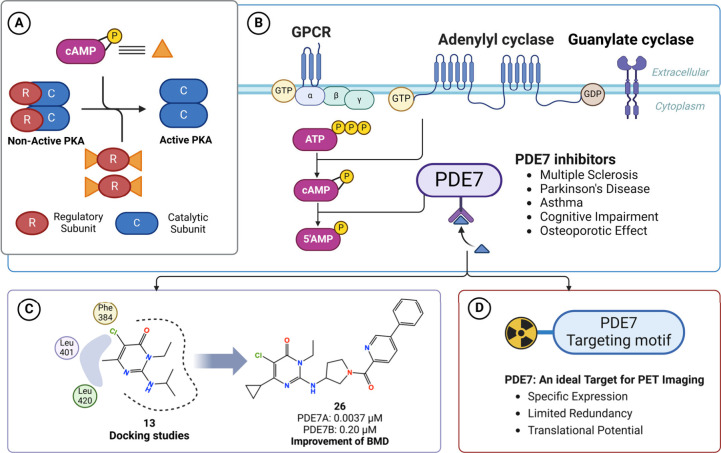 Figure 1
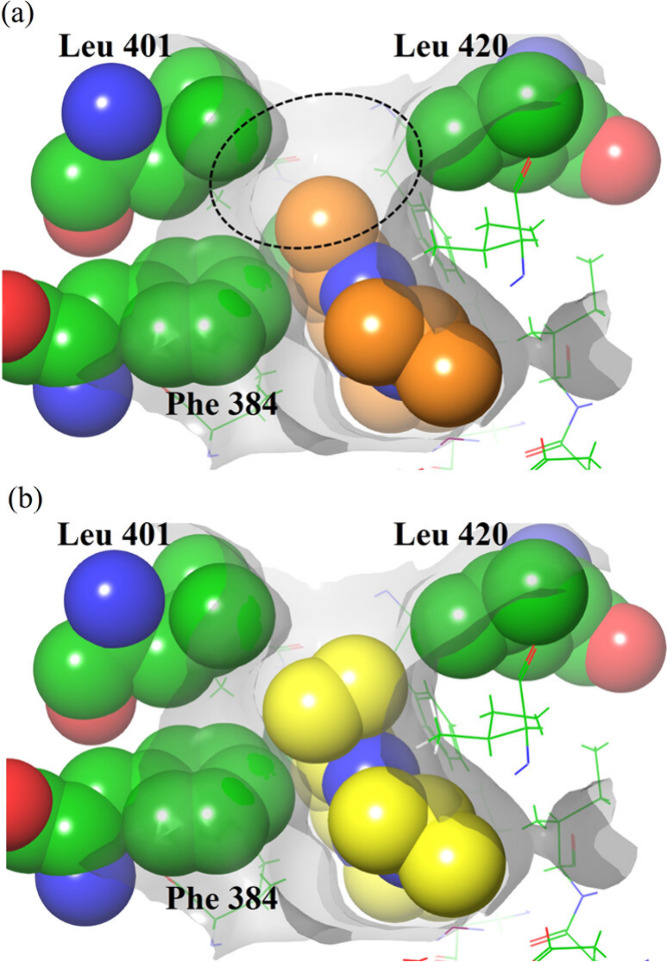 Figure 2
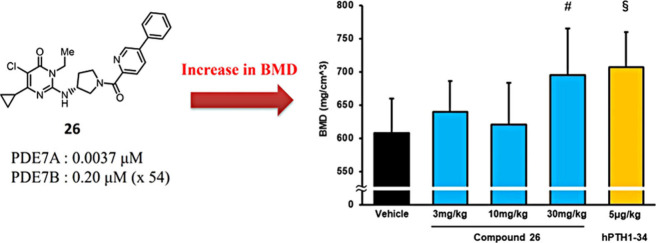 Figure 3
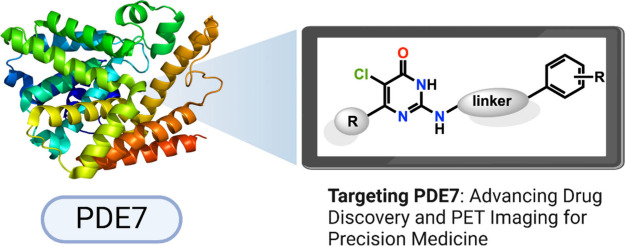 Figure 4
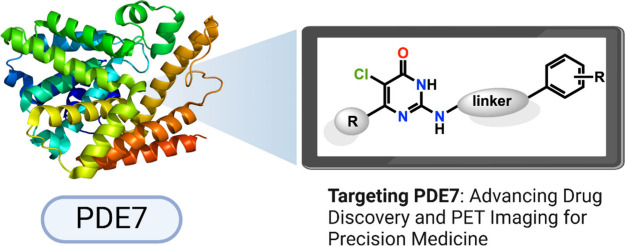 Figure 5
- —National Institutes of Health10.13039/100000002
- —National Institutes of Health10.13039/100000002
- —School of Medicine, Emory University10.13039/100007623
Peer Reviews
No public reviews on file for this paper yet. If you reviewed it on a platform where reviews are public (OpenReview, ICLR, NeurIPS, ICML), you can paste yours below so the community can read it here.
Videos
No videos yet. Explain this paper in a talk, walkthrough, or lecture? Add one.
Taxonomy
TopicsPhosphodiesterase function and regulation · Cholinesterase and Neurodegenerative Diseases · Renin-Angiotensin System Studies
Cyclic nucleotide signaling is a fundamental regulatory mechanism that governs various physiological processes by orchestrating cellular responses through complex molecular networks.? Among these, the cAMP-PKA (cyclic adenosine monophosphate–protein kinase A) pathway is a key regulatory node that modulates cellular responses to external stimuli. This pathway is initiated when G protein-coupled receptors (GPCRs) activate adenylyl cyclase, an enzyme that catalyzes the conversion of ATP into cAMP. The resulting increase in cAMP levels promotes the activation of PKA, which exists in an inactive state as a complex of regulatory and catalytic subunits. Binding cAMP to the regulatory subunits induces the release of the catalytic subunits, transitioning PKA into its active form, which phosphorylates downstream targets to regulate gene expression, metabolism, and immune responses (FigureA). ?,? To maintain cellular homeostasis, phosphodiesterases (PDEs) hydrolyze cAMP, effectively terminating PKA signaling.?
Among the 11 phosphodiesterase (PDE) families, PDE7 is a cAMP-specific enzyme that plays a pivotal role in immune regulation, neuroprotection, and inflammatory responses. By selectively degrading cAMP, PDE7 serves as a key modulator of the cAMP-PKA signaling pathway, counterbalancing adenylyl cyclase activity and preventing excessive downstream activation (FigureB). Dysregulation of PDE7 has been implicated in neurodegenerative diseases, autoimmune disorders, chronic inflammation, and metabolic dysfunctions, as elevated PDE7 activity reduces intracellular cAMP levels, impairing protective mechanisms that depend on sustained PKA activation. ?,? Consequently, PDE7 inhibitors have emerged as promising therapeutic agents for conditions such as multiple sclerosis, Alzheimer’s disease, Parkinson’s disease, asthma, cognitive impairment, and osteoporosis, aiming to restore cAMP homeostasis and regulate immune responses. PDE7 exists in two isoforms, PDE7A and PDE7B, with distinct expression patterns and functional roles. PDE7A is predominantly expressed in the lungs, hematopoietic cells, and placenta, suggesting a role in immune function and respiratory health. In contrast, PDE7B is widely distributed across various tissues, including the pancreas, brain, thyroid, and skeletal muscle, indicating broader physiological functions beyond immune regulation.? The differential expression of these isoforms underscores the tissue-specific regulation of cAMP signaling and highlights the potential for selective PDE7 inhibition as a targeted therapeutic strategy.
Over the past decades, significant progress in medicinal chemistry has led to the development of highly potent PDE4 inhibitors, such as Cilomilast and Roflumilast, which have undergone clinical trials for asthma and chronic obstructive pulmonary disease (COPD). However, despite their therapeutic potential, only a few PDE4 inhibitors have received market approval, largely due to their narrow therapeutic window and dose-limiting adverse effects such as emesis, which restrict their clinical utility.? As an alternative approach, targeting another cAMP-specific phosphodiesterase, PDE7, has gained attention, given its expression in immune and pro-inflammatory cells and its involvement in inflammatory and neurodegenerative diseases.
Recent advancements in PDE7 research indicate that PDE7A and PDE7B share highly similar catalytic domains and exhibit comparable high affinity for cAMP, making the development of selective PDE7 inhibitors an achievable goal. Structural and computational studies have provided valuable insights into PDE7 inhibition, guiding the rational design of highly selective and potent small-molecule inhibitors. ?,?
Given the structural similarities with cAMP and cGMP, nucleobase-mimicking scaffolds such as pyrimidinones and fused pyrimidinones have emerged as promising core structures for PDE inhibitors. Leveraging three-dimensional structural data of PDE7A and PDE7B, Kentaro et al. identified a novel PDE7A inhibitor with high selectivity over closely related isoforms (FigureC).? During the optimization process, compound 13 demonstrated the highest potent PDE7A inhibitory potency among a series of 10 analogs. Docking studies revealed that its methyl substituent in compound 13 did not fully occupy the binding pocket within the PDE7A active site (Figure). To enhance potency and selectivity, the introduction of a bulkier cyclopropyl group led to a 20-fold increase in PDE7A inhibitory potency while preserving its activity against PDE7B. Further modifications explored the distal group by incorporating a phenyl ring connected via a conformationally constrained linker, ultimately yielding the most potent and selective PDE7A inhibitor with an IC_50_ of 0.0037 μM and a 54-fold selectivity over PDE7B (IC_50_ = 0.20 μM).
Beyond its enzymatic potency, the optimized PDE7 inhibitor demonstrated significant biological effects, particularly in bone metabolism. Oral administration (30 mg/kg) significantly improved bone mineral density (BMD), achieving efficacy comparable to that of 5 μg/kg hPTH(1–34), a clinically relevant dose in humans (Figure). These findings highlight the therapeutic potential of PDE7 inhibitors in not only inflammatory and neurological disorders but also bone-related conditions.
Outlook
Selective PDE7 inhibitors have emerged as promising therapeutic agents due to their enhanced isoform specificity, optimized pharmacokinetic profiles, and improved therapeutic efficacy. Precise modulation of PDE7A and PDE7B strengthens their role in cAMP signaling regulation, offering promising applications in neurodegenerative, autoimmune, and inflammatory diseases, as well as reinforcing their role in precision medicine and targeted therapy development.
Positron emission tomography (PET) is a powerful molecular imaging technique that enables in vivo visualization and quantification of specific biological targets. ?,? Beyond their therapeutic potential, PDE7 inhibitors also show promise as PET imaging agents. ?,? Differential PDE7 expression in immune cells, the central nervous system, and inflammatory sites allows for noninvasive disease monitoring. Several radiolabeled PDE7 ligands, including [^11^C]MTP-38,? [^18^F]MICA-003,? [^11^C]P7-2104,? and [^18^F]P7-2302,? have been developed. Although these ligands exhibit limitations, such as insufficient specific bindings and/or poor brain permeability, they represent initial efforts to enable real-time imaging of PDE7 in the brain. The successful development of an optimized PDE7 PET ligand would provide valuable insights into disease progression, treatment response, and patient stratification in conditions such as Alzheimer’s disease, Parkinson’s disease, multiple sclerosis, and chronic inflammation.
Structural insights gained from PDE7 inhibitor optimization can further guide the design of PET tracers with high binding affinity, metabolic stability, and blood–brain barrier permeability. Radiolabeled PDE7 inhibitors could be particularly useful in neurodegenerative diseases, where visualizing PDE7 expression in affected brain regions may aid in early diagnosis and therapeutic monitoring.
In conclusion, the development of selective PDE7 inhibitors represents a promising therapeutic strategy for treating inflammatory, neurological, and metabolic disorders. Advances in structure-based drug design have led to the identification of potent and selective PDE7A inhibitors, with notable biological effects, including enhanced bone mineral density. Moving forward, radiolabeled PDE7 inhibitors hold significant potential as PET imaging agents, providing a powerful tool for disease monitoring, drug evaluation, and precision medicine. Further research into pharmacokinetics and biodistribution of PDE7-targeted PET tracers will be essential for translating these findings into clinical applications.
The reference list from the paper itself. Each links out to its DOI / PubMed record.
- 1Ednacot E. M. Q.Nabhani A.Dinh D. M.Morehouse B. R.Pharmacological Potential of Cyclic Nucleotide Signaling in Immunity Pharmacol. Ther.202425810865310.1016/j.pharmthera.2024.10865338679204 · doi ↗ · pubmed ↗
- 2Raker V. K.Becker C.Steinbrink K.The c AMP Pathway as a Therapeutic Target in Autoimmune and Inflammatory Diseases Front. Immunol.2016712310.3389/fimmu.2016.0012327065076 PMC 4814577 · doi ↗ · pubmed ↗
- 3Colombe A. S.Pidoux G.Cardiac c AMP-PKA Signaling Compartmentalization in Myocardial Infarction Cells 202110492210.3390/cells 1004092233923648 PMC 8073060 · doi ↗ · pubmed ↗
- 4Sadeghi M. A.Nassireslami E.Yousefi Zoshk M.Hosseini Y.Abbasian K.Chamanara M.Phosphodiesterase Inhibitors in Psychiatric Disorders Psychopharmacology (Berl.)202324061201121910.1007/s 00213-023-06361-337060470 · doi ↗ · pubmed ↗
- 5Chen Y.Wang H.Wang W. Z.Wang D.Skaggs K.Zhang H. T.Phosphodiesterase 7 (PDE 7): A Unique Drug Target for Central Nervous System Diseases Neuropharmacology 202119610869410.1016/j.neuropharm.2021.10869434245775 · doi ↗ · pubmed ↗
- 6Szczypka M.Role of Phosphodiesterase 7 (PDE 7) in T Cell Activity: Effects of Selective PDE 7 Inhibitors and Dual PDE 4/7 Inhibitors on T Cell Functions Int. J. Mol. Sci.20202117611810.3390/ijms 2117611832854348 PMC 7504236 · doi ↗ · pubmed ↗
- 7Sasaki T.Kotera J.Yuasa K.Omori K.Identification of Human PDE 7B, a c AMP-Specific Phosphodiesterase Biochem. Biophys. Res. Commun.2000271357558310.1006/bbrc.2000.266110814504 · doi ↗ · pubmed ↗
- 8Du B.Luo M.Ren C.Zhang J.PDE 4 Inhibitors for Disease Therapy: Advances and Future Perspective Future Med. Chem.202315131185120710.4155/fmc-2023-010137470147 · doi ↗ · pubmed ↗